
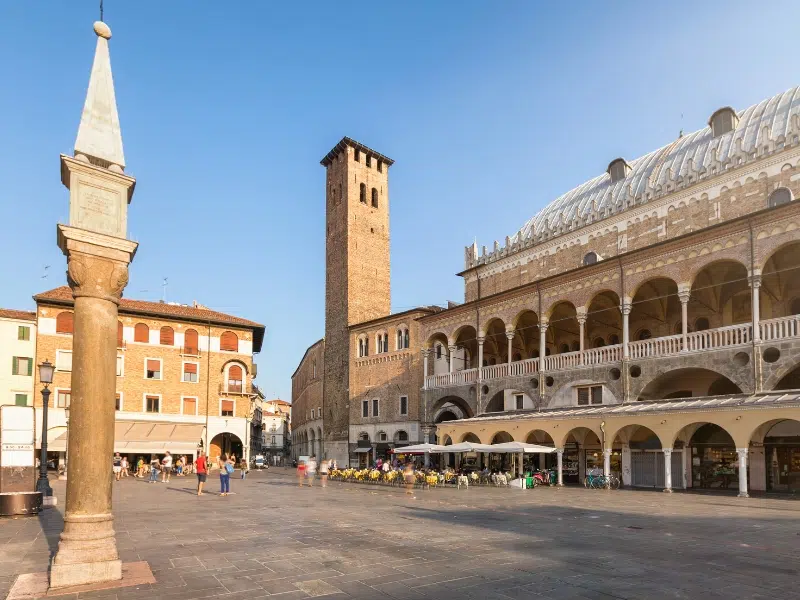
Piazza della Frutta is one of the two market squares that flank the Palazzo della Ragione in the centre of Padua: fruit on this, the north side, and vegetables in Piazza delle Erbe on the south. Above the stalls rises the Salone, the medieval town hall whose great upper hall, 81.5 metres long, is one of the largest medieval halls still standing, and whose ground floor has housed shops and market stalls for about 800 years.
Piazza della Frutta at a glance
- Where: along the north side of the Palazzo della Ragione, in the centre of Padua, with Piazza delle Erbe on the other side of the building and Piazza dei Signori a short walk west.
- Created: a market square since the Middle Ages, on one side of the Palazzo della Ragione, completed in 1219.
- What it is today: an open-air market in the mornings and a meeting place in the evening, when Padua's bars fill the square with people having a spritz.
- Time needed: 20 minutes for the square and the shops under the Salone, plus about an hour if you go up into the great hall.
Two squares and a great hall
Medieval Padua built its town hall, the Palazzo della Ragione (palace of law), between two market squares, and the names still tell you what was sold where. The building was completed in 1219: shops and stalls on the ground floor, courts and city offices upstairs. In 1306 an Augustinian friar, Fra Giovanni, covered the whole building with a single roof, the great curved roof that is still the first thing you notice from the square. Locals simply call the building il Salone, the great hall.
After a fire in 1420, architects working for Venice removed the internal partitions, creating one vast hall of 81.5 by 27 metres and 24 metres high. Its walls were covered with frescoes, first by Giotto and then, after the fire, by Nicolò Miretto and Stefano da Ferrara in 1425–1440: more than 2,000 square metres linking the months to the signs of the zodiac, trades and human characters. A tornado tore off the roof in 1756, and it was rebuilt. In 2021 the hall became part of the UNESCO World Heritage Site of Padua's fourteenth-century fresco cycles. Down below, the market has carried on through all of it.
What to look for
- The north side of the Salone above the square, with its long upper loggia and the huge curved roof.
- The fruit and vegetable stalls in the square in the morning, with produce from the Veneto that changes with the seasons.
- The shops under the Salone (Sotto il Salone), where butchers, cheesemongers, bakers and delicatessens have worked in the arcades of the ground floor since at least the late 16th century.
- The passages through the ground floor that link Piazza della Frutta with Piazza delle Erbe: walk through to see both markets.
- Upstairs in the Salone: the frescoes, the huge wooden horse of 1466 modelled on Donatello's Gattamelata statue, and the meridian line of 1761 on the floor, lit by a ray of sun at midday.
The stone of shame
In the north-east corner of the great hall stands a black stone stool, the pietra del vituperio. In the Middle Ages it was used to humiliate insolvent debtors in public. Tradition says that a debtor had to sit on it in his underwear in front of a crowd and declare that he gave up all his goods. Whatever the exact ritual, it was a fitting punishment in a building that sat on top of the city's markets.
Tips for your visit
- Come in the morning for the market, and come back around early evening, when the stalls are gone and the bars around the square fill up for the aperitivo.
- Buy something to eat from the stalls or the shops under the Salone and eat it standing in the square, as many locals do at lunchtime.
- Go up into the Salone if you can; the hall sometimes hosts exhibitions, so check what is on before you go.
Nearby
- Piazza delle Erbe: the twin market square on the south side of the Salone, with its own stalls and the best full view of the building.
- Piazza dei Signori: the elegant square a short walk west, overlooked by the clock tower with its large astronomical clock face.
- Palazzo del Bo: the historic seat of the University of Padua, where Galileo taught from 1592 to 1610 and where the anatomical theatre of 1595 still survives.
- Caffè Pedrocchi: the neoclassical café opened in 1831, once known as the café without doors because it stayed open day and night.
See Padua with World City Trail
Our Padua scavenger hunt turns the old town into a game you play on your phone. The route links 10 stops and takes around 2 hours, with about 42 minutes of walking. It includes the Scrovegni Chapel and Piazza Garibaldi.
If you prefer a different format, there is also a self-guided walking tour and an outdoor escape game in Padua.
Play the Padua scavenger hunt →
Take the self-guided walking tour of Padua →
Play the outdoor escape game in Padua →
Facts checked in October 2026.