
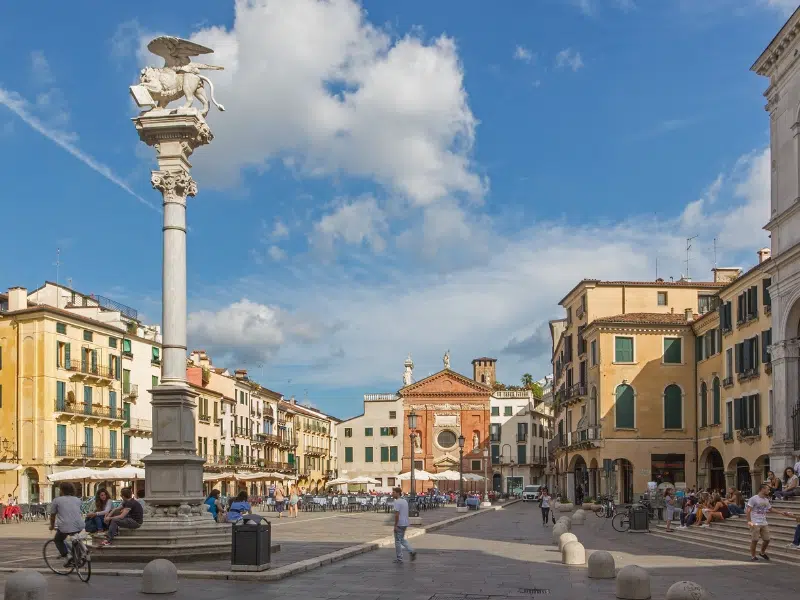
Piazza dei Signori is the elegant square in the centre of Padua where the city once held its tournaments, processions and official celebrations. It is closed at its west end by the Clock Tower, whose astronomical clock goes back to a 1344 design by Jacopo Dondi and famously shows only eleven signs of the zodiac.
Piazza dei Signori at a glance
- Where: in the historic centre, just north of Piazza delle Erbe and Piazza della Frutta, between the Clock Tower and the church of San Clemente.
- Created: opened up in the 14th century under the Carrara lords, who cleared an old district in front of San Clemente.
- What it is today: a rectangular square with porticoed houses, a morning market and, in the evening, one of the city's favourite places for an aperitivo.
- Time needed: 20 to 30 minutes, longer if you stop at a café under the arcades.
From the Carrara court to Venetian ceremonies
In the 14th century the Carrara family ruled Padua, and Ubertino da Carrara had a crowded district demolished to open a square in front of the gate tower of the palace he was building. According to tradition the square took its name from these signori. Its long, regular shape made it a natural stage for tournaments and courtly games. The war between the Carrara and the Visconti of Milan at the end of the century left it so damaged that people called it the square of Desolation.
After Venice took Padua in 1405, the Venetians restored the square in the 1420s and turned it into the setting for civic ritual: jousts, parades, concerts, a bull hunt at carnival, and on 17 July the celebrations for Venice's recapture of the city in 1509. In 1848, at the height of anti-Austrian feeling, the square was renamed Piazza Pio IX, and after Italian unification Piazza Unità d'Italia, before getting its old name back in the 20th century. Its herringbone brick paving was replaced from the 18th century with slabs of Euganean trachyte.
What to look for
- The astronomical clock: hours in Roman numerals, a band of stars, the zodiac and the Earth at the centre, following the old geocentric view of the universe.
- The missing Libra: Dondi followed Roman sources in which Scorpio occupied two months, so there is no separate Libra sign on the dial.
- The archway below the clock, redesigned in the 16th century by Giovanni Maria Falconetto as a triumphal arch with the Lion of St Mark.
- The Marciana column on the left side of the square: a Roman column found in 1764, topped by a lion of 1870 that replaced one destroyed by French troops in 1797.
- The flagpole base, carved in the 16th century with reliefs of the cardinal virtues.
- A marble plaque recording a crime committed against university students on 15 February 1722, and the punishments handed out to the culprits.
A clock older than its tower
Jacopo Dondi, an engineer and astronomer from Chioggia, designed Padua's first astronomical clock in 1344; his family was later known as Dondi dall'Orologio, of the clock. The original was destroyed in the wars at the end of the 14th century, and the clock you see today was rebuilt by the Venetians in the 15th century. It is often described as one of the oldest working astronomical clocks in Europe still in its original tower, which is about 30 metres high and reopened after a long restoration in 2010.
Tips for your visit
- Come in the morning to see the market stalls, or around 6 pm when the cafés fill up for the spritz hour.
- Stand at the east end near San Clemente for the best view of the tower and the whole length of the square.
- Walk through the arch under the clock into Piazza del Capitaniato, the quieter square behind, which leads on towards the cathedral.
Nearby
- Piazza delle Erbe and Palazzo della Ragione: the market squares and the huge medieval hall of justice, a couple of minutes' walk south.
- Padua Cathedral and Baptistery: the baptistery is covered in 14th-century frescoes by Giusto de' Menabuoi, a short walk away.
- Palazzo Bo: the historic seat of the University of Padua, with its 16th-century anatomical theatre, a few minutes' walk south-east.
- Caffè Pedrocchi: the 19th-century café opposite the university, once a meeting place for students and patriots.
See Padua with World City Trail
Our Padua scavenger hunt turns the old town into a game you play on your phone. The route links 10 stops and takes around 2 hours, with about 42 minutes of walking. It includes the Scrovegni Chapel and Piazza Garibaldi.
If you prefer a different format, there is also a self-guided walking tour and an outdoor escape game in Padua.
Play the Padua scavenger hunt →
Take the self-guided walking tour of Padua →
Play the outdoor escape game in Padua →
Facts checked in October 2026.