
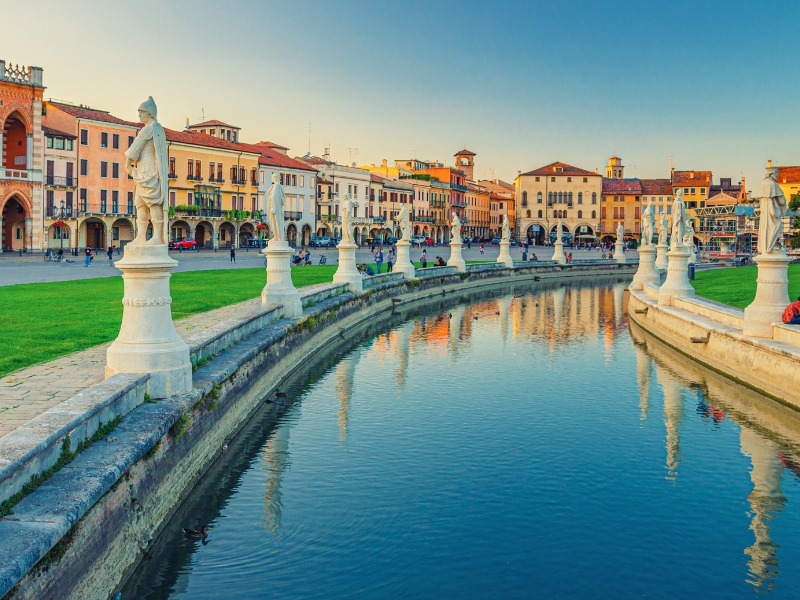
Prato della Valle is Padua's huge elliptical square, about 88,600 square metres, which makes it one of the largest squares in Europe. At its centre a green island is ringed by a canal, and along the canal's banks stand 78 statues of people connected with the city, from the mythical founder Antenor to the sculptor Antonio Canova. Two pedestals are still empty.
Prato della Valle at a glance
- Where: on the southern edge of Padua's historic centre, next to the Basilica of Santa Giustina and a short walk from the Basilica of Saint Anthony.
- Created: from 1775, when the marshy meadow was drained and redesigned; the statues went up between 1785 and 1838.
- By: the Venetian patrician Andrea Memmo, who launched and paid for much of the project, with a plan by the architect Domenico Cerato.
- What it is today: a public square and park where Paduans walk, jog, sit on the grass and meet friends, with a big outdoor market on Saturdays.
- Time needed: 30–45 minutes for a walk round the island and a look at the statues.
From a swampy meadow to Memmo's island
The name comes from the Latin 'pratum vallis', the meadow of the valley: a low, flood-prone area outside the medieval walls. In Roman times a theatre stood here, the Teatro Zairo, built in the 1st century AD; its foundations reappeared when the canal was dug in 1775, and University of Padua excavations in 2017 found more of it. Through the Middle Ages the meadow was used for fairs, markets and public gatherings, but it was often waterlogged.
The city took over the area in 1767, and in 1775 Andrea Memmo, the Venetian Republic's governor of Padua, set out to drain it and turn it into a grand public space. The central island, called Isola Memmia after him, was raised with around 10,000 cartloads of soil. To pay for the statues, Memmo invited families, institutions and admirers to sponsor a figure, under rules set in 1776: no saints, and no living people. The first statue, of Antenor, was put up in 1785 and the last, of the engineer Francesco Luigi Fanzago, in 1838. Memmo's own statue was added in 1794, a year after his death.
What to look for
- The double ring of statues: 78 today, out of an original 88, standing on the outer and inner banks of the canal. Each pedestal carries a number and an inscription.
- Famous names: look for Petrarch, Galileo, the Roman historian Livy, the painter Andrea Mantegna and Antonio Canova among the scholars, artists and soldiers.
- Andrea Memmo himself, on the outer ring, the man who created the square.
- Gaspara Stampa: the only woman on the square, a small bust of the 16th-century poet at the base of the statue of the sculptor Andrea Briosco.
- The four stone bridges that cross the canal to the island, and the fountain at the centre where their paths meet.
The two empty pedestals
The empty plinths near the island's northern bridge are not unfinished work. They held statues of Venetian doges, which were taken down in 1797, after Napoleon's troops ended the Republic of Venice. In 2021 and 2022 a proposal to fill them with statues of women, such as Elena Lucrezia Cornaro Piscopia, who in 1678 became the first woman in the world to earn a university degree, here in Padua, set off a lively debate. For now the pedestals remain empty, and some argue they should stay that way as a record of the end of Venetian rule.
Tips for your visit
- Walk the full loop on the outer ring first, then cross a bridge and do the inner ring: you see the statues from both sides of the canal.
- Come early on a Saturday morning if you like markets, or on a sunny late afternoon, when students and families sit on the grass of the island.
- Do as the locals do and bring a snack to eat on the lawn, but don't climb on the statues or their pedestals.
Nearby
- Basilica of Santa Giustina: the huge Benedictine church on the square's south-east side, which holds relics venerated as those of St Luke the Evangelist.
- Basilica of Saint Anthony: Padua's great pilgrimage church, with domes and minaret-like towers, a few minutes' walk north.
- Orto Botanico: the University of Padua's botanical garden, founded in 1545 and a UNESCO World Heritage Site, between the square and the basilica.
See Padua with World City Trail
Our Padua scavenger hunt turns the old town into a game you play on your phone. The route links 10 stops and takes around 2 hours, with about 42 minutes of walking. It includes the Scrovegni Chapel, with Giotto's frescoes, and Piazza Garibaldi.
If you prefer a different format, there is also a self-guided walking tour and an outdoor escape game in Padua.
Play the Padua scavenger hunt →
Take the self-guided walking tour of Padua →
Play the outdoor escape game in Padua →
Facts checked in October 2026.