
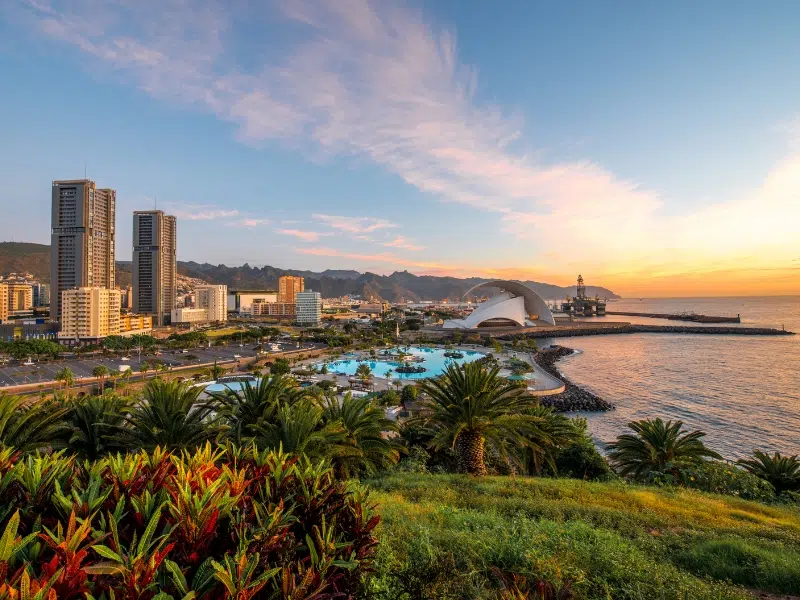
Santa Cruz de Tenerife is the island's capital and busiest port, a city of plazas, parks and seafront between the Atlantic and the Anaga mountains. It shares the role of capital of the Canary Islands with Las Palmas de Gran Canaria, and all of Spain knows it for its carnival. Here are the facts and stories that make it special.
10 fun facts about Santa Cruz de Tenerife
- Named after a cross: the conqueror Alonso Fernández de Lugo landed here on 3 May 1494 and planted a wooden cross, which gave the city its name, Holy Cross. The cross is kept in the Church of La Concepción.
- A capital shared with a rival: since 1927 the Canary Islands have been split into two provinces, and Santa Cruz shares the title of regional capital with Las Palmas de Gran Canaria.
- A castle under the square: the Castillo de San Cristóbal was demolished in 1928 to make way for Plaza de España. Its remains were found again in 2006, when Herzog & de Meuron redesigned the square, and a corner can be visited in an underground gallery.
- A concert for the record books: in 1987 the Cuban singer Celia Cruz performed at the carnival in Plaza de España, and Guinness World Records listed it as the largest gathering in an outdoor plaza for a concert.
- A beach made of Sahara sand: Playa de Las Teresitas, a short drive north of the centre, was created in 1973 with about 270,000 tonnes of sand shipped from the Western Sahara.
- A concert hall like a wave: the Auditorio de Tenerife by Santiago Calatrava opened in 2003. Its white roof curls over it like a breaking wave.
- The largest park in the Canaries: Parque García Sanabria opened in 1926 and is the biggest urban park in the islands. Its floral clock, made in Switzerland, was a gift in 1958.
- Spain's highest peak on the horizon: Mount Teide, at 3,715 metres, is the highest mountain in Spain, and its national park has been a UNESCO World Heritage Site since 2007.
- Ancient forest behind the city: the Anaga mountains, which rise straight behind Santa Cruz, have been a UNESCO biosphere reserve since 2015, protecting rare laurel forest.
- A tram to the old capital: since 2007 a tram has linked Santa Cruz with San Cristóbal de La Laguna, the island's former capital, whose old town has been a World Heritage Site since 1999.
The night Nelson lost his arm
In July 1797, Rear-Admiral Horatio Nelson arrived off Santa Cruz, hoping to seize the port and a valuable cargo. In the early hours of 25 July his men attacked in small boats. The defenders, led by General Antonio Gutiérrez, were ready: many boats were sunk, and as Nelson stepped ashore he was hit in the right arm, which had to be amputated. Local tradition credits the shot to a cannon nicknamed El Tigre, still preserved in the city. The British who reached the town were surrounded and allowed to leave under a truce, and the two commanders exchanged gifts: English beer and cheese for Canarian wine. Santa Cruz still remembers the victory every 25 July.
The carnival, explained
The Carnival of Santa Cruz is one of the biggest in the world. When it was banned under Franco, the city kept it alive under a new name, the Winter Festival. Highlights include the election of the Carnival Queen, whose costumes are so large they are wheeled onto the stage, the satirical choirs called murgas, and the Burial of the Sardine, a mock funeral that marks the end of the party.
What to eat in Santa Cruz de Tenerife
- Papas arrugadas con mojo: small potatoes boiled in very salty water until their skins wrinkle, served with spicy red mojo or green coriander mojo.
- Gofio: flour made from toasted grain, a Canarian staple since before the Spanish conquest, stirred into soups, desserts or milk.
- Barraquito: a layered coffee with condensed milk, milk foam, a dash of Licor 43, lemon peel and cinnamon, served in a glass.
- Queso asado: grilled local goat's cheese, served with palm honey or mojo.
- Canary wine: Malvasía wine from the islands was so popular in England that Shakespeare's characters drink 'canary'.
Good to know before you go
- Carnival dates follow Easter, so they change every year. Book accommodation early if you want to be there.
- To walk the final path to the summit of Teide you need a free permit from the national park, which can be booked up weeks ahead.
- Roads into the Anaga mountains are narrow and winding. The north side of the island is often cloudier and cooler than the south.
- Las Teresitas is easy to reach by bus from the centre.
Explore Santa Cruz de Tenerife with World City Trail
Our Santa Cruz de Tenerife scavenger hunt turns these sights into a game you play on your phone. The route takes around three hours, with about 48 minutes of walking, and leads you through the main sights of the city centre.
At each stop you solve a puzzle and hear a short story, at your own pace. You can start whenever you like and play in English, German, French, Italian, Spanish or Dutch.
Play the Santa Cruz de Tenerife scavenger hunt →
Facts checked in October 2026.