

Table of Contents
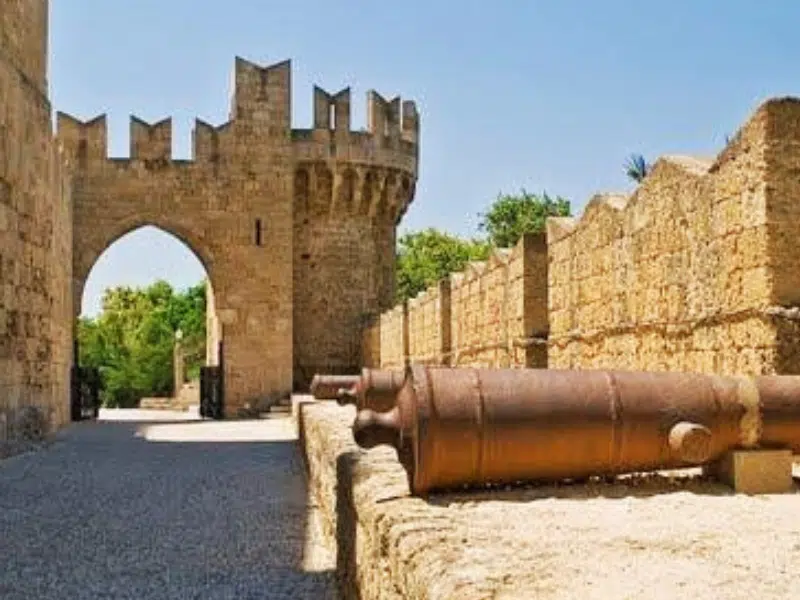
Saint Anthony’s Gate, known locally as “Pili Agiou Antoniou,” is a significant historical landmark in the medieval city of Rhodes, Greece. Originally serving as the western entrance to the city, this gate has witnessed centuries of history and stands as a testament to the island’s rich cultural heritage.
A Glimpse of History
The construction of Saint Anthony’s Gate dates back to the era of the Knights of the Order of Saint John, who ruled Rhodes from 1309 to 1522. The gate played a crucial role in the city’s defense system, serving as an entry point for soldiers, merchants, and citizens alike.
During the period of the Knights Hospitaller, Rhodes was heavily fortified to withstand sieges from enemy forces, particularly the Ottoman Empire. The strategic placement of Saint Anthony’s Gate on the western side of the city made it an essential part of the island’s defenses. It was built as a secondary entrance, mainly used for specific military operations and limited civilian access.
As military tactics and weapons evolved, new fortifications were constructed around the city. The impressive d’Amboise Gate, which was later added to the city’s fortification system, took over much of the primary traffic. However, Saint Anthony’s Gate remained in use and continued to serve as an important part of Rhodes’ defensive architecture.
Architectural Features
One of the most distinctive features of the gate is the presence of two turrets, which added to its defensive capabilities. These turrets allowed guards to oversee the western approach to the city and provide an additional layer of protection against potential invaders. The thick walls and narrow passageways were designed to slow down enemy troops, making it easier for defenders to repel an attack.
Above the entrance, remnants of medieval insignias and symbols of the Knights Hospitaller can still be seen, showcasing the legacy of the Order of Saint John. The surrounding fortifications were further strengthened by moats, bastions, and additional defensive structures, ensuring that the medieval city remained one of the most fortified settlements in the Mediterranean.
Role During the Ottoman Period
In 1522, the Ottoman Empire, led by Sultan Suleiman the Magnificent, laid siege to Rhodes. After a long and grueling battle, the Knights of Saint John surrendered, and the Ottomans took control of the island.
Under Ottoman rule, many of the city’s gates, including Saint Anthony’s Gate, remained in use, but their roles changed. The Ottomans made modifications to the fortifications, adapting them to their own military strategies. Saint Anthony’s Gate continued to function as an access point to the city, but it saw less military use as peace prevailed under Ottoman administration.
The Gate in the Modern Era
Today, Saint Anthony’s Gate stands as an enduring testament to Rhodes’ medieval history. It is part of the UNESCO-listed Old Town of Rhodes, which is one of the best-preserved medieval towns in Europe. Tourists walking through the gate can still feel the weight of history as they pass beneath its arches and explore the surrounding fortifications.
Many visitors use Saint Anthony’s Gate as an entryway into the Old Town, where they can admire the stunning medieval architecture, visit historical landmarks such as the Palace of the Grand Master, and wander through the narrow streets filled with shops, cafes, and museums.

Saint Anthony’s Gate is part of Rhodes scavenger hunt and walking tour!
Embark on an unforgettable journey through the enchanting city of Rhodes with World City Trail. Our interactive walking tour combines the thrill of exploration with the rich history and culture of this beautiful city.
Key Features:
Interactive gameplay: Solve engaging puzzles and challenges as you explore the city.
Hidden gems: Uncover lesser-known spots.
Cultural insights: Learn about the city’s fascinating history.
Flexibility: Explore at your own pace and create your own itinerary.
Family friendly activity and a great way to explore the city!
Further reading on Wikipedia: Rhodes