
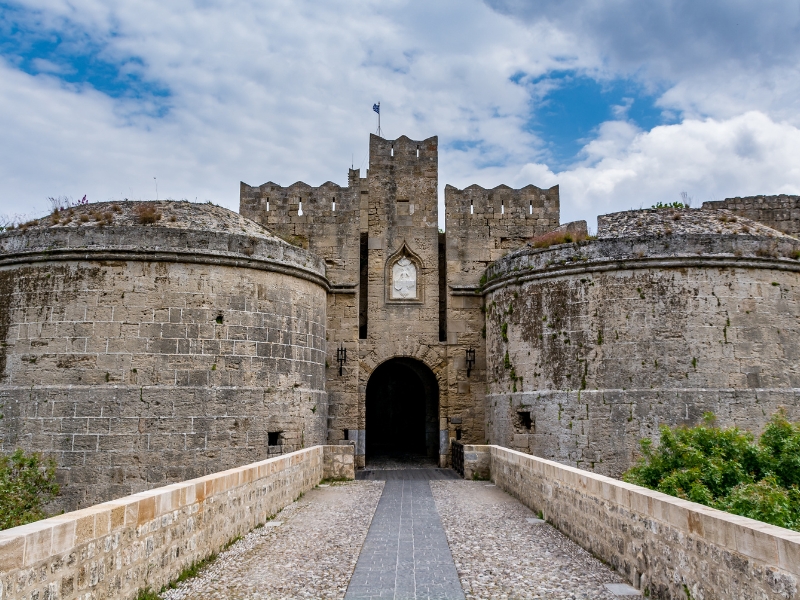
The Gate of Amboise (Pyli Amvouaz) is the fortified gate in the north-western walls of Rhodes Old Town, just below the Palace of the Grand Master. The Knights of St John built it in 1512 under Grand Master Emery d'Amboise, who died that same year, and an angel carved above the entrance still holds up his coat of arms. Crossing its bridge and winding passage is the most dramatic way to walk into the medieval town.
The Gate of Amboise at a glance
- Where: on the north-western side of the Old Town walls, between the New Town and the Palace of the Grand Master, reached by a bridge across the moat.
- Built: 1512, the date carved on the gate with the name 'DAMBOYSE'.
- By: the Knights of St John (Knights Hospitaller), under Grand Master Emery d'Amboise.
- What it is today: one of the main pedestrian entrances to the Old Town, part of the Medieval City of Rhodes, a UNESCO World Heritage Site since 1988.
- Time needed: 10–15 minutes to cross the bridge, look at the carvings and walk through the passage.
A gate for the age of cannon
The Knights of St John ruled Rhodes from 1309. In 1480 they held out against a three-month Ottoman siege, but the cannon fire had shown that medieval walls were no longer enough. The Grand Masters Pierre d'Aubusson and, after him, Emery d'Amboise rebuilt the defences for the age of gunpowder: thicker walls, low bastions and earth platforms in the middle of the moat. The Gate of Amboise belongs to this work. Instead of a single opening, it leads through several layers of walls, with a covered entrance and walkways for defenders on more than one level, while the pentagonal bastion of St George nearby could cover the approach with its guns.
Ten years after the gate was finished, the defences faced their greatest test. In 1522 Sultan Suleiman the Magnificent besieged Rhodes for six months, and the Knights finally surrendered and left the island at the start of 1523. Rhodes stayed Ottoman until the Italians took it in 1912, and joined Greece after the Second World War. The gate has survived largely as the Knights left it, and today it is a popular way into the Old Town for visitors coming from the New Town.
What to look for
- The two round towers on either side of the entrance, built to cover the gate with fire from both sides.
- The relief above the gateway: an angel holding the coat of arms of Emery d'Amboise, beside the arms of the Order, with the inscription 'DAMBOYSE MDXII'.
- The bridge across the dry moat: stop in the middle to look down into the moat and along the massive walls.
- The passage beyond the gate, which turns and runs through more than one line of walls before it reaches the town, a design meant to slow down attackers.
- The remains of the old studded wooden doors, still visible in the gateway.
Who was Emery d'Amboise?
Emery d'Amboise was a French nobleman, born in 1434 at Chaumont-sur-Loire. He was elected Grand Master of the Order of St John on 10 July 1503, succeeding Pierre d'Aubusson, and he died on Rhodes on 13 November 1512, aged about 78, so the gate that bears his name was one of the last works of his rule. His coat of arms appears in other places too: on the Kastellania in Hippocrates Square, dated 1507, and on cannons cast for the Order, one of which was later given by the Ottoman sultan Abdülaziz to the French emperor Napoleon III in 1862.
Tips for your visit
- Walk in from outside: start on the New Town side, cross the bridge and follow the passage into the Old Town, the way the gate was meant to be seen.
- Come in the morning or late afternoon; in summer the stone walls and the moat hold the heat in the middle of the day.
- Wear shoes with some grip: the paving in the passage and in the Old Town is uneven and worn smooth.
- Continue straight on to the Palace of the Grand Master and then down the Street of the Knights for a classic first walk through the Old Town.
Nearby
- Palace of the Grand Master: the Knights' fortress-palace just inside the gate, largely rebuilt by the Italians in the 1930s.
- Street of the Knights: the cobbled medieval street lined with the inns of the Order's national groups, running down from the palace.
- Mosque of Suleiman: the pink-plastered mosque at the top of Sokratous Street, founded just after the Ottoman conquest; you can see its outside from the street.
- Mandraki Harbour: the old harbour outside the walls, with its windmills and the bronze deer on columns at its entrance.
See Rhodes with World City Trail
Our Rhodes scavenger hunt turns the old town into a game you play on your phone. The route links 10 stops and takes around 2 hours, with about 30 minutes of walking. Among the places it includes are the Palace of the Grand Master and the Street of the Knights in the medieval Old Town. You can play in English, German, French, Italian, Dutch, Polish and Greek.
If you prefer a different format, there is also a self-guided walking tour and an outdoor escape game in Rhodes.
Play the Rhodes scavenger hunt →
Take the self-guided walking tour of Rhodes →
Play the outdoor escape game in Rhodes →
Facts checked in October 2026.