
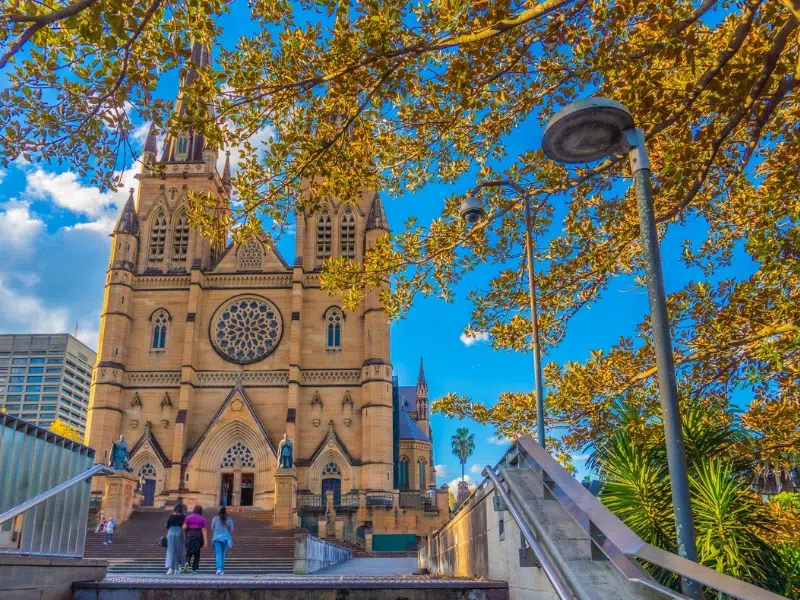
St Mary's Cathedral is Sydney's Catholic cathedral, a Gothic Revival church of golden sandstone on the eastern edge of the city centre, facing Hyde Park. It took more than 60 years to build, from 1868 to 1928, and the two spires on its front, part of the architect's original design, were only added in 2000.
St Mary's Cathedral at a glance
- Where: College Street, on the east side of Hyde Park, at the edge of the Sydney CBD.
- Built: 1868–1928 to the design of William Wardell; the façade spires were completed in 2000.
- By: William Wardell, a Gothic Revival architect who also designed St Patrick's Cathedral in Melbourne.
- What it is today: the seat of the Catholic Archbishop of Sydney and a minor basilica, open to visitors outside services; listed on the New South Wales State Heritage Register.
- Time needed: 30–45 minutes for the church, longer if the crypt is open.
Three churches before the cathedral
Catholic priests were only officially allowed into the colony in 1820. One of them, Father John Therry, asked for land to build a church, and the government granted a site on the edge of what is now Hyde Park. Governor Macquarie laid the foundation stone of the first St Mary's in 1821. That church burned down in 1865, and a temporary wooden church that replaced it also burned in 1869.
Archbishop John Bede Polding then asked William Wardell to design a new cathedral, giving him a free hand: in his words, any plan, any style, anything beautiful and grand. The foundation stone was laid in 1868, the first part was dedicated in 1882, and the nave was finished in 1928, in time for an International Eucharistic Congress. Wardell's spires on the two front towers were never built at the time, and for decades the façade looked unfinished. With help from a government grant to mark the new millennium, they were finally added in 2000.
What to look for
- The two spires on the south front, completed in 2000, and the central tower over the crossing; with the spires the cathedral reaches about 75 metres.
- The building's orientation: unusually, it runs north to south rather than east to west, because of the size of the site and the slope of the land.
- The stained glass, made by Hardman's studio in Birmingham, England, including the Great North Window showing the Coronation of the Virgin.
- Inside, a slight change in the colour and texture of the sandstone on the walls, marking the join between the first and second building phases.
- The crypt floor, when it is open: a terrazzo mosaic by the Melocco Brothers in the shape of a Celtic cross, with medallions of the days of Creation.
The bells of the central tower
The central tower holds a ring of 14 bells cast by the Whitechapel Bell Foundry in London, the heaviest ring of 14 bells hung for change ringing in Australia. The cathedral's first bells arrived in 1843 and were the first in Australia hung for change ringing; the present ring was first rung in 1986. If you are nearby on a Sunday or a feast day, listen out for them across Hyde Park.
Tips for your visit
- Go on a weekday morning, when the church is quieter and you can look at the windows in peace.
- For the full view of the façade and spires, walk a little way into Hyde Park and look back across College Street.
- It is a working cathedral: dress respectfully, keep your voice down and avoid walking around during Mass.
- Combine it with a walk through Hyde Park to the Archibald Fountain and on to the Hyde Park Barracks.
Nearby
- Hyde Park: the historic park in front of the cathedral, with the Archibald Fountain and avenues of fig trees.
- Hyde Park Barracks: a former convict barracks from the time of Governor Macquarie, part of the UNESCO-listed Australian Convict Sites.
- Australian Museum: the country's oldest museum, across College Street, a few minutes' walk away.
- Art Gallery of New South Wales: a walk through The Domain, with Australian, European and Asian art.
See Sydney with World City Trail
Our Sydney scavenger hunt turns the city centre into a game you play on your phone. The route links 10 stops and takes around 3 hours, with about 68 minutes of walking, and includes places such as Darling Harbour and St Andrew's Cathedral.
If you prefer a different format, there is also a self-guided walking tour and an outdoor escape game in Sydney.
Play the Sydney scavenger hunt →
Take the self-guided walking tour of Sydney →
Play the outdoor escape game in Sydney →
Facts checked in October 2026.