
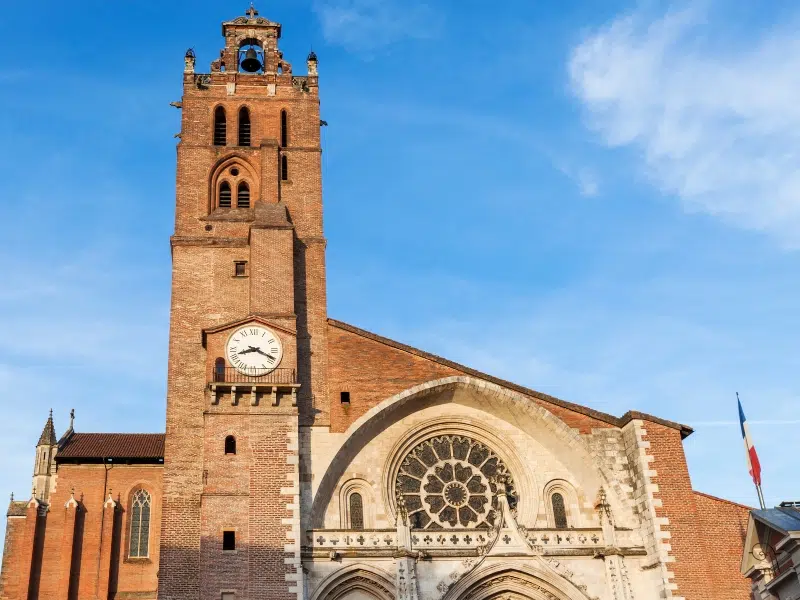
Saint-Étienne Cathedral (Cathédrale Saint-Étienne) stands on Place Saint-Étienne on the eastern side of Toulouse's old centre. It looks lopsided because it is: a wide early 13th-century nave in the southern Gothic style and a much larger northern Gothic choir were joined on two different axes, after the plan to rebuild the whole church ran out of money. Pierre-Paul Riquet, the engineer of the Canal du Midi, is buried inside.
Saint-Étienne Cathedral at a glance
- Where: Place Saint-Étienne, at the eastern edge of the old centre, a short walk from the Grand Rond garden.
- Built: mainly in the 13th century on the site of older churches. The nave dates from the early 1200s, the choir was begun in 1272, and work carried on into the 20th century.
- What it is today: the cathedral of the Catholic Archdiocese of Toulouse, owned by the French state and listed as a historic monument since 1862.
- Time needed: 30–45 minutes inside, plus a few minutes on the square to take in the façade.
Two Gothic cathedrals that never became one
A church on this site is first mentioned in 844, and under Bishop Isarn (1071–1105) a Romanesque cathedral was built here. In the early 13th century it gave way to the present nave, built in the southern Gothic style: one broad space without aisles, enclosed by massive walls, known as the nef raymondine. Its west rose window is said to be modelled directly on the one at Notre-Dame de Paris.
In 1272 Bishop Bertrand de l'Isle-Jourdain began a far more ambitious choir in the northern Gothic style, with an ambulatory ringed by chapels, meant to be followed by a matching new nave. The money ran out, so the old nave stayed and the new choir, about twice as wide, was attached to it off-centre. In the 16th century Archbishop Jean d'Orléans built the link between the two. In 1609 a fire destroyed the choir's wooden roof, and the architect Pierre Levesville gave it a stone vault at about 28 metres instead of the planned 40. Viollet-le-Duc and other architects drew up plans to finish the building in the 19th century; none were carried out, and the north transept was only completed in the 20th century.
What to look for
- The west front: the rose window, the 15th-century portal and the bell tower do not line up, the first sign that this is several buildings rather than one.
- The broken axis: stand just inside the main door and look towards the altar. The choir does not open straight ahead but to one side of the nave.
- The organ, hung high on the wall like a swallow's nest. Its case dates from the early 17th century and is the oldest organ case in Toulouse; the instrument is listed as a historic monument.
- The tomb of Pierre-Paul Riquet (1609–1680), who designed the Canal du Midi, the canal linking Toulouse and the Garonne with the Mediterranean.
- The stained glass of the choir, the oldest of it from the 14th century.
- Around the high altar: marble columns from Caunes-Minervois that copy those of the Hall of Mirrors at Versailles, and wrought-iron grilles from the 18th and 19th centuries enclosing the sanctuary.
The bell that broke
In 1794, during the Revolution, the cathedral's great bell, the Cardailhac, came down from the bell tower. It weighed 12 to 13 tonnes. Straw had been spread on the square to soften the impact, but the bell sank into the ground and cracked. When you stand on the square, look up at the tower and picture the drop.
Tips for your visit
- Look at the west front from the far side of Place Saint-Étienne first: only from a distance do you see how the rose window, portal and tower fail to match.
- Walk the full length inside, from the nave to the choir, to feel the change from the wide, dim southern Gothic hall to the tall, brighter northern Gothic choir.
- It is a working cathedral: keep your voice down, don't walk around during Mass, and expect parts to be closed during services.
Nearby
- Griffoul fountain: the fountain in the middle of Place Saint-Étienne, said to be the oldest in Toulouse.
- Grand Rond: the round public garden at the end of the tree-lined allées, with a bandstand and old trees, a short walk south-east.
- Jardin des Plantes: a large park with ponds just beyond the Grand Rond, home to Toulouse's natural history museum.
- Place du Capitole: Toulouse's main square, with the long 18th-century façade of the city hall, about 15 minutes' walk west.
See Toulouse with World City Trail
Our Toulouse scavenger hunt turns the old town into a game you play on your phone. The route links 10 stops and takes around 3 hours, with about 45 minutes of walking. Among the places it includes are the Basilica of Saint-Sernin and the Musée Saint-Raymond, the city's archaeology museum.
If you prefer a different format, there is also a self-guided walking tour and an outdoor escape game in Toulouse.
Play the Toulouse scavenger hunt →
Take the self-guided walking tour of Toulouse →
Play the outdoor escape game in Toulouse →
Facts checked in October 2026.