
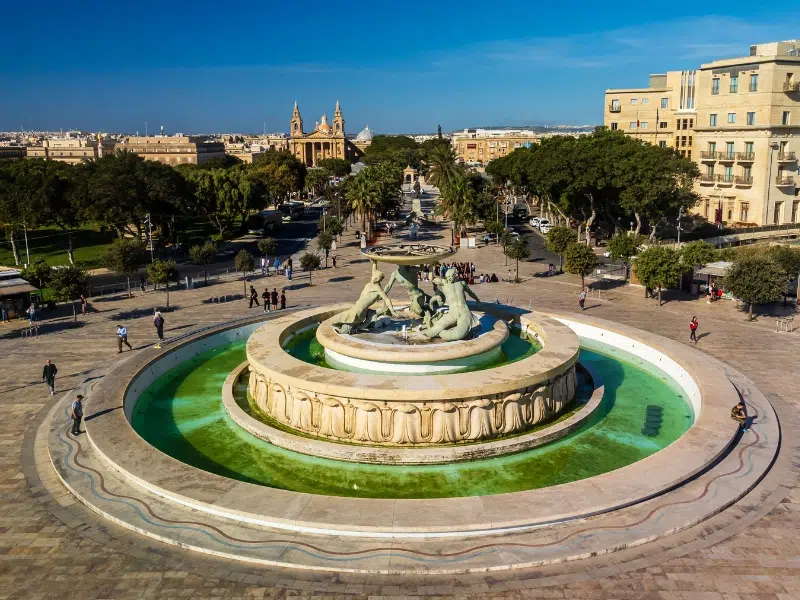
The Triton Fountain (Il-Funtana tat-Tritoni) is the big bronze fountain in the square just outside City Gate, where almost every visitor arriving by bus first sets foot in Valletta. Three Tritons, half men and half fish, hold up a wide basin together. It first ran in 1959, collapsed in 1978, and was only officially inaugurated in 2018, after a full restoration.
The Triton Fountain at a glance
- Where: Triton Square, just outside City Gate at the entrance to Valletta, beside the main bus terminus. Strictly speaking it stands in Floriana, on the site of a former outwork of the fortifications.
- Built: 1955–1959; first switched on on 16 May 1959 and officially inaugurated on 12 January 2018.
- By: the sculptor Vincent Apap, with the draughtsman Victor Anastasi, who worked out the engineering and the water system.
- What it is today: one of Malta's best-known modern monuments, scheduled as a Grade 1 property in 2012 and fully restored in 2017–2018.
- Time needed: 10–15 minutes, or longer if you come back after dark to see it lit.
A competition, a collapse and a late inauguration
In 1953 the government held a competition for a fountain at the entrance to the capital. Vincent Apap won with a design called 'Triton'. His partner Victor Anastasi, who handled the technical side, could not be named on the entry because he worked for the Public Works Department. Apap took inspiration from Rome's Turtle Fountain. Work on the foundations began in June 1955, the base was finished by mid-1958, and the bronze figures were cast at a foundry in Naples. The fountain was switched on for the first time on 16 May 1959, without an official inauguration, at a time of political tension under British colonial rule.
Over the years the fountain was used as a stage for events, which weakened the structure. On 1 March 1978 one Triton's arm gave way and the basin crashed down, damaging two of the figures. The Malta Drydocks repaired it in 1986, adding a central support and a bronze seagull that critics felt spoiled the design. A major restoration began in 2017: the figures were taken to the Ferdinando Marinelli foundry in Florence, fitted with an internal steel structure and cleaned, the travertine base was restored, and the seagull was removed. On 12 January 2018, almost 59 years after it first ran, the fountain was formally inaugurated.
What to look for
- The three Tritons: muscular sea creatures with fish tails, their bodies twisted together as they lift the basin above their heads.
- The basin: a round basin about five metres across, held high so the water spills over its rim.
- The base: concentric rings clad in travertine from Rome, laid out in three parts around the central pool.
- The setting: behind the fountain rise the bastions of Valletta, City Gate and Renzo Piano's Parliament building; in front lies the long avenue towards Floriana.
- The lighting: after dark the fountain is floodlit, and the bronze and the falling water look quite different from the daytime.
Why Tritons?
In Greek mythology Triton was a son of Poseidon, the sea god, usually shown with a fish's tail and blowing a conch shell. Apap chose the Tritons to stand for Malta's bond with the sea, which has shaped the island's history, trade and defences. Placing them at the gate of a city built by the Knights of St John to guard its harbours makes the point clearly.
Tips for your visit
- Come in the late afternoon or evening, when the heat eases, the stone of the bastions turns golden and the fountain lights come on.
- The square is busy with buses and traffic: use the marked crossings and step back from the kerb for photos.
- Start your walk into Valletta here: go through City Gate and follow Republic Street straight down the spine of the city.
Nearby
- City Gate: the modern entrance to Valletta, rebuilt to a design by Renzo Piano and completed in 2014.
- Parliament House: Renzo Piano's stone-clad parliament just inside the gate, opened in 2015.
- Pjazza Teatru Rjal: the ruins of the Royal Opera House, destroyed by bombing in 1942 and now used as an open-air venue.
- Upper Barrakka Gardens: the terraced garden on the bastions, with the best view over the Grand Harbour, a few minutes' walk away.
See Valletta with World City Trail
Our Valletta scavenger hunt turns the old town into a game you play on your phone. The route links 10 stops and takes around 3 hours, with about 45 minutes of walking. The Triton Fountain is one of the stops, along with the Parliament building and the Upper Barrakka Gardens.
If you prefer a different format, there is also a self-guided walking tour and an outdoor escape game in Valletta.
Play the Valletta scavenger hunt →
Take the self-guided walking tour of Valletta →
Play the outdoor escape game in Valletta →
Facts checked in October 2026.