
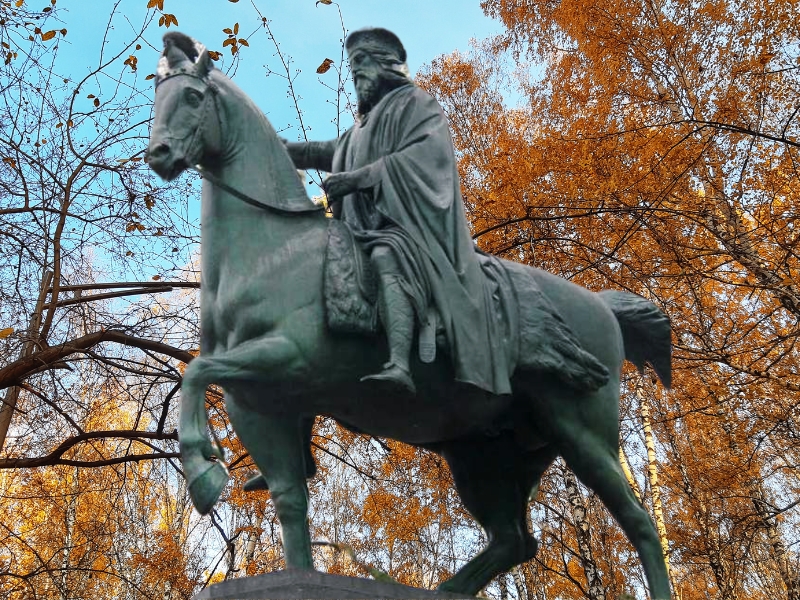
The statue of Charlemagne is a bronze equestrian monument on Boulevard d'Avroy in Liège, showing the Frankish emperor on horseback above a stone pedestal. Liège has long claimed him as a local: his family came from this part of the Meuse valley, and nearby Jupille and Herstal are among the places put forward as his birthplace. That is why six of his ancestors stand in niches around the base.
The Charlemagne statue at a glance
- Where: at the crossing of Boulevard d'Avroy and Boulevard Piercot, beside the Parc d'Avroy, south-west of the city centre.
- Created: completed in 1867 and inaugurated on 26 July 1868.
- By: Louis Jehotte, a Liège-born sculptor who taught at the Brussels Academy of Fine Arts.
- What it is today: a 12-metre monument with a 5-metre statue, restored in 2011–2012 and one of the stops on our Liège scavenger hunt.
- Time needed: 10 minutes to walk round the pedestal and identify the six ancestors.
A sculptor's dream and a quarrel over the site
Jehotte proposed the monument to the city in 1855. He had a lifelong interest in Charlemagne and later co-wrote an essay about him, and his idea fitted the mood of the young Belgian state, which was looking for national heroes. The city approved it in 1860 and in 1862 agreed to place it on Place Saint-Lambert, where Liège's great cathedral had stood until it was demolished after the revolution of 1789. In 1863, however, the council chose a new site on the boulevards of a recently built district. Jehotte took the city to court over the change and lost.
He finished the statue in his Brussels workshop in 1867, and it was unveiled the following summer. Three of the pedestal figures were damaged by vandals in 1888. By the 2000s the monument's internal anchors were a concern, so on 14 December 2011 the statue was taken down and sent to a workshop in Périgueux, in France, for a full restoration. It returned to Boulevard d'Avroy on 11 September 2012.
What to look for
- Charlemagne himself, dressed in a short cloak (chlamys) and tunic, with a short sword at his side and one arm stretched out in a gesture of friendship and protection.
- The six niches in the pedestal, each with an ancestor: Pepin of Landen, his daughter St Begga, Pepin of Herstal, Charles Martel, Bertrada and Pepin the Short.
- The local choice of ancestors: Jehotte picked the branch of the family rooted around Liège, so Herstal and Landen appear by name.
- The details of the base: medallions, small columns, plant motifs and the imperial eagle.
- The scale: step back across the boulevard to see the whole 12-metre composition rise above the traffic.
Charlemagne and Tchantchès
Charlemagne also lives on in Liège folklore. The city's best-loved puppet character, Tchantchès, a cheeky local with a big nose and a patched outfit, is said in local tradition to have been a companion of the emperor, and their imagined dialogue is a classic of Liège puppet theatre. It is pure legend, but it shows how firmly the city has adopted the emperor as one of its own.
Tips for your visit
- Walk all the way round the pedestal: the ancestors face in different directions, and the names are easiest to read up close.
- Late afternoon light falls nicely on the bronze; the Parc d'Avroy next to it is a good place for a break.
- Combine the statue with the Collegiate Church of Saint-Jacques, a short walk away, for two very different sides of Liège's history.
Nearby
- Collegiate Church of Saint-Jacques: a late-Gothic church with a richly painted vaulted ceiling, a few minutes' walk away.
- Parc d'Avroy: a 19th-century park with a pond, right beside the statue.
- Cathedral of Saint-Paul: Liège's cathedral since the old one on Place Saint-Lambert was destroyed, known for its treasury.
See Liège with World City Trail
Our Liège scavenger hunt turns the city into a game you play on your phone. The route links 10 stops and takes around three hours, with about 54 minutes of walking. The Charlemagne statue is one of the stops, along with Liège Cathedral, the Collegiate Church of Saint-Jacques and the Aquarium-Muséum.
If you prefer a different format, Liège also has a self-guided walking tour and an outdoor escape game.
Play the Liège scavenger hunt →
Take the self-guided walking tour of Liège →
Play the outdoor escape game in Liège →
Facts checked in October 2026.