
Aix-en-Provence, a city steeped in artistic heritage, proudly houses a true gem of medieval painting: Nicolas Froment’s magnificent “Burning Bush” triptych. This iconic altarpiece, a testament to the skill of the French Early Renaissance artist, offers a profound theological narrative intertwined with striking visual detail, making it a pivotal work for understanding 15th-century art in Provence.
The Artist and the Commission
Nicolas Froment (c. 1435 – c. 1486) was a leading figure of the “Second School of Avignon,” a group of artists who infused French painting with elements of Flemish naturalism. His works are characterized by their intricate detail, rich symbolism, and a captivating blend of realism and spiritual intensity.
Burning Bush in Aix-en-Provence was a prestigious commission from King René I of Anjou, also known as René the Good. René, a highly cultured monarch, duke, and patron of the arts, spent significant time in Provence, and his court in Aix and Angers became a center of artistic flourishing. He commissioned this altarpiece in 1475 (some sources indicate 1476), intending it for the high altar of the Grands-Carmes convent in Aix-en-Provence, where his entrails were to be interred. The painting was completed between 1475 and 1476, reflecting the artistic sensibilities of the era.

The “Burning Bush”: A Triptych of Profound Meaning
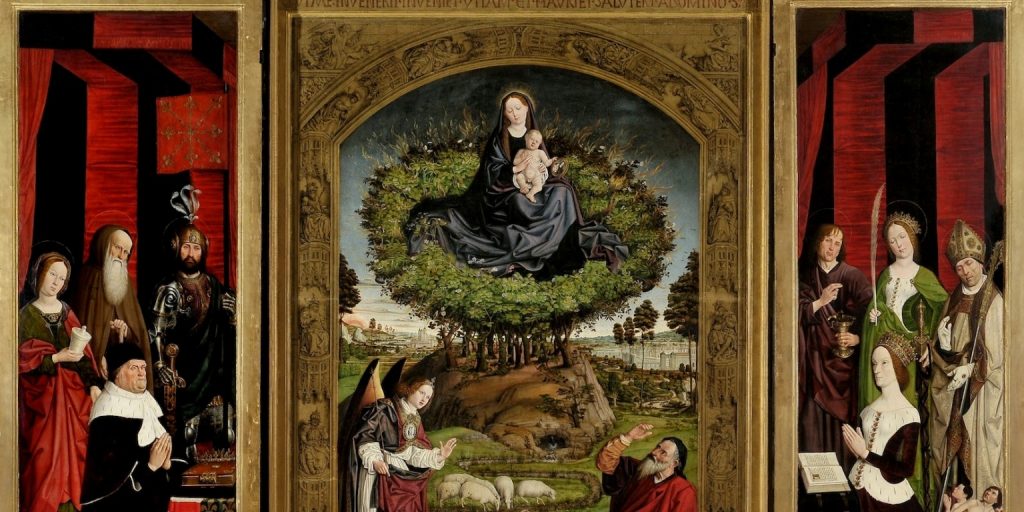
The Burning Bush in Aix-en-Provence is a large oil-on-panel triptych, meaning it consists of three hinged panels designed to be opened and closed.
When closed, the outer panels depict a trompe-l’œil grisaille (a painting in shades of gray to imitate sculpture) of the Annunciation, with the Angel Gabriel and the Virgin Mary. This serves as a preparation for the vibrant narrative within.
When opened, the triptych reveals its full glory:
- Left Panel: This panel features King René himself, dressed in the habit of the canons of the Abbey of St Victor, kneeling in prayer. He is surrounded by his patron saints: Mary Magdalene, Saint Anthony the Great, and Saint Maurice, the latter carrying the banner of the Ordre du Croissant (Order of the Crescent), an order founded by René. The inclusion of the king underscores his piety and his role as the patron of the artwork.
- Central Panel: This is the heart of the masterpiece, depicting the biblical scene of the Madonna and Child in the Burning Bush in Aix-en-Provence. Inspired by the Book of Exodus, Moses is shown in the foreground, tending his flock, when he beholds the miraculous vision: a bush that burns without being consumed. Within the flames, the Virgin Mary and the Infant Jesus are enthroned, symbolizing the Incarnation and the purity of Mary, who conceived without being consumed by sin. The landscape in the background subtly evokes Provence, with a town possibly representing Avignon and a castle that may refer to René’s own château de Saumur. The scene is rich with symbolic elements, from the ewes and vegetation to gestures and colors, all contributing to its complex theological message. The rock from which the bush grows, with its twelve fig branches, further emphasizes biblical imagery and God’s steadfastness.
- Right Panel: This panel, if present, would typically feature other figures or elements complementing the central narrative, often related to the Virgin Mary or Christ’s lineage.
The Place of the Masterpiece: Aix Cathedral
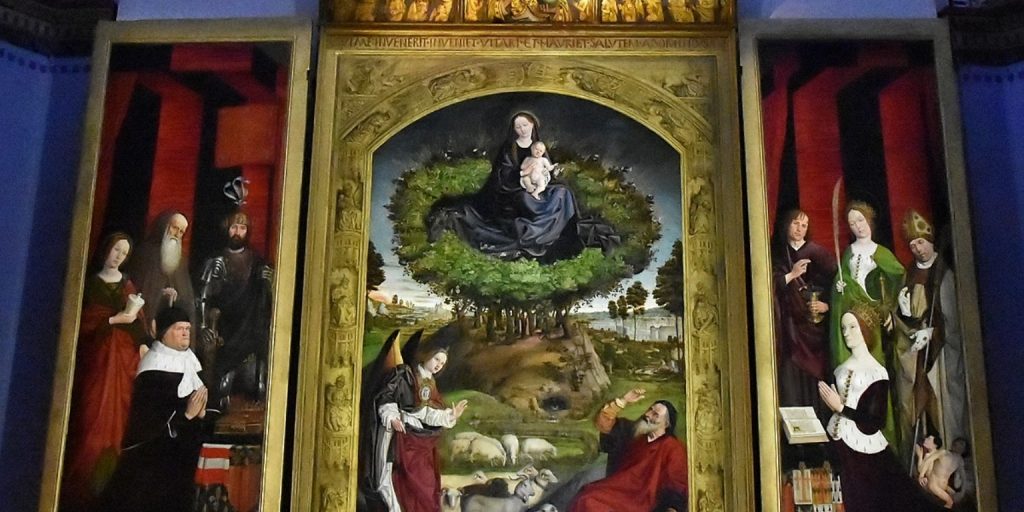
The Burning Bush in Aix-en-Provence by Nicolas Froment is proudly housed in the Cathédrale Saint-Sauveur d’Aix-en-Provence (Cathedral of the Holy Saviour). This magnificent cathedral, itself a blend of Romanesque, Gothic, and Baroque styles, has a long and storied history, built over centuries on the site of a Roman forum.
Originally, as commissioned by King René, the triptych stood on the altarpiece in the Grands-Carmes convent. However, during the turmoil of the French Revolution in 1792, the convent was destroyed. Fortunately, the masterpiece was saved and subsequently moved to the Aix Cathedral in 1808, ensuring its preservation for future generations. After a significant restoration, it was reinstalled in the cathedral’s Saint-Lazare chapel in late January 2011, allowing its intricate details and vibrant colors to be appreciated anew.
A visit to the Cathédrale Saint-Sauveur is incomplete without spending time before this profound work. Nicolas Froment’s “Burning Bush” is not merely a painting; it is a spiritual meditation, a historical document, and a supreme example of 15th-century Provençal art. Burning Bush in Aix-en-Provence, enduring presence within the venerable walls of the Aix Cathedral offers a compelling glimpse into the devotional art and royal patronage that shaped the cultural landscape of Aix-en-Provence centuries ago.