
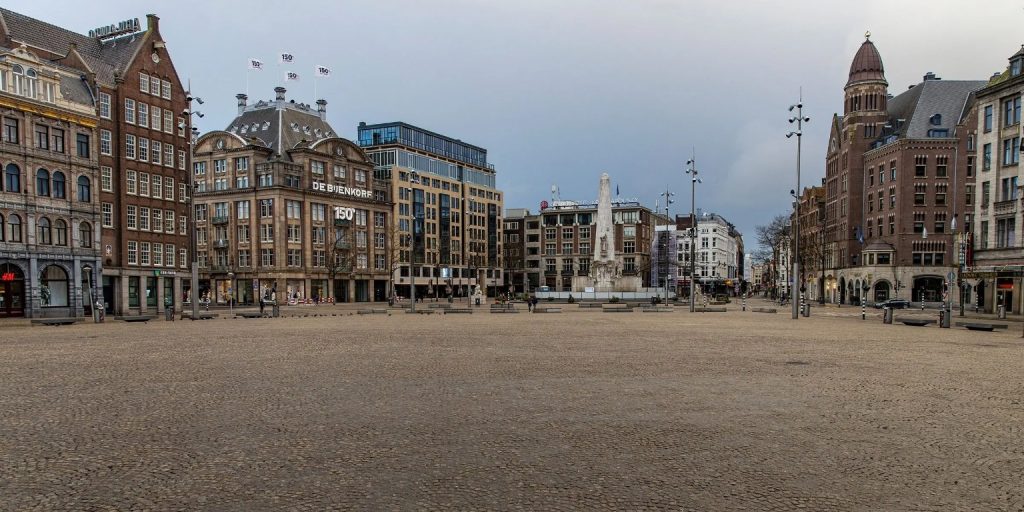
At the very core of Amsterdam, where the city’s origins are deeply rooted, lies Dam Square in Amsterdam. More than just a public space, this iconic square serves as the beating heart of the Dutch capital, a place where history, commerce, and daily life converge. From its humble beginnings as a literal dam to its current status as a bustling hub flanked by majestic landmarks, Dam Square in Amsterdam encapsulates the fascinating evolution of the city itself.
The Genesis of Amsterdam: A Dam on the Amstel
The story of DDam Square in Amsterdam is intrinsically linked to the very birth of the city. The city’s name, “Amsterdam,” literally means “dam in the Amstel,” a direct reference to the square’s original function. In the 13th century, to combat the ever-present threat of flooding from the Zuiderzee (a former inland sea), the early settlers built a dam across the River Amstel. This crucial engineering feat, erected somewhere between 1204 and 1275, served to protect the burgeoning settlements on both sides of the river and facilitate passage.
The dam wasn’t just a barrier; it soon became a vital point of connection and trade. A lock was incorporated into the dam to allow ships to pass, and over time, the top of the dam widened. This widening, combined with the gradual expansion of the port (the Damrak), transformed the original “Middeldam” and an adjacent plaza called “Plaetse” into a single, expansive square. By the 14th century, this newly formed square had become the undisputed geographical, commercial, and administrative center of the nascent city.
Landmarks and Eras: A Timeline of Transformation
Dam Square in Amsterdam has witnessed centuries of change, with numerous significant buildings and events shaping its character:
- 14th Century onwards: Commercial Hub: From its early days, Dam Square was the city’s primary marketplace. A weigh house (Waag) was established here in 1341 (replaced by a new one in 1565) where goods were officially weighed, highlighting its central role in trade.
- 15th Century: The Nieuwe Kerk: Construction of the Nieuwe Kerk (New Church), a striking Gothic-style church, began in 1408 just north of the old city hall. Although it suffered a devastating fire in 1645 and was subsequently reconstructed, it remains a prominent feature of the square, used today for exhibitions, organ recitals, and even royal inaugurations and weddings.
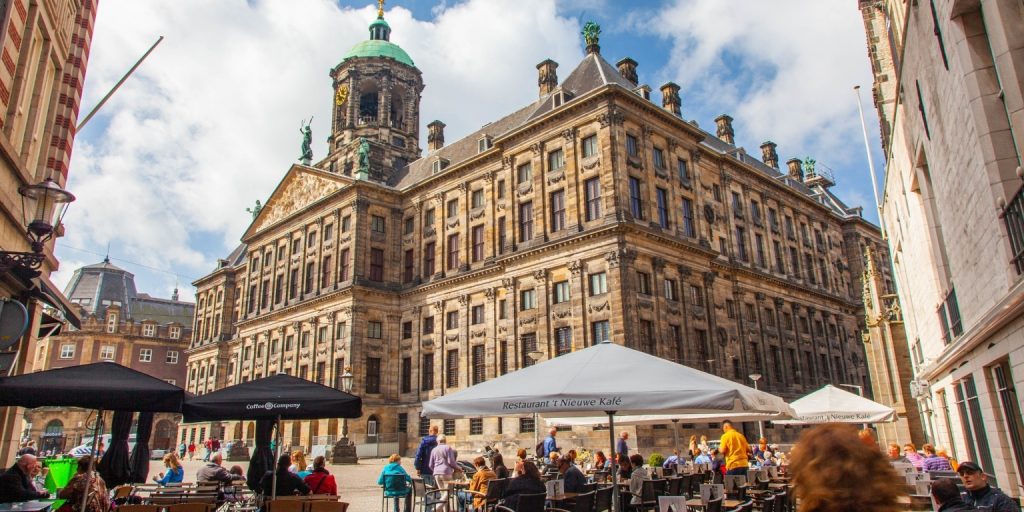
- 17th Century: The Royal Palace (Former City Hall): The most imposing structure on Dam Square is the Royal Palace of Amsterdam (Koninklijk Paleis Amsterdam). This architectural masterpiece was originally built between 1648 and 1655 by Jacob van Campen to serve as Amsterdam’s City Hall (Stadhuis). Its immense scale and classical design were intended to reflect the city’s newfound power and prosperity during the Dutch Golden Age. In 1808, it was converted into a royal palace by Louis Bonaparte, brother of Emperor Napoleon, and has largely retained that function for ceremonial purposes and state visits ever since.
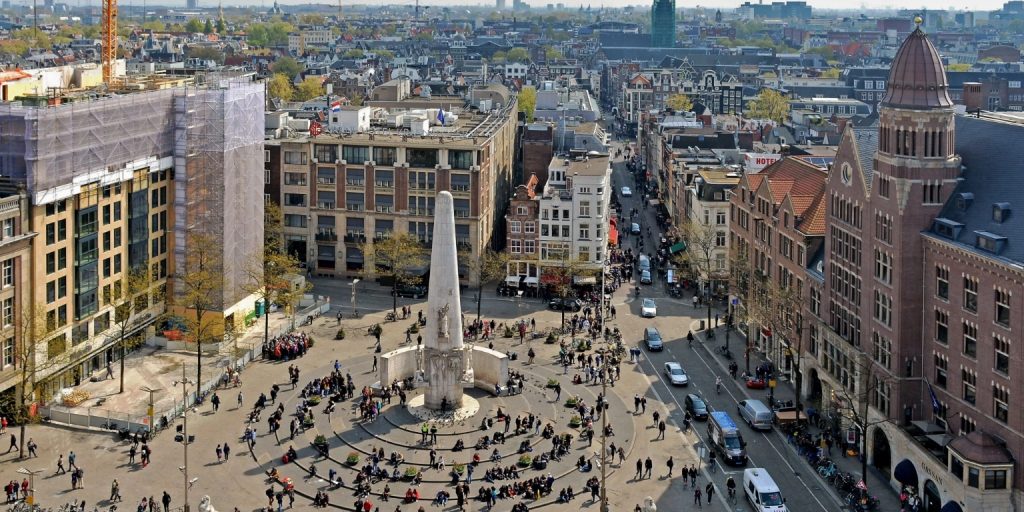
- 19th and 20th Centuries: Evolution and Remembrance: The 19th century saw some changes, including the demolition of the Waag in 1808 by order of Louis Napoleon. The square continued to evolve as a public space and a site for demonstrations and celebrations. After World War II, a powerful symbol of remembrance was added: the National Monument. Designed by J.J.P. Oud, this imposing white stone pillar was unveiled on May 4, 1956, to commemorate the Dutch victims of World War II and subsequent conflicts. It is the focal point for the annual Remembrance Day ceremony.
Dam Square Today: A Living Icon
Today, Dam Square in Amsterdam remains an unparalleled magnet for both locals and millions of tourists. It’s a bustling arena where street performers entertain crowds, pigeons famously congregate, and historical gravitas coexists with modern vibrancy. The square is flanked by an array of attractions, including the Madame Tussauds wax museum, the upscale De Bijenkorf department store, and numerous shops and restaurants.
More than just a collection of buildings, Dam Square is a public stage that has witnessed countless historical events, from royal celebrations to protests and cultural gatherings. It truly is the “beating heart” of Amsterdam, a dynamic testament to the city’s remarkable journey from a small fishing settlement protected by a dam to a globally recognized metropolis. Its long history, dating back to the 13th century with the construction of the original dam, ensures its place as an enduring symbol of Amsterdam’s past, present, and future.