
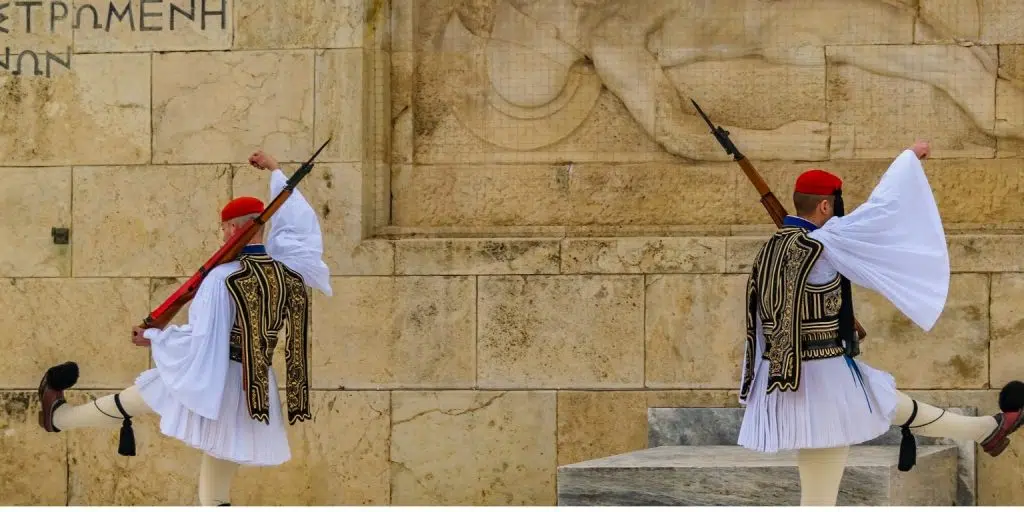
In the heart of Athens, amidst the bustling streets and ancient monuments, stand figures that embody Greece’s proud history, unwavering spirit, and deep-rooted traditions: the Evzones in Athens. These elite soldiers of the Presidential Guard are instantly recognizable by their distinctive uniform and their highly stylized, synchronized movements. They are far more than ceremonial guards; they are living symbols of the nation’s struggles, sacrifices, and enduring identity, making them one of Athens’ most iconic and moving sights.
A History Forged in Battle: From Elite Fighters to Presidential Guard
The term “Evzone” (Εύζωνες), meaning “well-girt” or “well-belted,” has ancient roots, even appearing in Homer’s Iliad to describe swift and brave warriors. However, the modern history of the the Evzones in Athens began in 1867 with the formal establishment of infantry regiments within the Hellenic Army. These units quickly gained a reputation for their bravery and fighting spirit, distinguishing themselves in numerous conflicts throughout the 19th and 20th centuries, including the Balkan Wars, the Asia Minor Campaign, and both World Wars. Their courageous contributions on the battlefield cemented their heroic status in the Greek collective consciousness.
A pivotal moment in their ceremonial role came in 1914 with the formation of the “Palace Guard,” the direct predecessor of today’s Presidential Guard. Following the construction of the Tomb of the Unknown Soldier in Syntagma Square, which was unveiled on March 25, 1932, a company of the Evzones was assigned the solemn duty of guarding this cenotaph dedicated to fallen Greek soldiers.
Over the decades, and through various political changes in Greece, the unit’s name evolved (e.g., Royal Guard, Guard of Honor of the Unknown Soldier), but its core mission of guarding the Presidential Palace and the Tomb of the Unknown Soldier remained. Since the restoration of democracy in 1974, the unit has been formally known as the Presidential Guard.

Where to Witness the Evzones in Athens
The Evzones are most famously seen performing their duties at several key locations in the city:
- The Tomb of the Unknown Soldier: Located directly in front of the Hellenic Parliament Building in Syntagma Square. This is where the iconic Changing of the Guard ceremony takes place.
- The Presidential Mansion: Situated on Herodou Attikou Street, near the National Garden. Evzones also stand guard at the entrance of the Presidential Palace.
- The Acropolis: On Sundays and national holidays, Evzones participate in the solemn flag-raising and lowering ceremonies at the Sacred Rock of the Acropolis.
- Presidential Guard Barracks: Located on Herodou Attikou Street, behind the Presidential Mansion. On Sundays, the larger, more elaborate Changing of the Guard involves the entire Evzone garrison marching from their barracks to the Tomb of the Unknown Soldier, accompanied by a military band.
The Changing of the Guard occurs hourly, on the hour, every day, at the Tomb of the Unknown Soldier. The more elaborate Sunday ceremony at 11:00 AM is particularly popular, featuring a larger contingent of Evzones and a marching band, drawing significant crowds.

The Uniform: A Tapestry of Symbolism and History
The Evzones uniform is perhaps its most captivating feature, steeped in historical, folkloric, and religious symbolism. Each component is meticulously handmade, often taking months to complete, and every detail carries meaning:
- Foustanella: The distinctive white kilt, made from 30 meters of white fabric, features 400 pleats. Each pleat is said to symbolize a year of Ottoman occupation of Greece. Its white color, along with the white shirt (ypoditis), represents the purity of the struggle for national independence.
- Fermeli: The ornate, hand-embroidered waistcoat. Its intricate designs often include patterns with deep cultural and folkloric value.
- Fario: The red felt cap, adorned with the national emblem, symbolizes the blood shed by Greek fighters. Its long black silk tassel (thisanos) represents tears and mourning for the victims of war.
- Tsarouchia: The traditional leather clogs, each weighing approximately 2 kilograms, are reinforced with 60 nails in the sole and a horseshoe on the heel. Their characteristic loud clacking sound during the march is said to let ancestors hear that Greeks are alive and free. The black pom-poms on the toes, according to tradition, were once used to conceal knife blades for close combat.
- Krossia: The blue and white silk fringes on the uniform symbolize the colors of the Greek flag.
The Evzones, chosen for their imposing stature (over 1.87 meters tall) and rigorous training, maintain an extraordinary stillness and stoicism while on duty, regardless of weather conditions. They are a profound and enduring symbol of Greek strength, dignity, and historical memory, making a visit to witness their ceremonial duties an unforgettable part of any trip to Athens.