
Before the construction of the Chain Bridge, the two cities of Buda and Pest were separate entities, connected only by a temporary pontoon bridge in the summer and a ferry in the winter. This made travel between the two sides difficult, especially when the river froze over. The push for a permanent bridge came from a personal and pivotal event in the life of Count István Széchenyi, a leading Hungarian statesman and reformer. In 1820, he was unable to attend his father’s funeral because he was stuck on the Pest side of the river, unable to cross due to the icy conditions. This experience fueled his determination to build a permanent bridge.
Széchenyi commissioned the English engineer William Tierney Clark to design the bridge, with construction supervised by the Scottish engineer Adam Clark (no relation). The project began in 1839 and, after ten years of meticulous work, the bridge was inaugurated on November 20, 1849. Its opening was a monumental event, as it was the first permanent bridge across the Danube in Hungary. This physical connection was a key catalyst for the economic and social development that led to the official unification of Buda and Pest, along with Óbuda, into the single city of Budapest in 1873. The bridge became a powerful symbol of progress and national unity.
An Architectural and Engineering Marvel
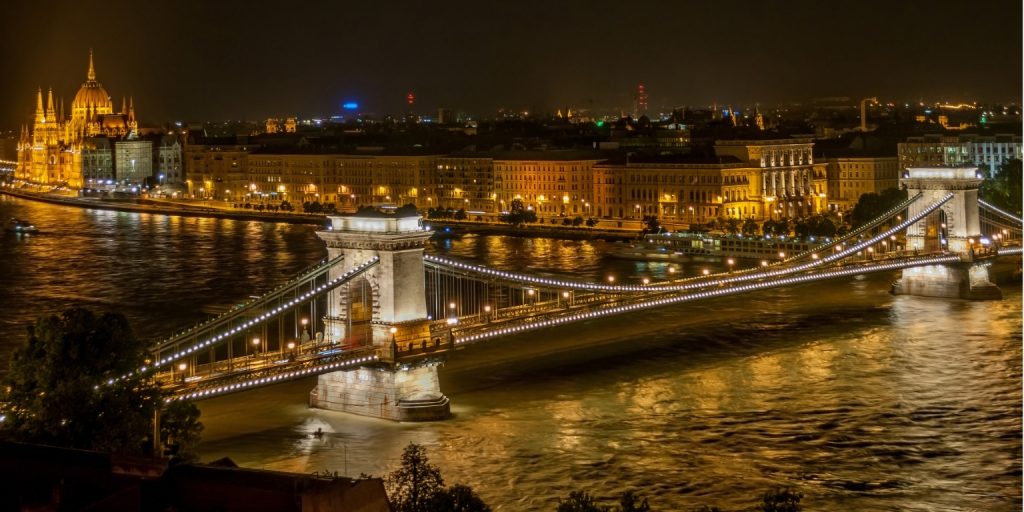
The Chain Bridge is a masterpiece of 19th-century engineering and Neo-classical design. At the time of its completion, its 202-meter main span was one of the largest in the world. The bridge’s design is defined by two massive stone towers, through which the huge iron chains run, supporting the bridge deck below. The chains, composed of meticulously linked bars, give the bridge its name. The use of wrought iron for the structure was a technological marvel, showcasing the industrial advancements of the era.
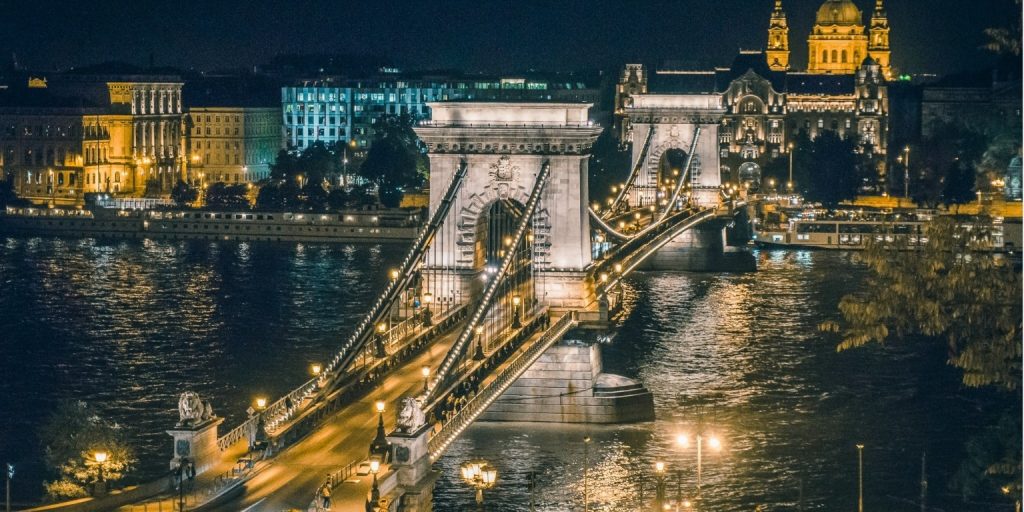
The bridge’s aesthetic beauty is enhanced by its decorative elements. At both ends, guarding the entrances, are four majestic lion statues, sculpted by János Marschalkó in 1852. These lions, with their powerful paws and regal expressions, have become as iconic as the bridge itself. A popular urban legend claims the lions have no tongues, and that the sculptor, upon being mocked for the oversight, threw himself into the Danube. This is, of course, a myth; the lions do have tongues, they are just not visible from a street-level perspective, and Marschalkó lived a long and successful life.

The Bridge’s Resilience
The Chain Bridge has endured a turbulent history, a reflection of the struggles of the city it connects. It survived an attempt by the Austrians to destroy it during the 1848 Revolution, but it was not as fortunate during World War II. On January 18, 1945, the retreating German army blew up all of Budapest’s bridges, leaving only the stone towers of the Chain Bridge standing.
The destruction was a devastating blow to the city, but the bridge’s reconstruction became a symbol of Budapest’s resilience and determination to rebuild. The bridge was meticulously restored to its original design and reopened exactly 100 years after its first inauguration, on November 20, 1949. This act of rebirth reaffirmed its place as the heart of the city.
A Modern Landmark and a View to Remember
Today, the Chain Bridge is a must-see for any visitor to Budapest. It is a vital part of the urban landscape, connecting the bustling energy of Pest with the historic and serene Castle Hill in Buda. While recent renovations have restricted car traffic, allowing only buses and taxis, the bridge remains a popular place for pedestrians. A walk across its elegant span offers some of the most breathtaking panoramic views in the city, with the Buda Castle and Fisherman’s Bastion on one side and the stunning Hungarian Parliament Building and Gresham Palace on the other.
At night, the bridge is magnificently illuminated, its lights reflecting on the dark surface of the Danube, creating a truly unforgettable spectacle. The Chain Bridge is more than just a means of crossing a river; it is a journey through Budapest’s history, a celebration of its triumphs, and an enduring symbol of its identity as a unified and beautiful city.