
Eleftherios Venizelos (1864–1936) is a towering figure in Greek history, often hailed as the “maker of modern Greece.” Born in Crete, he played a central role in the island’s struggle for independence from the Ottoman Empire and its eventual unification with Greece in 1913. As Prime Minister, he embarked on a series of ambitious reforms that transformed the country, modernizing its constitution, legal system, military, and economy. His leadership during the Balkan Wars and World War I led to a significant expansion of Greece’s territory, effectively doubling its size and earning him a reputation as a master diplomat.
Venizelos’s political life was marked by both immense success and bitter division. He was a champion of liberal democracy and was instrumental in shaping the Greek state as it is known today. His legacy, however, also includes periods of exile and a deep political rift with the monarchy. Despite the turmoil, his influence on Greek politics and his vision for a greater, modern Greece are unparalleled.
Upon his death in Paris in 1936, his body was brought back to his beloved homeland of Crete, where he was buried on the hill of Profitis Ilias (Prophet Elias), a place he had frequented and a location with which he had a deep personal connection. The decision to bury him here, away from the nation’s capital, was a symbolic choice, reaffirming his strong bond with Crete.
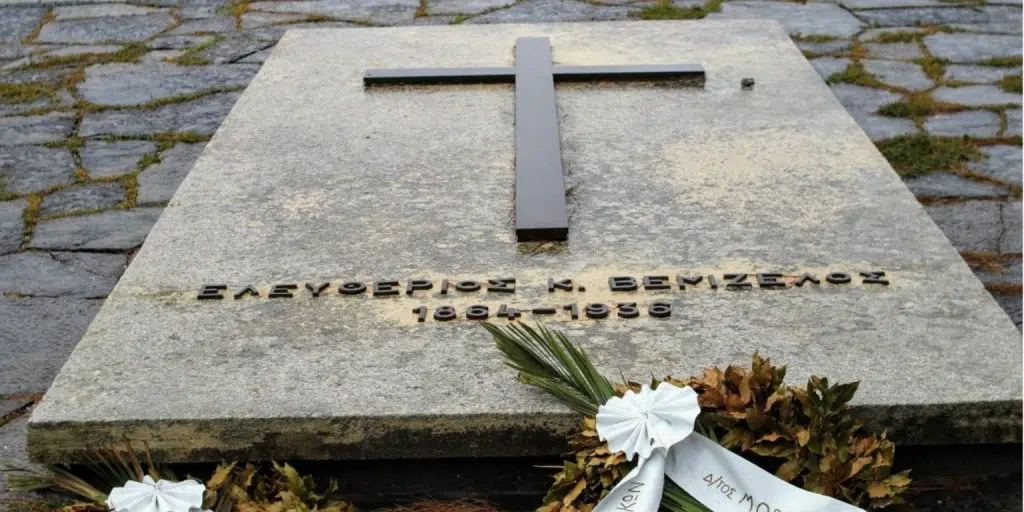
The Tombs and the Park
The site consists of two simple but elegant tombs. The first is that of Eleftherios Venizelos, marked by a granite slab that bears a simple but powerful inscription: his name, his dates, and a tribute to his role in Greek history. Adjacent to his is the tomb of his son, Sophoklis Venizelos (1894–1964), who followed in his father’s footsteps, serving as Prime Minister on three separate occasions. The proximity of their tombs symbolizes the continuity of a family’s dedication to public service and the political ideals of liberal democracy.
The surrounding park, meticulously landscaped with trees, flowers, and walking paths, adds to the solemn and dignified atmosphere. A statue of Venizelos stands at the entrance to the park, welcoming visitors. The area is also a popular spot for locals and tourists to relax and enjoy the natural beauty. The park’s benches are perfectly positioned to take in the breathtaking panorama, which includes the entire city of Chania, the historic Venetian Harbor, and the deep blue waters of the Bay of Souda. The view is particularly spectacular at sunset, when the sky is painted with a palette of vibrant colors, and the city lights begin to twinkle below.
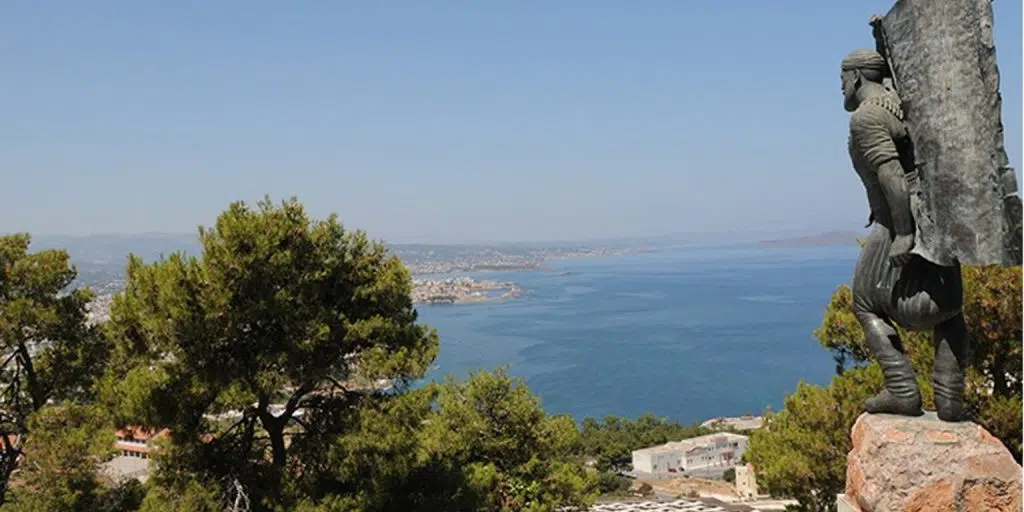
A Place of Reflection and Patriotism
The Venizelos Tombs site is more than a historical monument; it is a place of pilgrimage for those who wish to pay their respects to a pivotal figure in Greek history. It serves as an open-air museum, where visitors can learn about the life and legacy of Venizelos through informational plaques. It is a place for quiet reflection on the struggles for national identity, democracy, and independence that have shaped modern Greece.
The location of the tombs, on a hill that offers a commanding view of the city, is no accident. It is a powerful metaphor for Venizelos’s political vision, a man who looked out over his homeland and worked tirelessly to build a stronger, more united nation. For history enthusiasts, political scholars, or anyone with an appreciation for a stunning landscape, a visit to the Venizelos Tombs is an essential and moving experience. It is a place where history, nature, and patriotism converge to create a truly unforgettable landmark.