
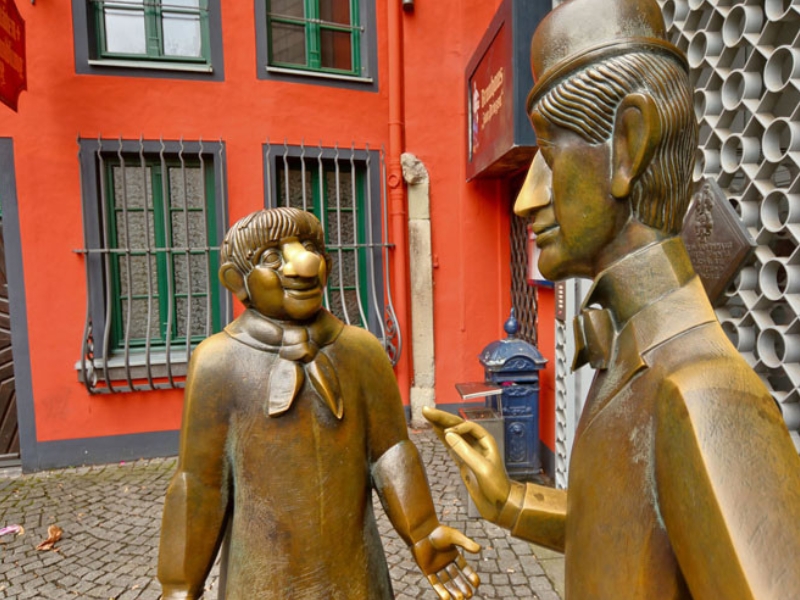
Tünnes and Schäl are two life-size bronze figures standing beside the Romanesque church of Great St. Martin in Cologne's old town. They portray the city's best-loved comic pair from the Hänneschen puppet theatre, and Tünnes' big nose shines gold because so many visitors rub it for luck.
Tünnes and Schäl at a glance
- Where: in the Altstadt next to Great St. Martin, by the Hanenhaus at Lintgasse 9, a few minutes from the Alter Markt and the Rhine.
- By: the Cologne sculptor Wolfgang Reuter, commissioned by the Cologne architect Josef 'Jupp' Engels (1909–1991).
- What it is today: a free, always accessible pair of statues and one of the most photographed spots in the old town.
- Time needed: 5–10 minutes.
From puppet stage to street corner
Tünnes and Schäl come from the Hänneschen-Theater, Cologne's traditional stick-puppet theatre. Tünnes was created in 1803 by Johann Christoph Winters, the founder of the first Hänneschen theatre; Schäl joined the cast around 1850. Over two centuries they have become the stars of countless Cologne jokes, in which the slow but good-hearted Tünnes and the cunning Schäl argue about life, money and the city.
The two are caricatures of Cologne types. Tünnes, whose name is the Rhineland short form of Antonius, is the countryman who moved to the city, in a farmer's smock with a big red nose. Schäl is the slim city dweller and bon vivant in tailcoat and hat who thinks he is smarter than his friend. His name refers to his squint, and in the Cologne dialect 'schäl' also means wrong or crooked.
What to look for
- Tünnes' nose: polished bright by thousands of hands, it stands out clearly against the dark bronze of the rest of the figure.
- The contrast between the two: compare Tünnes' round, rustic figure with Schäl's thin frame, tailcoat and hat.
- The plaque on the Hanenhaus: a sign on the building says that Tünnes and Schäl lodge here with their friend Jupp Engels, the architect who commissioned them.
- The church behind: the apses of Great St. Martin make the backdrop, so you get both landmarks in one picture.
Rubbing the nose and the 'wrong side'
Touching Tünnes' nose is said to bring good luck, which is why it gleams while the rest of the statue stays dark. There is also a story, best treated as a rumour, that Schäl was invented to mock a rival puppet theatre on the right bank of the Rhine, the side people in Cologne still jokingly call the 'Schäl Sick', the wrong side.
Tips for your visit
- Come in the morning if you want a photo without a queue; later in the day groups gather around the statues.
- Rub the nose gently and step aside so the next person can have a turn.
- If you like the characters, look for the second pair of similar figures in the banking hall of the Kreissparkasse at Neumarkt.
Nearby
- Great St. Martin: the Romanesque church right behind the statues, with Roman remains in its crypt.
- Fischweiber-Brunnen: a basalt fountain with four fishwives on the Fischmarkt, a minute or two away.
- Alter Markt: the old market square with the City Hall tower and the Jan von Werth fountain, a few minutes' walk.
- Hänneschen-Theater: the puppet theatre on the Eisenmarkt where Tünnes and Schäl still appear on stage, close to Heumarkt.
See Cologne with World City Trail
Our Cologne scavenger hunt turns the old town into a game you play on your phone. The route links 10 stops and takes around 2 hours, with about 20 minutes of walking. The statues are not a stop themselves, but the route stops at Great St. Martin right next to them, and also includes the Old Market, the Fischmarkt and Cologne Cathedral. You can play in English, German, French, Italian, Spanish and Dutch.
If you prefer a different format, there is also a self-guided walking tour and an outdoor escape game in Cologne.
Play the Cologne scavenger hunt →
Take the self-guided walking tour of Cologne →
Play the outdoor escape game in Cologne →
Facts checked in October 2026.