
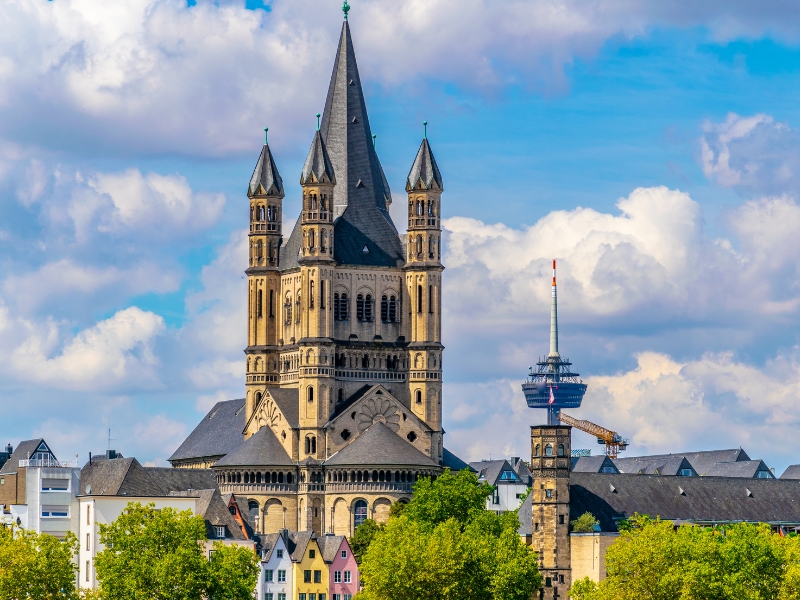
Great St. Martin (Groß St. Martin) is the Romanesque church whose square tower with four slim turrets rises above the old town between Cologne Cathedral and the Rhine. It was built from around 1150 on the foundations of Roman warehouses on what was then an island in the river, and you can still see those Roman remains beneath the church today.
Great St. Martin at a glance
- Where: in the Altstadt, a few steps from the Fischmarkt and the Rhine promenade.
- Built: from around 1150, consecrated in 1172 and completed in the 13th century; rebuilt after the Second World War, with the work finished in 1985.
- What it is today: a Catholic church run since 2009 by a community of the Monastic Fraternities of Jerusalem, and one of Cologne's twelve great Romanesque churches.
- Time needed: 20–30 minutes for the church, a little more if you visit the excavations below.
From Roman island to rebuilt landmark
In Roman times this ground lay on an island in front of the city. Excavations found a large walled square with a big water basin from the 1st century, and later four long halls that were probably warehouses for river trade. Archbishop Bruno, who ruled Cologne from 953 to 965, founded a church here dedicated to St Martin of Tours, and from the late 10th century it belonged to a Benedictine abbey, first settled by monks from Ireland. After a fire swept the city in 1150, the present church was begun; its clover-leaf east end with three rounded apses was consecrated in 1172.
The abbey survived storms and fires but not secularisation: it was dissolved in 1802, the abbey buildings were demolished, and the church became a parish church. Air raids in 1942 and 1943 destroyed large parts of the nave and vaults. The tower was rebuilt by 1965, and the whole church was rededicated in 1985, forty years after the war ended. The narrow houses around it date mostly from the 1970s and 1980s, built to give the old town back its tight medieval scale.
What to look for
- The crossing tower: a square tower with four corner turrets, one of the defining shapes of the Cologne skyline seen from across the Rhine.
- The clover-leaf choir: walk around the east end to see three apses meeting at the crossing, a plan Cologne shares with St. Maria im Kapitol.
- The Roman excavations: a crypt created during the rebuilding lets you look at remains from Roman times beneath the church floor.
- The name: 'Groß' (great) distinguishes it from Klein St. Martin, a smaller market church of which only the tower survives.
- The setting: from the Rhine promenade, the tower lines up with the colourful riverside houses for the classic old-town picture.
A forged chronicle
For centuries a chronicle claimed that Great St. Martin was founded as a chapel in 690 and turned into a monastery in 708, complete with a papal visit and Viking raids. In 1900 the historian Otto Oppermann showed that it was a forgery, written around 1730 by Oliver Legipont, a Benedictine monk living at the abbey. The reliable record starts with Archbishop Bruno in the 10th century.
Tips for your visit
- It is a working church with daily prayer: keep quiet during services and visit between them.
- For the best photo, cross the Hohenzollern Bridge or the Deutz bank and look back: the tower stands just to the left of the cathedral.
- Combine it with the Fischmarkt and Alter Markt, which are both within a few minutes, and end your walk on the Rhine promenade.
Nearby
- Fischweiber-Brunnen: a basalt fountain with four market women on the Fischmarkt, whose basin echoes the church's clover-leaf choir.
- Tünnes and Schäl: two bronze puppet-theatre characters next to the church; rubbing Tünnes' nose is said to bring luck.
- Alter Markt and City Hall: the old market square and the Gothic City Hall tower with its carillon, a few minutes' walk.
- Cologne Cathedral: the Gothic twin-spired cathedral, a short walk north through the old town.
See Cologne with World City Trail
Our Cologne scavenger hunt turns the old town into a game you play on your phone. The route links 10 stops and takes around 2 hours, with about 20 minutes of walking. Great St. Martin is one of the stops, along with Cologne Cathedral, the Old Market and the Fischmarkt. You can play in English, German, French, Italian, Spanish and Dutch.
If you prefer a different format, there is also a self-guided walking tour and an outdoor escape game in Cologne.
Play the Cologne scavenger hunt →
Take the self-guided walking tour of Cologne →
Play the outdoor escape game in Cologne →
Facts checked in October 2026.