
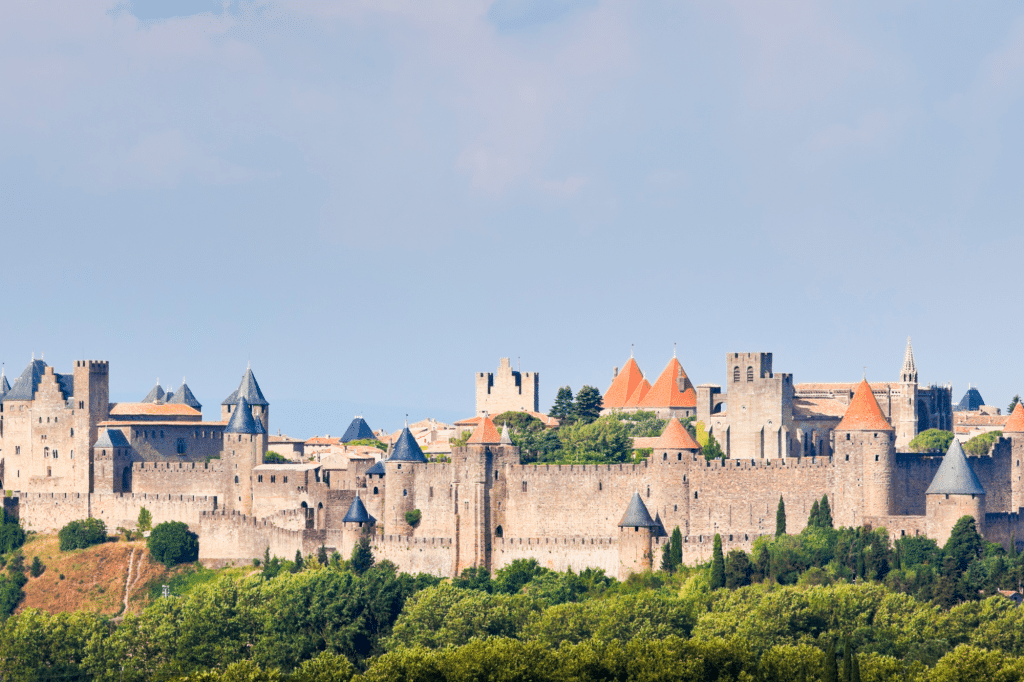
Carcassonne is really two towns: the walled Cité on its hill and the Bastide Saint-Louis, the lower town laid out in a grid across the river Aude. This guide covers six places that link them: the ramparts and the Château Comtal, the Porte Narbonnaise, the Basilica of Saint-Nazaire, the Pont Vieux, Place Carnot and the Cathedral of Saint-Michel. All six are stops on our scavenger hunt, and together they tell the city's story from the Romans to the 19th-century rescue of the Cité.
The ramparts of the Cité
The Cité stands on a hill above the Aude, behind a double ring of walls with 52 towers. The Romans fortified the hill in the 3rd century, and parts of their walls survive in the inner ring. In the 12th century the Trencavel family, viscounts of Carcassonne, ruled from here. On 1 August 1209 the crusader army of the war against the Cathars laid siege to the town, and on 15 August Viscount Raimond-Roger Trencavel surrendered in exchange for the lives of the citizens. The town then passed to the French crown, which turned it into a royal fortress on the border with Aragon.
By the 19th century the fortress had lost its military role and was falling apart, and in 1849 the government decided to demolish it. Local protests, led by the historian Jean-Pierre Cros-Mayrevieille and supported by the writer Prosper Mérimée, reversed the decision. From 1853 the architect Eugène Viollet-le-Duc restored the walls, work continued after his death in 1879, and in 1997 the Cité became a UNESCO World Heritage Site.
- The lices, the open strip of ground between the two walls, where houses stood until they were cleared by 1911.
- The pointed slate roofs on the towers, Viollet-le-Duc's most criticised choice: slate is typical of northern France, while this region traditionally used flatter terracotta tiles.
- The difference in the stones: the small blocks and brick bands of the Roman walls in the inner ring, and the larger, more regular medieval masonry.
The Château Comtal
Inside the Cité stands a castle within the fortress, built at the beginning of the 12th century for the viscounts and strengthened between 1240 and 1250. It has its own moat, a barbican in front of the entrance and its own towers, so it could hold out even if the town fell. Since 1961 it has housed a museum, and the visit includes a walk along part of the ramparts. The château and the ramparts are two of the scavenger hunt stops.
- The wooden hoardings on the walls and towers, covered galleries from which defenders could drop stones on attackers, reconstructed by Viollet-le-Duc.
- The views from the wall walk over the lices, the Bastide and the Pyrenees on a clear day.
Porte Narbonnaise
The Porte Narbonnaise is the main gate of the Cité, on its eastern side, and most visitors walk in through it. It was built around 1280 under King Philip III the Bold, between two massive towers with pointed spurs designed to deflect missiles. A niche above the gateway holds a statue of the Virgin. It is a stop on our scavenger hunt.
Next to the entrance stands a bust of Dame Carcas. According to legend, she was the widow of a Saracen prince who defended the town when Charlemagne besieged it for years. When food ran out, she fed the last pig with the last sack of wheat and threw it over the walls. The besiegers concluded that the town still had plenty to eat and gave up. As they left, the bells rang, and the legend says the name of Carcassonne comes from Carcas sonne, Carcas rings. It is a story, not history, but you will hear it everywhere in town.
Basilica of Saint-Nazaire
In 1096 the Trencavel viscount authorised the building of a church here, with the blessing of Pope Urban II. The nave, built around the middle of the 12th century, is Romanesque: low, solid and dark. The transept and choir were rebuilt between 1269 and 1330 in the Gothic Rayonnant style of northern France, with tall windows that fill the east end with coloured light. Saint-Nazaire was the cathedral of Carcassonne until 1803, when the bishop's seat moved to Saint-Michel in the lower town, and it was made a basilica in 1898. It is one of the scavenger hunt stops.
- The stained-glass windows of the 13th and 14th centuries, including the Tree of Life and the Tree of Jesse windows from the early 14th century.
- The two rose windows in the transept facades.
- The statues of the apostles on the pillars of the choir, modelled on those of the Sainte-Chapelle in Paris.
Pont Vieux
For centuries the Pont Vieux, the Old Bridge, was the only way to cross the Aude between the lower town and the Cité. A bridge here is first recorded in 1184; the present stone bridge was begun in the early 14th century and finished around 1320. It has twelve round arches of different widths, it has been a listed historic monument since 1926, and today it is reserved for pedestrians. Walk across it towards the Cité for the classic view of the walls rising above the river. It is a stop on our scavenger hunt.
Place Carnot
Place Carnot is the main square of the Bastide Saint-Louis, the lower town founded in 1247 by King Louis IX after the people living around the Cité had been driven out. The Bastide was laid out as a grid of straight streets crossing at right angles, with the square at its centre. In 1355 the troops of Edward the Black Prince burned the lower town, which was then rebuilt. Its walls were pulled down in 1764, and the boulevards that ring the Bastide today follow their line. Place Carnot is a scavenger hunt stop.
The fountain in the middle of the square, and the café terraces that line it.
Cathedral of Saint-Michel
- Saint-Michel was begun in 1247, on the orders of Louis IX, as the parish church of the new Bastide. It is a good example of southern French Gothic: a single wide nave without aisles. After the Black Prince's raid of 1355 the church was built into the town's new defences, and a round tower near the apse still recalls this. It became the cathedral of Carcassonne in 1803. After a fire in 1849 it was restored, from 1857 under the direction of Viollet-le-Duc. Look up at the large rose window on the facade. It is one of the scavenger hunt stops.
How to see them in one walk
Start in the Bastide at the Cathedral of Saint-Michel and walk to Place Carnot. From there head for the river and cross the Pont Vieux, then climb through the Trivalle district to the Porte Narbonnaise. Inside the Cité, visit the Château Comtal and its rampart walk, then the Basilica of Saint-Nazaire. Finish with a walk through the lices between the walls. The Cité is at its quietest early and late in the day.
See Carcassonne with World City Trail
Our Carcassonne scavenger hunt turns the Bastide and the Cité into a game you play on your phone. The route links 10 stops, from Square André Chénier to the Porte Narbonnaise, and all six places in this guide are on it, together with the Musée des Beaux-Arts and the Porte d'Aude. At each stop you solve a puzzle and learn a story, at your own pace.
There is also a self-guided walking tour and an outdoor escape game in Carcassonne, for people who prefer a different format.
Play the Carcassonne scavenger hunt →
Take the self-guided walking tour of Carcassonne →
Play the outdoor escape game in Carcassonne →
Facts checked in October 2026.