
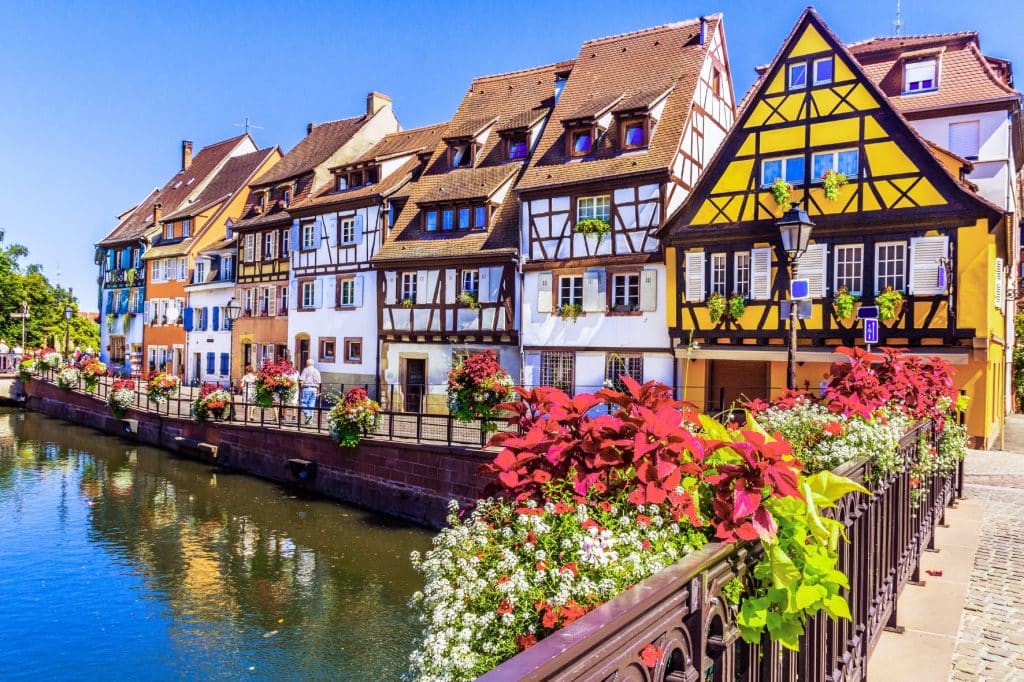
Colmar's old town is compact, and most of what makes it famous lies within a short walk: a Gothic church, painted Renaissance houses, an old customs house, canals lined with half-timbered houses and a museum built around one of the great paintings of the Middle Ages. This guide covers seven of those places: St Martin's Church, the Pfister House, the Unterlinden Museum, the Koïfhus, Little Venice with the fishmongers' quarter, the Roesselmann Fountain and the Bartholdi Museum. They sit on the same streets, so you can see them all in one walk.
St Martin's Church
St Martin's is the largest church in Colmar and is often called the cathedral, although it is a collegiate church, not a bishop's seat. Its title comes from the French Revolution, when the chapter was abolished and a constitutional bishop was installed here; that ended with the Concordat in 1802, and it has been a parish church since. The present Gothic building was raised between about 1234 and 1365 in Vosges sandstone of different shades. A Master Humbert led the early work on the transept, nave and towers, and Guillaume de Marbourg designed the choir, finished in the 1360s. The planned north tower was never built.
The tower that was built lost its roof and spire in a fire in 1572. They were replaced by the onion-shaped lantern that still gives the church its outline. For centuries the church also held Martin Schongauer's Madonna of the Rose Bush, painted in 1473; it was stolen in 1972, recovered in 1973, and now hangs in the nearby Dominican church.
- The south portal, with a tympanum showing St Nicholas saving three girls.
- The central portal, whose tympanum shows the Adoration of the Magi above the Last Judgement.
The Pfister House
On the corner of Rue des Marchands stands one of the most photographed houses in Alsace. It was built in 1537 for Ludwig Scherer, a hatter from Besançon, in yellow sandstone and wood, and its painted decoration was added in 1577. It owes its name to later owners, the Pfister family, who held it in the 19th century. It is a listed historic monument and a private building, so you admire it from the street.
- The two-storey corner oriel, with Gothic-style stone tracery below and a wooden gallery above, and the octagonal stair turret topped with a small bulb.
- The wall paintings, attributed to Christian Vacksterffer: Germanic emperors, the four Evangelists, scenes from Genesis and allegories such as Faith and Justice.
The Unterlinden Museum
The Unterlinden Museum, whose name means under the lime trees, fills a former Dominican convent and opened to the public in 1853. It is run by the Société Schongauer and is known above all for the art of the Upper Rhine in the 15th and 16th centuries, including works by Martin Schongauer, who was born in Colmar.
Its most famous work is the Isenheim Altarpiece, painted by Matthias Grünewald between 1512 and 1516 for a monastery hospital, with carved parts by Nicolas de Haguenau. The museum was extended in 2015 by the architects Herzog & de Meuron, who linked the convent with a new wing and the former municipal baths.
- The convent cloister and the chapel where the Isenheim Altarpiece is displayed, with its panels opened out so you can see all the scenes.
The Koïfhus (Old Customs House)
The Koïfhus, or Ancienne Douane, on Grand-Rue is the oldest public building in Colmar. Its southern wing was built in 1480 and altered in the 16th and 18th centuries. Goods coming into and leaving the town were stored and taxed on the ground floor, while the hall upstairs hosted meetings of the Decapolis, the league of ten imperial cities of Alsace, and later the court and the town council. General Jean Rapp, one of Napoleon's officers, was born in the northern building in 1771.
- The roof of glazed coloured tiles with its balustrade, the best view of the building, from the square in front of it.
Little Venice and the fishmongers' quarter
Little Venice (La Petite Venise) is the stretch of the Lauch river on the southern edge of the old town, in the Krutenau quarter. In the Middle Ages this marshy ground was turned into market gardens, and the growers used flat-bottomed boats on the river to bring their vegetables to market. The quarter runs from the covered market along the Quai de la Poissonnerie to the Saint-Pierre bridge.
The Quai de la Poissonnerie takes its name from the fish trade that once gave this street its living. Its half-timbered houses, painted in strong Alsatian colours, date mostly from the 14th to the 18th century. Today flat-bottomed boats take visitors along the Lauch from the covered market.
- The view of the canal and the coloured houses from the Saint-Pierre bridge and from the bridges near the covered market.
The Roesselmann Fountain
On the Place des Six-Montagnes-Noires, at the edge of Little Venice, stands a fountain by Auguste Bartholdi, unveiled in 1888. It honours Jean Roesselmann, the town's provost, who died in 1262 defending Colmar against troops of the bishop of Strasbourg. Bartholdi gave the statue the face of a former mayor of Colmar who had opposed the German annexation of Alsace after 1871. In 1943 the occupying authorities pulled the statue down to melt it; it was found damaged at the Rhine port and put back in 1945.
The Bartholdi Museum
Auguste Bartholdi, the sculptor of the Statue of Liberty and the Lion of Belfort, was born in Colmar in 1834, in the house at 30 Rue des Marchands. The house was left to the town in 1907 and is now a museum of his work, with plaster models, drawings, photographs and models of his statues on three floors.
- The bronze group The Great Supporters of the World (Les grands Soutiens du monde), from 1902, in the courtyard.
How to see them in one walk
Start at the Unterlinden Museum in the north of the old town and walk south past the Pfister House to the Bartholdi Museum, both on Rue des Marchands. Turn to St Martin's Church, then continue to the Koïfhus on Grand-Rue. From there walk down to the covered market and follow the Quai de la Poissonnerie through Little Venice to the Roesselmann Fountain. Allow time inside the Unterlinden Museum, which deserves a good part of a morning.
See Colmar with World City Trail
Our Colmar scavenger hunt turns the old town into a game you play on your phone. The route links 10 stops, from St Martin's Church to the Bartholdi Museum, and St Martin's, the Unterlinden Museum, the Roesselmann Fountain, Little Venice, the fishmongers' quarter, the Old Customs House and the Bartholdi Museum are all stops, along with the Municipal Theatre, the Champ de Mars park and the church of Saint-Matthieu. The Pfister House is not a stop, but it is a few steps from the route. At each stop you solve a puzzle and learn a story, at your own pace.
There is also a self-guided walking tour and an outdoor escape game in Colmar, for people who prefer a different format.
Play the Colmar scavenger hunt →
Take the self-guided walking tour of Colmar →
Play the outdoor escape game in Colmar →
Facts checked in October 2026.