
Erfurt grew rich in the Middle Ages on woad, a plant that gave a blue dye, and much of what you see in its old town was paid for by that trade. This guide covers eight places: the Old Synagogue, the Renaissance houses Zum Breiten Herd and Zum Stockfisch, the Angermuseum, the natural history museum in a woad warehouse, the riverside quarter called Venedig, the Petersberg Citadel and, a short tram ride out, the egapark. The first seven lie within an easy walk of each other.
Old Synagogue
Hidden in a courtyard near the Fischmarkt, the Old Synagogue is one of the oldest preserved synagogue buildings in Europe; its oldest walls date back to around 1100. After the pogrom of 1349 it was turned into a storehouse, and its later uses as a warehouse, restaurant and dance hall disguised it so well that it survived almost forgotten. It opened as a museum in 2009.
The highlight is the Erfurt Treasure, found in 1998 in a wall in the nearby Michaelisstraße: coins, silver vessels and jewellery buried around the time of the 1349 pogrom, including a Jewish wedding ring of extraordinary craftsmanship. In 2023 the Old Synagogue, the medieval mikveh by the Krämerbrücke and the Stone House became a UNESCO World Heritage Site as the Jewish-Medieval Heritage of Erfurt.
Zum Breiten Herd
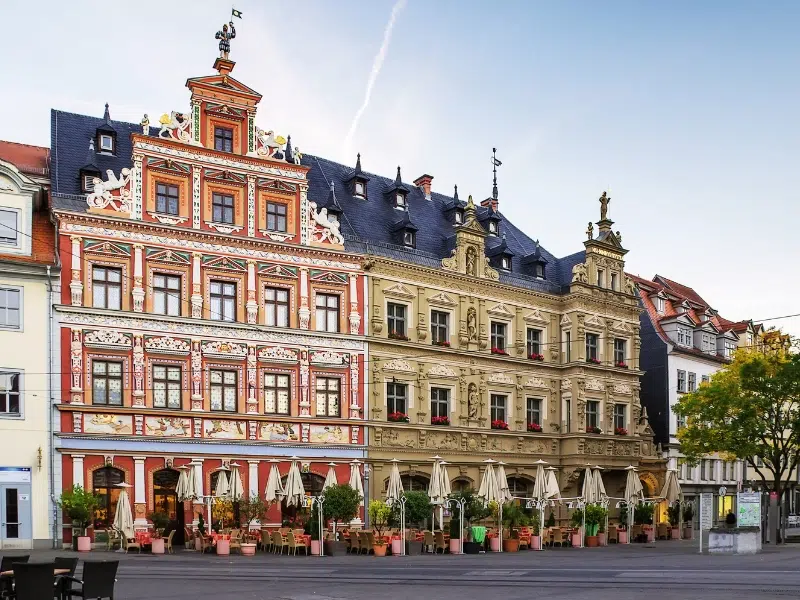
On the Fischmarkt, opposite the town hall, stands one of Erfurt's finest Renaissance façades. The house Zum Breiten Herd was built in 1584 for Heinrich von Denstedt, a town official. Along the first floor runs a carved frieze of the five senses, figures based on designs by the Antwerp artist Frans Floris. Look closely at Smell: behind the figure there is a small view of Erfurt.
The colourful paintwork you see today is a reconstruction from 1968. The house to the right, the Gildehaus, looks like a twin, but it is Neo-Renaissance, built in the 1880s and 1890s and modelled on its older neighbour. Zum Breiten Herd is one of the stops on our Erfurt scavenger hunt.
Haus zum Stockfisch (Stadtmuseum)
The city museum is housed in a Renaissance merchant's house on Johannesstraße, built in 1606 and 1607 for the woad merchant Paul Ziegler. Its name comes from the house sign above the richly decorated portal: a stockfish, or dried cod, floating on water. The ground floor is covered with stone panels in a chequerboard pattern, and the original door knocker is still in place.
The city bought the house in 1905, and the Stadtmuseum has used the whole building since 1974. Inside, the exhibitions follow Erfurt's history from the Middle Ages, with the woad trade, the university and the city's Reformation years. It is a stop on the scavenger hunt.
Angermuseum
Erfurt's art museum sits on the Anger, the main shopping street, in a Baroque building put up in 1706 to 1711 as the public weighing house, to plans by Maximilian von Welsch. The museum opened here in 1886 and was the city's first municipal museum.
Its collections range from medieval altarpieces and Thuringian faience to modern art, but the room people come for is on the ground floor: the Heckel Room, painted by the Expressionist Erich Heckel between 1922 and 1924 with murals on the stages of life. They are among the most important surviving wall paintings of German Expressionism. The Angermuseum is the first stop of the scavenger hunt.
Naturkundemuseum
The natural history museum fills a tall woad warehouse from 1577 in the street Große Arche, the kind of building where the dried dye plant was once stored. The museum opened in 1922 in the Haus zum Stockfisch and moved here in 1995.
Its showpiece is an English oak in the atrium, about 350 years old and around 14 metres tall, felled in Erfurt's city forest in 1991. Its roots sit on the ground floor and its crown reaches the top, so you climb the building alongside the tree. The museum is one of the scavenger hunt stops.
Venedig and its bridges
North of the Krämerbrücke, at the edge of the Andreas quarter, the River Gera splits into several arms and forms small islands. This green corner is called Venedig, Venice. In the 16th century up to seven water mills worked here; today it is a park with paths, lawns and small bridges, two of which were completed in 2004. A dyer's house called Zur kleinen Venedige is recorded on the island in 1666, and the name may refer to Venice, a long-standing trading partner of Erfurt, though other explanations exist.
Petersberg Citadel
Above the cathedral rises the Petersberg Citadel, one of the largest preserved Baroque town fortresses in Central Europe. Construction began in 1665, when Erfurt was ruled by the Electorate of Mainz. Inside the walls stand the Romanesque church of the former Benedictine monastery of St Peter and several barracks and officers' buildings.
Under the bastions runs a network of tunnels, the listening galleries, where soldiers once listened for enemy miners; parts can be visited on guided tours. The best reason to climb up, though, is the view over the cathedral, St Severus and the rooftops of the old town.
egapark
A short tram ride west of the centre, the egapark is a 36-hectare garden show park on the site of the Cyriaksburg fortress. The international garden exhibition opened here in 1961, and the park was the main site of the Federal Garden Show in 2021. Look for the large flower bed, more than 6,000 square metres and replanted twice a season, the Japanese garden and the German Horticultural Museum in the old fortress. The old gun tower is now a lookout.
How to see them in one walk
Start at the Angermuseum on the Anger, then head to Johannesstraße for the Haus zum Stockfisch. Walk on to the Krämerbrücke, and turn into the lanes towards the Fischmarkt for the Old Synagogue and Zum Breiten Herd opposite the town hall. Continue to the Naturkundemuseum on Große Arche, make a detour north to the islands of Venedig and finish on the Domplatz, climbing up to the Petersberg for the view. Keep the egapark for another half day.
See Erfurt with World City Trail
Our Erfurt scavenger hunt turns the old town into a game you play on your phone. The route links 10 stops, from the Angermuseum to the church of St Severus. Four places in this guide are stops: the Angermuseum, the Stadtmuseum Haus zum Stockfisch, Zum Breiten Herd and the Naturkundemuseum, along with the Luther monument, the Krämerbrücke, the town hall, the Domplatz and the cathedral.
If you prefer a different format, there is also a self-guided walking tour and an outdoor escape game in Erfurt.
Play the Erfurt scavenger hunt →
Take the self-guided walking tour of Erfurt →
Play the outdoor escape game in Erfurt →
Facts checked in October 2026.