
This guide covers four places that sit along one line through the old centre of Naples, from the hill of the museums down to the sea: the National Archaeological Museum, the monastery complex of Santa Chiara, the church of San Nicola alla Carità on Via Toledo and the castle of Castel Nuovo by the port. Together they span Roman Pompeii, the Angevin kings of the Middle Ages and the Baroque painters of the 1600s, and all four are stops on our scavenger hunt.
National Archaeological Museum
The museum fills a large palazzo at the top of the old town. The building dates from 1585 and began as a cavalry barracks; from 1616 to 1777 it was the seat of the University of Naples, which is why it was long called the Palazzo degli Studi. In 1777 King Ferdinand IV decided to bring the main Bourbon collections together here, and the architect Ferdinando Fuga took charge of the conversion until his death in 1782.
Two collections make it one of the great museums of the ancient world. The first is the Farnese collection of Roman sculpture, which Charles of Bourbon inherited through his mother, Elisabetta Farnese, in 1731. The second is the stream of finds from Pompeii and Herculaneum, the towns buried by Vesuvius in AD 79: frescoes, mosaics, bronzes and everyday objects, and even the carbonised papyrus scrolls found after 1752 in the Villa of the Papyri at Herculaneum.
- The Farnese Bull, often described as the largest single sculpture recovered from antiquity, and the muscular Farnese Hercules nearby.
- The Alexander Mosaic, made around 100 BC, which once covered a floor in the House of the Faun at Pompeii and shows the battle between Alexander the Great and the Persian king Darius.
- The Secret Cabinet, the rooms where the Bourbons kept the erotic finds from Pompeii and Herculaneum away from view; they were opened to the general public only in April 2000.
Santa Chiara
Santa Chiara is a double monastery, built between 1313 and 1340 by King Robert of Anjou and his queen, Sancha of Majorca, for Franciscan friars and Poor Clare nuns. Its church is the largest Gothic basilica of the Angevin era in the city, a single tall nave with ten chapels on each side and no transept. In the 18th century the interior was dressed in Baroque, but almost all of that decoration burned after the bombing of 4 August 1943, and the restoration completed in 1953 brought back the bare Gothic lines you see today.
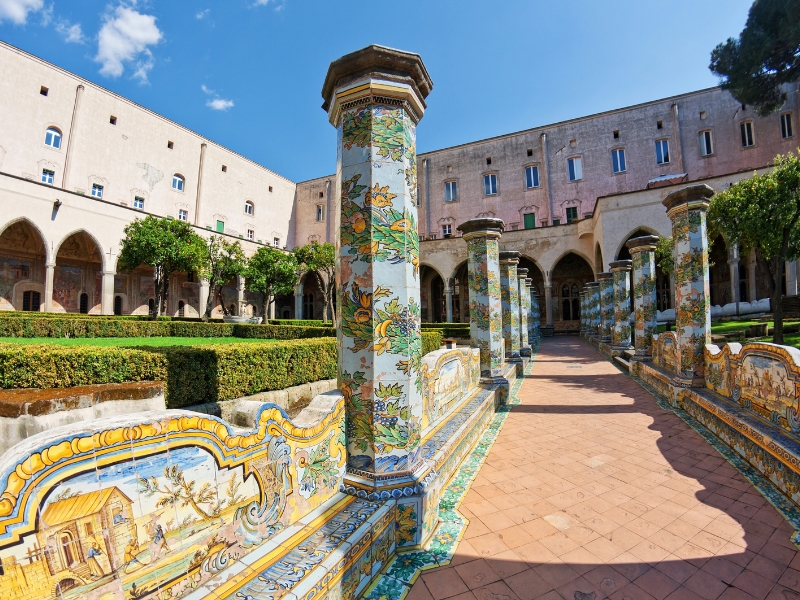
The best-known part of the complex is the nuns' cloister, redesigned from 1742 by the architect Domenico Antonio Vaccaro. Its walkways are lined with pillars and benches covered in painted majolica tiles made by Giuseppe and Donato Massa, a rare burst of colour among the grey stone of the old centre. The cloister, the museum with the archaeological finds and the collection of Neapolitan nativity scenes are visited on a separate ticket from the church.
- Behind the main altar, the tomb of Robert of Anjou, carved by Pacio and Giovanni Bertini in 1343.
- The chapel of the Bourbons, the tenth on the right, where the kings of the Two Sicilies from Ferdinand I to Francis II are buried with their wives.
- The square bell tower in the street outside: its marble base is the only part that survived the earthquake of 1456, and its Gothic inscriptions record the founding of the church.
San Nicola alla Carità
This church on Via Toledo, between Piazza Dante and Piazza della Carità, is easy to walk past among the shops. It was founded in 1647 by the Pii Operai, a congregation known for its charity work, with a design by Onofrio Antonio Gisolfi. Gisolfi died in the plague of 1656 and work stopped; Cosimo Fanzago took over in 1668, and the church was finished in 1682. Inside, it is a small anthology of Neapolitan painting around 1700.
- The vault of the nave, frescoed by Francesco Solimena in 1696, and the dome above it, painted by Francesco De Mura in 1734.
- On the inside of the entrance wall, a large fresco of Saint Nicholas by Paolo De Matteis, dated 1712; he also painted the Death of Saint Nicholas in the apse in 1707.
Castel Nuovo
The 'new castle' was built from 1279 for Charles I of Anjou, who had made Naples his capital, and was designed by the French architect Pierre de Chaulnes. Neapolitans usually call it the Maschio Angioino, the Angevin keep. What you see is mostly a rebuilding: Alfonso V of Aragon, who took Naples in 1443, had the Catalan architect Guillem Sagrera remodel it from 1453, and the work was completed in 1479. The castle stands over Piazza Municipio, a short walk from the ferry port.
Between the two towers at the entrance rises a white marble triumphal arch, built in 1470 to celebrate Alfonso's entry into the city; modern scholars attribute the design to Francesco Laurana, and several sculptors worked on its reliefs. Inside, the Civic Museum, opened in 1990, starts in the Palatine Chapel, whose back wall is the only part of the 14th-century Angevin castle still standing. Giotto painted the chapel around 1330, but only fragments of his work survive in the window splays.
- The triumphal arch: look for Alfonso's procession in the relief above the lower arch.
- The Hall of the Barons, under a Catalan Gothic vault by Sagrera. Around 1487 King Ferdinand I invited the barons who had plotted against him here, supposedly for a wedding, and had them arrested and put to death.
- In the courtyard, a glass floor over Roman-era remains found during restoration work.
How to see them in one walk
Start at the Archaeological Museum, at the top of the old town, and give it most of the morning. Walk down into the narrow streets of the historic centre and follow Spaccanapoli to Piazza del Gesù Nuovo, with the Gesù Nuovo church on one side and Santa Chiara just beyond it. From there head west to Via Toledo and turn south to San Nicola alla Carità. Keep following Via Toledo towards the sea, then turn left to Piazza Municipio and Castel Nuovo, and finish at the Galleria Umberto I and Piazza del Plebiscito nearby.
See Naples with World City Trail
Our Naples scavenger hunt turns the old town into a game you play on your phone. The route links 10 stops, from the National Archaeological Museum to Piazza del Plebiscito, and all four places in this guide are stops, along with the Sansevero Chapel, San Domenico Maggiore, the Gesù Nuovo, the Fountain of Neptune and the Galleria Umberto I. At each stop you solve a puzzle and learn a story, at your own pace.
There is also a self-guided walking tour and an outdoor escape game in Naples, for people who prefer a different format.
Play the Naples scavenger hunt →
Take the self-guided walking tour of Naples →
Play the outdoor escape game in Naples →
Facts checked in October 2026.