
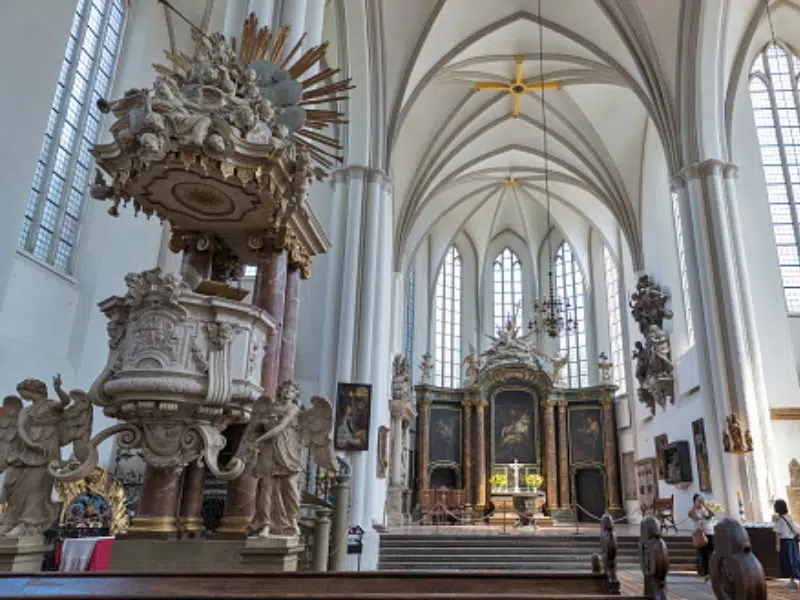
The Marienkirche (St. Mary's Church) is the medieval brick church standing on its own in the open space below Berlin's TV Tower, near Alexanderplatz. First mentioned in 1294, it is one of the oldest churches in the city and still a working parish church. Inside its entrance hall is a 22-metre Dance of Death painted around 1485, one of the last medieval dances of death north of the Alps still in its original place.
The Marienkirche at a glance
- Where: Karl-Liebknecht-Strasse, between the TV Tower and the Neptune Fountain, a few minutes' walk from Alexanderplatz.
- Built: begun around 1270 and finished in the early 14th century as an early Gothic hall church; the tower dates from the 15th century and its top from 1789–1790.
- What it is today: a Protestant parish church open to visitors, also used for services and concerts.
- Time needed: 30–45 minutes for the church, the Dance of Death and the cross outside.
Seven centuries in the old centre
The Marienkirche was built in the second half of the 13th century for the new part of the twin town of Berlin-Cölln, and it is first mentioned in writing in 1294. City fires in 1376 and 1380 damaged it badly, and the church you see is largely the result of the rebuilding that followed. The square stone base of the tower was added in the 15th century, and in 1789–1790 Carl Gotthard Langhans, the architect of the Brandenburg Gate, crowned it with a top that mixes Baroque and neo-Gothic forms.
For most of its history the church stood among the narrow streets of the crowded old centre of Berlin. The Second World War and the redevelopment of East Berlin in the 1960s swept that quarter away, and the TV Tower went up next door. Today the church seems almost lost in the open space, a few steps below street level, which shows how much the ground around it has risen over the centuries.
What to look for
- The Dance of Death (Totentanz): a fresco about 2 metres high and 22 metres long in the tower hall, painted around 1485, probably after a plague. Clergy and lay people, in order of rank, dance in a line with Death. It was found under layers of paint in 1860 and is now behind glass.
- The pulpit: carved in alabaster by Andreas Schlüter in 1703, with reliefs of John the Baptist and figures of Faith, Hope and Love.
- The baptismal font: a bronze font from 1437, carried by three black dragons that stand for the demons overcome by baptism.
- The organ: built by Joachim Wagner in 1720–1721, in a richly carved case finished in 1723.
- The atonement cross: a stone cross outside the church recalls the murder of the provost Nikolaus von Bernau by a Berlin mob in 1325.
- Martin Luther: a bronze statue of the reformer stands beside the church.
The murder that cost Berlin its Mass
In 1325 Nikolaus von Bernau, a provost who sided with the Pope in his quarrel with the German king Ludwig of Bavaria, was dragged from a house by a crowd of Berliners, beaten to death and burned. The Pope placed the city under an interdict, which banned most church services. About ten years later Berlin did penance, paying compensation and putting up an atonement cross, and the ban was finally lifted in 1345. The worn cross by the Marienkirche is the reminder of this story.
Tips for your visit
- The church is open to visitors most days, but during services and concerts access is limited to participants. Dress and behave as you would in any working church.
- Look at the Dance of Death from left to right: each figure is paired with a dancing Death, and short verses run beneath the figures.
- For a photo that shows the church dwarfed by the TV Tower, step back towards the Neptune Fountain.
Nearby
- TV Tower (Fernsehturm): the 368-metre East German tower of 1969, with a viewing platform and revolving restaurant, right next door.
- Neptune Fountain: Reinhold Begas's lavish bronze fountain of 1891, with Neptune and four women representing Germany's great rivers, a short walk away.
- Red City Hall (Rotes Rathaus): the red-brick seat of Berlin's mayor, built in the 1860s, across the square.
- Nikolaiviertel: the rebuilt old quarter around the Nikolaikirche, Berlin's oldest church building, a few minutes south.
See Berlin with World City Trail
Our Berlin scavenger hunt turns the city centre into a game you play on your phone. The route links 10 stops and takes around 3 hours, with about 65 minutes of walking, and includes the Brandenburg Gate, the Reichstag and Unter den Linden.
If you prefer a different format, there is also a self-guided walking tour and an outdoor escape game in Berlin.
Play the Berlin scavenger hunt →
Take the self-guided walking tour of Berlin →
Play the outdoor escape game in Berlin →
Facts checked in October 2026.