
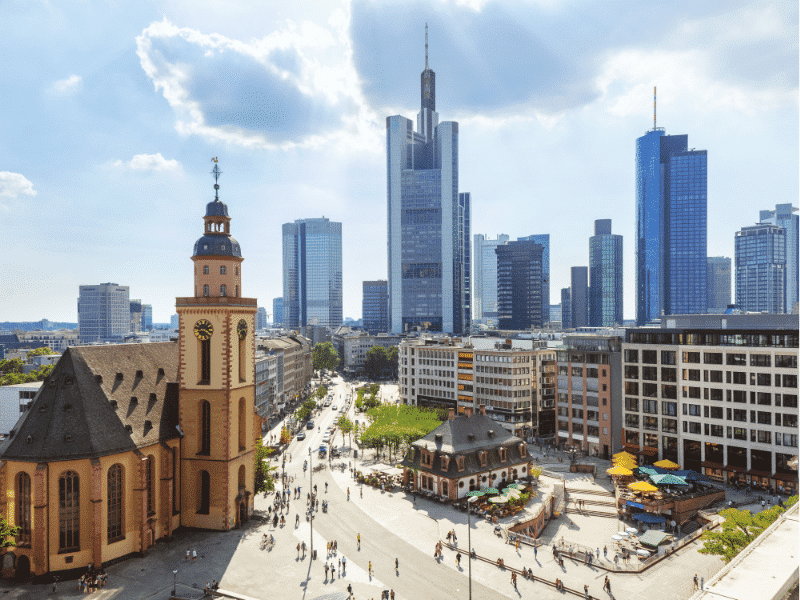
Fráncfort son dos ciudades a la vez: un perfil de torres bancarias que le ha valido el apodo de Mainhattan, y una ciudad mucho más antigua donde se elegía a los reyes alemanes y se coronaba a los emperadores. Entre las torres todavía encuentras plazas de entramado de madera, tabernas de sidra y la casa donde nació Goethe. Estos son los datos y las historias que hay detrás.
10 curiosidades sobre Fráncfort
- Where kings were chosen: under the Golden Bull of 1356, the kings of the Romans were elected in Frankfurt, and from 1562 to 1792 emperors were also crowned here, in St Bartholomew's Cathedral.
- A town hall since 1405: the city council bought the house called Zum Römer in 1405, and the Römer has been Frankfurt's town hall ever since. Its Kaisersaal is lined with portraits of 52 rulers.
- Goethe's birthplace: Johann Wolfgang von Goethe was born on 28 August 1749 in a house on the Großer Hirschgraben. It was destroyed in 1944 and carefully rebuilt after the war.
- Germany's first parliament: in 1848 and 1849 the Frankfurt National Assembly, the first freely elected parliament for all of Germany, met in St Paul's Church.
- Un casco antiguo nuevo: los bombardeos de marzo de 1944 destruyeron el centro medieval. Desde 2018, entre la catedral y el Römer se alza un nuevo barrio de 35 edificios, 15 de ellos reconstrucciones fieles.
- Germany's tallest building: the Commerzbank Tower, completed in 1997, is 259 metres tall and is still the tallest building in the country.
- Una Justicia con los ojos abiertos: la estatua de la Justicia en la fuente frente al Römer sostiene la espada y la balanza, pero no lleva venda.
- Anne Frank's home town: Anne Frank was born in Frankfurt on 12 June 1929. Her family left for Amsterdam after the Nazis came to power in 1933.
- Where the Rothschilds began: Mayer Amschel Rothschild built up his business in Frankfurt's Jewish lane, the Judengasse, in the 18th century. His five sons later ran banks in Frankfurt, London, Paris, Vienna and Naples.
- Struwwelpeter is from here: the Frankfurt doctor Heinrich Hoffmann wrote and drew Struwwelpeter as a Christmas present for his son. Published in 1845, it became one of the best-known German children's books.
La leyenda del vado de los francos
Frankfurt means 'ford of the Franks', and a legend explains the name. Charlemagne, at war with the Saxons in the late 8th century, was chased to the bank of the river Main with his army and no way across. Then a deer stepped out of the forest and waded into the water, revealing a shallow ford just below the surface. Charlemagne followed it and reached safety on the other side, while the Saxons were left behind. The history is plainer but just as old: the city is first mentioned in writing in 794, when Charlemagne held a great church council here.
Sachsenhausen y la sidra, explicados
Cross the Main on the Eiserner Steg, an iron footbridge from 1869, and you reach Sachsenhausen, home of Frankfurt's apple-wine taverns. Apfelwein, or Ebbelwoi in local dialect, is a dry, slightly sour cider served in a grey stoneware jug called a Bembel and drunk from a ribbed glass, the Geripptes. Taverns that press their own hang a wreath of pine branches over the door. Long shared tables are part of the experience, so expect to sit with strangers.
Qué comer en Fráncfort
- Grüne Soße: una salsa fría de siete hierbas, borraja, perifollo, berro, perejil, pimpinela, acedera y cebollino, servida con huevos duros y patatas. Su nombre está protegido por la UE desde 2016.
- Handkäs mit Musik: a tangy sour-milk cheese marinated in oil, vinegar and onions. The 'music' is the onions.
- Frankfurter Würstchen: salchichas finas de cerdo ahumadas, calentadas en agua en lugar de a la parrilla y comidas con mostaza y pan.
- Rippchen mit Kraut: una chuleta de cerdo curada y cocida con chucrut, un clásico de las tabernas de sidra.
- Frankfurter Kranz: un bizcocho en forma de anillo relleno de crema de mantequilla y mermelada y cubierto de crocante, que dicen que recuerda a una corona.
Antes de ir
- Para ver el perfil de la ciudad desde arriba, la Main Tower tiene un mirador abierto al público. Infórmate antes, porque cierra con mal tiempo.
- El Museumsufer, una hilera de museos en la orilla sur del Meno, incluye el Städel. A finales de agosto, la fiesta del Museumsufer llena las orillas.
- El mercado navideño del Römerberg es uno de los más antiguos de Alemania, y el casco antiguo se llena muchísimo los fines de semana de Adviento.
- Durante las grandes ferias, sobre todo la Feria del Libro de octubre, los precios de los hoteles se disparan. Heidelberg, Maguncia y el valle del Rin son excursiones fáciles en tren.
Descubre Fráncfort con World City Trail
Nuestra búsqueda del tesoro en Fráncfort convierte estos lugares en un juego en tu móvil. La ruta une 10 paradas y dura unas dos horas, con unos 24 minutos de caminata, y te lleva por el casco antiguo alrededor del Römerberg.
En cada parada resuelves un acertijo y escuchas una historia breve, a tu ritmo. Puedes empezar cuando quieras.
Juega a la búsqueda del tesoro de Fráncfort →
Datos comprobados en octubre de 2026.