
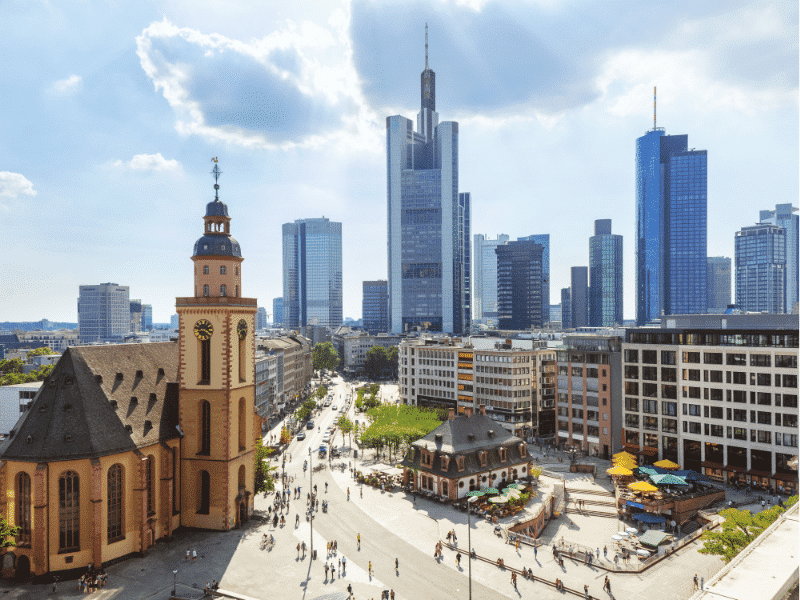
Frankfurt são duas cidades ao mesmo tempo: um horizonte de torres de bancos que lhe valeu a alcunha de Mainhattan, e uma cidade muito mais antiga onde se elegiam os reis alemães e se coroavam os imperadores. Entre as torres ainda encontras praças de enxaimel, tabernas de sidra e a casa onde Goethe nasceu. Estes são os factos e as histórias por trás dela.
10 curiosidades sobre Frankfurt
- Where kings were chosen: under the Golden Bull of 1356, the kings of the Romans were elected in Frankfurt, and from 1562 to 1792 emperors were also crowned here, in St Bartholomew's Cathedral.
- A town hall since 1405: the city council bought the house called Zum Römer in 1405, and the Römer has been Frankfurt's town hall ever since. Its Kaisersaal is lined with portraits of 52 rulers.
- Goethe's birthplace: Johann Wolfgang von Goethe was born on 28 August 1749 in a house on the Großer Hirschgraben. It was destroyed in 1944 and carefully rebuilt after the war.
- Germany's first parliament: in 1848 and 1849 the Frankfurt National Assembly, the first freely elected parliament for all of Germany, met in St Paul's Church.
- Um centro histórico novo: os bombardeamentos de março de 1944 destruíram o centro medieval. Desde 2018, entre a catedral e o Römer ergue-se um novo bairro de 35 edifícios, 15 deles reconstruções fiéis.
- Germany's tallest building: the Commerzbank Tower, completed in 1997, is 259 metres tall and is still the tallest building in the country.
- Uma Justiça de olhos abertos: a estátua da Justiça na fonte em frente ao Römer segura a espada e a balança, mas não tem venda nos olhos.
- Anne Frank's home town: Anne Frank was born in Frankfurt on 12 June 1929. Her family left for Amsterdam after the Nazis came to power in 1933.
- Where the Rothschilds began: Mayer Amschel Rothschild built up his business in Frankfurt's Jewish lane, the Judengasse, in the 18th century. His five sons later ran banks in Frankfurt, London, Paris, Vienna and Naples.
- Struwwelpeter is from here: the Frankfurt doctor Heinrich Hoffmann wrote and drew Struwwelpeter as a Christmas present for his son. Published in 1845, it became one of the best-known German children's books.
A lenda do vau dos francos
Frankfurt means 'ford of the Franks', and a legend explains the name. Charlemagne, at war with the Saxons in the late 8th century, was chased to the bank of the river Main with his army and no way across. Then a deer stepped out of the forest and waded into the water, revealing a shallow ford just below the surface. Charlemagne followed it and reached safety on the other side, while the Saxons were left behind. The history is plainer but just as old: the city is first mentioned in writing in 794, when Charlemagne held a great church council here.
Sachsenhausen e a sidra, explicados
Cross the Main on the Eiserner Steg, an iron footbridge from 1869, and you reach Sachsenhausen, home of Frankfurt's apple-wine taverns. Apfelwein, or Ebbelwoi in local dialect, is a dry, slightly sour cider served in a grey stoneware jug called a Bembel and drunk from a ribbed glass, the Geripptes. Taverns that press their own hang a wreath of pine branches over the door. Long shared tables are part of the experience, so expect to sit with strangers.
O que comer em Frankfurt
- Grüne Soße: um molho frio de sete ervas, borragem, cerefólio, agrião, salsa, pimpinela, azeda e cebolinho, servido com ovos cozidos e batatas. O nome está protegido pela UE desde 2016.
- Handkäs mit Musik: a tangy sour-milk cheese marinated in oil, vinegar and onions. The 'music' is the onions.
- Frankfurter Würstchen: salsichas finas de porco fumadas, aquecidas em água em vez de grelhadas e comidas com mostarda e pão.
- Rippchen mit Kraut: uma costeleta de porco curada e cozida com chucrute, um clássico das tabernas de sidra.
- Frankfurter Kranz: um bolo em forma de anel recheado de creme de manteiga e doce e coberto de crocante, que dizem lembrar uma coroa.
Antes de ires
- Para veres o horizonte de cima, a Main Tower tem um miradouro aberto ao público. Informa-te antes, porque fecha com mau tempo.
- O Museumsufer, uma fila de museus na margem sul do Meno, inclui o Städel. No fim de agosto, a festa do Museumsufer enche as margens.
- O mercado de Natal do Römerberg é um dos mais antigos da Alemanha, e o centro histórico fica muito cheio nos fins de semana do Advento.
- Durante as grandes feiras, sobretudo a Feira do Livro em outubro, os preços dos hotéis disparam. Heidelberg, Mainz e o vale do Reno são excursões fáceis de comboio.
Descobre Frankfurt com a World City Trail
A nossa caça ao tesouro em Frankfurt transforma estes locais num jogo no teu telemóvel. O percurso liga 10 paragens e demora cerca de duas horas, com cerca de 24 minutos a pé, e leva-te pelo centro histórico à volta do Römerberg.
Em cada paragem resolves um enigma e ouves uma pequena história, ao teu ritmo. Podes começar quando quiseres.
Jogar a caça ao tesouro de Frankfurt →
Factos verificados em outubro de 2026.