
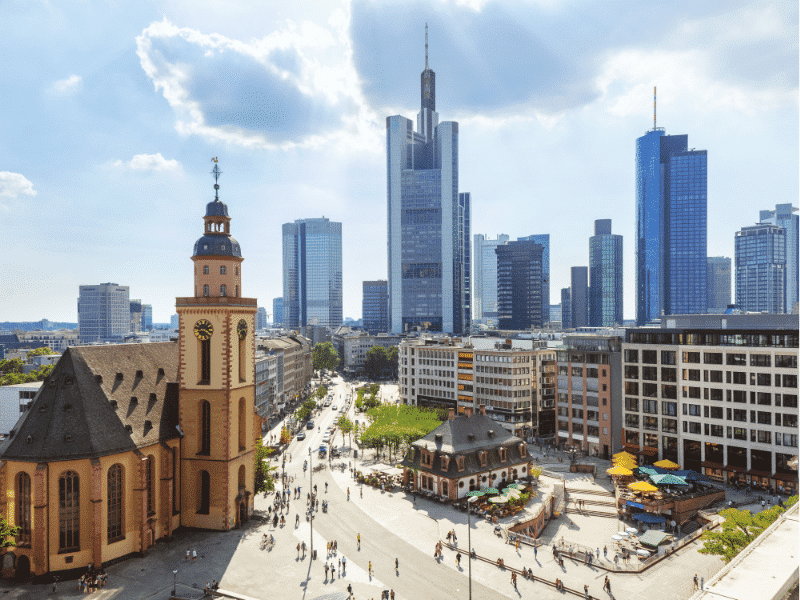
Frankfurt is two cities at once: a skyline of bank towers that earned it the nickname Mainhattan, and a far older city where German kings were elected and emperors crowned. Between the towers you still find half-timbered squares, apple-wine taverns and the house where Goethe was born. Here are the facts and stories behind it.
10 fun facts about Frankfurt
- Where kings were chosen: under the Golden Bull of 1356, the kings of the Romans were elected in Frankfurt, and from 1562 to 1792 emperors were also crowned here, in St Bartholomew's Cathedral.
- A town hall since 1405: the city council bought the house called Zum Römer in 1405, and the Römer has been Frankfurt's town hall ever since. Its Kaisersaal is lined with portraits of 52 rulers.
- Goethe's birthplace: Johann Wolfgang von Goethe was born on 28 August 1749 in a house on the Großer Hirschgraben. It was destroyed in 1944 and carefully rebuilt after the war.
- Germany's first parliament: in 1848 and 1849 the Frankfurt National Assembly, the first freely elected parliament for all of Germany, met in St Paul's Church.
- A new old town: air raids in March 1944 destroyed the medieval centre. Since 2018, a new quarter of 35 buildings stands between the cathedral and the Römer, and 15 of them are faithful reconstructions.
- Germany's tallest building: the Commerzbank Tower, completed in 1997, is 259 metres tall and is still the tallest building in the country.
- Justice with open eyes: the statue of Justitia on the fountain in front of the Römer holds her sword and scales but wears no blindfold.
- Anne Frank's home town: Anne Frank was born in Frankfurt on 12 June 1929. Her family left for Amsterdam after the Nazis came to power in 1933.
- Where the Rothschilds began: Mayer Amschel Rothschild built up his business in Frankfurt's Jewish lane, the Judengasse, in the 18th century. His five sons later ran banks in Frankfurt, London, Paris, Vienna and Naples.
- Struwwelpeter is from here: the Frankfurt doctor Heinrich Hoffmann wrote and drew Struwwelpeter as a Christmas present for his son. Published in 1845, it became one of the best-known German children's books.
The legend of the Frankish ford
Frankfurt means 'ford of the Franks', and a legend explains the name. Charlemagne, at war with the Saxons in the late 8th century, was chased to the bank of the river Main with his army and no way across. Then a deer stepped out of the forest and waded into the water, revealing a shallow ford just below the surface. Charlemagne followed it and reached safety on the other side, while the Saxons were left behind. The history is plainer but just as old: the city is first mentioned in writing in 794, when Charlemagne held a great church council here.
Sachsenhausen and apple wine, explained
Cross the Main on the Eiserner Steg, an iron footbridge from 1869, and you reach Sachsenhausen, home of Frankfurt's apple-wine taverns. Apfelwein, or Ebbelwoi in local dialect, is a dry, slightly sour cider served in a grey stoneware jug called a Bembel and drunk from a ribbed glass, the Geripptes. Taverns that press their own hang a wreath of pine branches over the door. Long shared tables are part of the experience, so expect to sit with strangers.
What to eat in Frankfurt
- Grüne Soße: a cold sauce of seven herbs, borage, chervil, cress, parsley, burnet, sorrel and chives, served with boiled eggs and potatoes. Its name has been protected by the EU since 2016.
- Handkäs mit Musik: a tangy sour-milk cheese marinated in oil, vinegar and onions. The 'music' is the onions.
- Frankfurter Würstchen: thin, smoked pork sausages, heated in water rather than grilled and eaten with mustard and bread.
- Rippchen mit Kraut: a cured, cooked pork chop with sauerkraut, a classic in the apple-wine taverns.
- Frankfurter Kranz: a ring-shaped sponge cake layered with buttercream and jam and coated in crunchy brittle, said to look like a crown.
Good to know before you go
- For the skyline from above, the Main Tower has a public viewing platform. Check before you go, as it closes in bad weather.
- The Museumsufer, a row of museums along the south bank of the Main, includes the Städel. In late August the Museumsuferfest fills the riverbanks.
- The Christmas market on the Römerberg is one of the oldest in Germany, and the old town gets very busy on Advent weekends.
- During big trade fairs, especially the book fair in October, hotel prices rise sharply. Heidelberg, Mainz and the Rhine valley are all easy day trips by train.
Explore Frankfurt with World City Trail
Our Frankfurt scavenger hunt turns these sights into a game you play on your phone. The route links 10 stops and takes around two hours, with about 24 minutes of walking, and leads you through the old centre around the Römerberg.
At each stop you solve a puzzle and hear a short story, at your own pace. You can start whenever you like.
Play the Frankfurt scavenger hunt →
Facts checked in October 2026.