
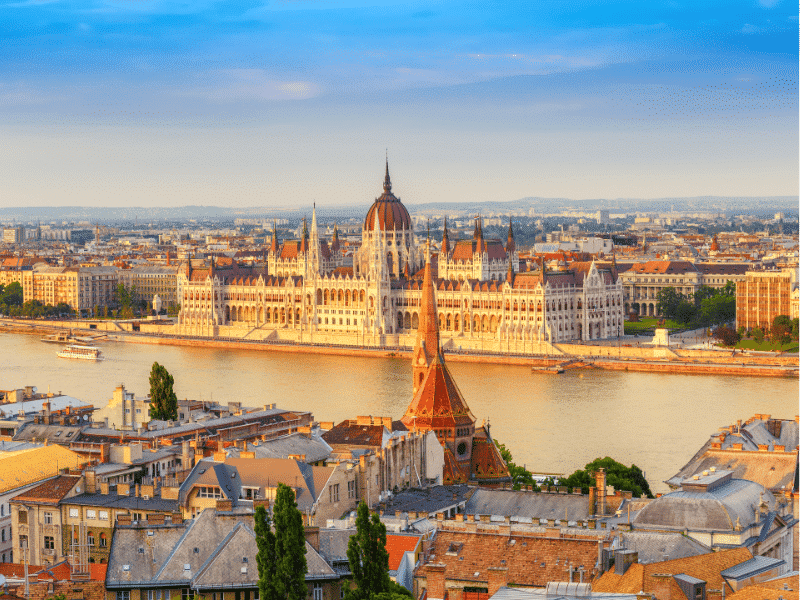
Budapest is two cities facing each other across the Danube: hilly Buda with its castle on one bank, flat and busy Pest with the Parliament on the other. Much of what you see was built in a rush of confidence around 1896, when Hungary celebrated a thousand years since the Magyars arrived. Here are the facts and stories that make the city special.
10 fun facts about Budapest
- A young capital made of three towns: Budapest only exists since 1873, when Buda, Óbuda and Pest were merged into one city.
- A number with a meaning: the dome of the Parliament is 96 metres high, a reference to the year 896, traditionally given as the arrival of the Magyars in the Carpathian Basin. St Stephen's Basilica has exactly the same height.
- The largest building in Hungary: the Parliament, designed by Imre Steindl, was finished in 1904. Since 2000 it has also kept the Holy Crown of Hungary, guarded under the central dome.
- A dome that fell in: during the construction of St Stephen's Basilica, the dome collapsed in 1868 and work had to start again. The church was only finished in 1905.
- A royal hand: the basilica's most precious relic is the Holy Right, the mummified right hand of Saint Stephen, Hungary's first king.
- The oldest metro on the European continent: the yellow Line 1, the Millennium Underground, opened in 1896 under Andrássy Avenue. Both are on the UNESCO World Heritage List.
- The first permanent bridge: the Chain Bridge opened in 1849 as the first permanent bridge across the Danube in the city. It was designed by the English engineer William Tierney Clark and built by the Scot Adam Clark, who gave his name to the square at its Buda end.
- The largest synagogue in Europe: the Dohány Street Synagogue, finished in 1859, is the largest synagogue in Europe and one of the largest in the world.
- A city of baths: Budapest sits on dozens of thermal springs, and the Széchenyi Bath, opened in 1913 in City Park, is one of the largest spa complexes in Europe, with outdoor pools you can use even in winter.
- A famous puzzle: Ernő Rubik, a Budapest architecture lecturer, invented the Rubik's Cube in 1974 to help his students think in three dimensions.
The lions of the Chain Bridge
Four stone lions guard the two ends of the Chain Bridge. They were carved by the sculptor János Marschalkó and put in place in 1852. Legend says that at the unveiling a boy shouted that the lions had no tongues, and the sculptor was so ashamed that he jumped into the Danube. In fact the lions do have tongues: they just cannot be seen from the pavement, because they lie flat in the mouths. And Marschalkó did not drown: he lived until 1877. The story is still told on every walking tour, and many visitors stop to look up into the lions' mouths.
Liberty Square, explained
Liberty Square was laid out on the site of a huge Habsburg barracks, where Lajos Batthyány, the first prime minister of Hungary, was executed in 1849. An eternal flame in his memory burns in a nearby street. Today the square tells much of the 20th century in one place: a Soviet war memorial from 1945 still stands at one end, close to the US Embassy, and a bronze statue of Ronald Reagan has walked across the square since 2011. The grand building with a temple front is the former Stock Exchange Palace, facing the Hungarian National Bank.
What to eat in Budapest
- Gulyás: in Hungary goulash is a soup of beef, paprika, potatoes and vegetables, first cooked by cattle herders in a kettle over the fire.
- Lángos: deep-fried dough topped with sour cream, grated cheese and garlic. Try it upstairs in the Great Market Hall, which opened in 1897.
- Dobos torte: a sponge cake layered with chocolate buttercream and topped with hard caramel, created by the confectioner József C. Dobos in 1885.
- Kürtőskalács: chimney cake, dough wrapped around a spit, baked over heat and rolled in sugar, cinnamon or walnuts.
- Pálinka: strong fruit brandy, most often made from apricots or plums, offered as a welcome or after a big meal.
Good to know before you go
- The Parliament can only be visited on guided tours. Book online ahead, as tours in some languages sell out quickly.
- Take tram 2 along the Pest embankment for one of the best views of the Parliament and Buda Castle, without paying for a cruise.
- Fisherman's Bastion, built between 1895 and 1902, has seven towers for the seven Magyar tribes. Go early in the morning to have its terraces almost to yourself.
- For a day trip, take the HÉV suburban train to Szentendre, a small baroque town on the Danube with galleries, churches and narrow lanes.
Explore Budapest with World City Trail
Our Budapest scavenger hunt turns these sights into a game you play on your phone. The route links 11 stops and takes around three hours, with about 64 minutes of walking, and passes the Hungarian Parliament, Liberty Square and St Stephen's Basilica, among others.
At each stop you solve a puzzle and hear a short story, at your own pace. You can start whenever you like.
Play the Budapest scavenger hunt →
Facts checked in October 2026.