
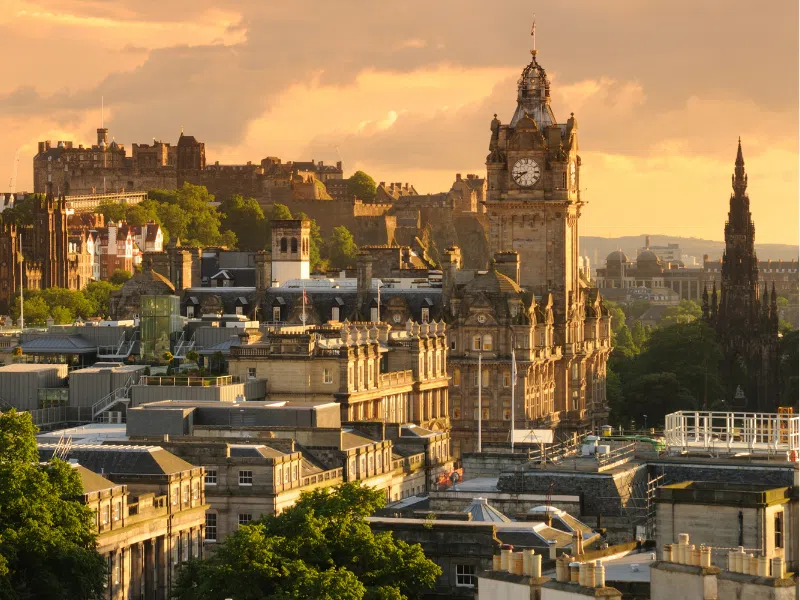
Edinburgh is a city built on volcanoes. A castle sits on one, a mountain-sized park rises from another, and between them a medieval Old Town faces a Georgian New Town across a valley of gardens and railway lines. Here are the facts and stories behind Scotland's capital.
10 fun facts about Edinburgh
- A Gothic rocket for a novelist: the Scott Monument on Princes Street, finished in 1844 and inaugurated in 1846, is about 61 metres tall, making it one of the largest monuments to a writer anywhere. A spiral of 287 steps leads to the top platform.
- A designer who never saw it finished: the monument's architect, George Meikle Kemp, was self-taught and entered the competition under the pseudonym John Morvo. He drowned in the Union Canal on a foggy evening in March 1844, months before the spire was completed.
- A writer and his dog: under the monument's canopy sits a statue of Sir Walter Scott in white Carrara marble by John Steell, with his deerhound Maida lying at his side.
- A station named after a book: Waverley, Edinburgh's main railway station, takes its name from Scott's Waverley novels.
- A gallery with a queen on the roof: the Royal Scottish Academy building on the Mound was designed by William Henry Playfair and built between 1822 and 1826 as the Royal Institution. A statue of Queen Victoria by John Steell crowns its north portico.
- A castle on a volcano: Edinburgh Castle stands on Castle Rock, the plug of an extinct volcano. Its oldest building, the small St Margaret's Chapel from the 12th century, is also the oldest surviving building in the city.
- A gun that tells the time: since 1861 the One O'Clock Gun has been fired from the castle every day except Sundays, Good Friday and Christmas Day. It was a time signal for ships in the Firth of Forth.
- Two towns, one World Heritage Site: the medieval Old Town and the Georgian New Town, planned by James Craig after he won a competition in 1766, were listed together by UNESCO in 1995.
- A festival that started uninvited: in 1947 eight theatre groups turned up at the first Edinburgh International Festival without an invitation and performed anyway. Their fringe event grew into the Edinburgh Festival Fringe, today the largest arts festival in the world.
- A mountain in the middle of town: Arthur's Seat, another extinct volcano, rises to 251 metres in Holyrood Park, a short walk from the Royal Mile.
The story of Greyfriars Bobby
Edinburgh's most famous dog was a Skye terrier called Bobby. When his owner, a police night watchman named John Gray, died in 1858 and was buried in Greyfriars Kirkyard, the story goes that Bobby refused to leave the grave and kept watch there for 14 years. Bobby died in 1872, and a year later a small bronze statue of him was set up at the corner of Candlemaker Row. Some historians doubt parts of the tale, but the statue's nose has been rubbed shiny by visitors, and his own grave lies just inside the kirkyard gate.
The Royal Mile, explained
The Royal Mile is the chain of streets that runs down the ridge from Edinburgh Castle to the Palace of Holyroodhouse, the King's official residence in Scotland. It is roughly one Scots mile long, a little longer than an English mile. On both sides, narrow alleys called closes and wynds lead off between tall stone tenements. At the bottom, opposite the palace, stands the Scottish Parliament building by Enric Miralles, opened in 2004.
What to eat in Edinburgh
- Haggis, neeps and tatties: spiced sheep's offal with oatmeal, served with mashed turnip and potato. It is the centre of every Burns Supper on 25 January.
- Cullen skink: a thick, creamy soup of smoked haddock, potato and onion from the north-east coast, perfect on a cold day.
- Cranachan: a dessert of whipped cream, raspberries, honey, toasted oats and a splash of whisky.
- Shortbread and tablet: buttery biscuits and a crumbly, very sweet fudge.
- Whisky: Edinburgh has whisky bars with hundreds of bottles, so ask for a dram from a region you have not tried yet.
Good to know before you go
- Book Edinburgh Castle tickets online in advance, especially in summer. Arrive before one o'clock if you want to see the gun fired.
- In August the city hosts the Fringe and several other festivals at once. Accommodation fills up months ahead.
- The staircase in the Scott Monument is narrow and steep, and the upper galleries are tight, so it is not ideal if you dislike small spaces.
- For a classic view over the city without a long climb, walk up Calton Hill at the east end of Princes Street, ideally around sunset.
Explore Edinburgh with World City Trail
Our Edinburgh scavenger hunt turns these sights into a game you play on your phone. The route links 10 stops and takes around three hours, with about 56 minutes of walking. Along the way you visit the Scott Monument and the Royal Scottish Academy.
At each stop you solve a puzzle and hear a short story, at your own pace. You can start whenever you like and play in English, German, French, Italian, Spanish or Dutch.
Play the Edinburgh scavenger hunt →
Facts checked in October 2026.