
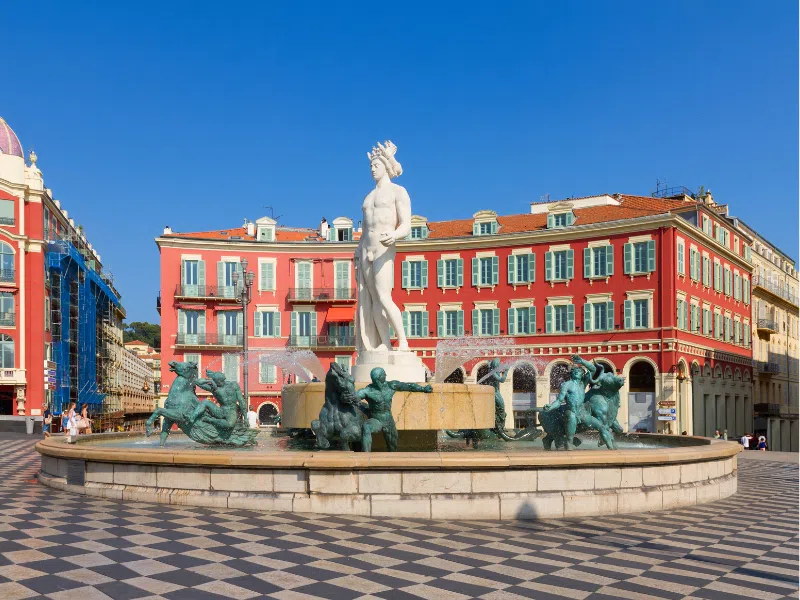
Nice has been French only since 1860, and you can tell: the ochre and pink houses of the old town, the local dialect and the food owe as much to Italy as to France. Add the long curve of the Baie des Anges and the painters who came for the light, and you have the largest city on the French Riviera. Here are the facts and stories that make the city special.
10 fun facts about Nice
- A Greek name: Greek settlers from Massalia, today's Marseille, founded a trading post here and called it Nikaia, a name usually linked to Nike, the goddess of victory.
- French only since 1860: for most of the period from 1388 to 1860 Nice belonged to the House of Savoy. It became French in 1860 under the Treaty of Turin, confirmed by a vote.
- Garibaldi was born here: Giuseppe Garibaldi, hero of Italian unification, was born in Nice in 1807 and opposed its handover to France.
- A promenade named after the English: in the 1820s English winter residents, including the Reverend Lewis Way, paid for a seafront path. Locals called it the Camin deis Anglés, the English Way, and today the Promenade des Anglais runs about seven kilometres along the bay.
- A castle hill without a castle: the fortress on the Colline du Château was taken by French troops in 1705 and destroyed on Louis XIV's orders in 1706. Today the hill is a park with one of the best views of the city.
- Flowers as weapons: the Nice Carnival, held every February, includes the Battle of Flowers, a parade first held in 1876 in which performers throw flowers to the crowd.
- Matisse's city: Henri Matisse lived in Nice from 1917 until his death in 1954. He is buried in Cimiez, close to the museum dedicated to his work.
- A museum opened in the artist's lifetime: the Marc Chagall National Museum in Cimiez opened in 1973, while Chagall was still alive and working.
- A pink dome on the seafront: the Hotel Negresco, with its pink-domed corner tower, opened in 1913 and is one of the landmarks of the Promenade des Anglais.
- A World Heritage winter resort: since 2021 Nice has been on UNESCO's World Heritage List as the Winter Resort Town of the Riviera, shaped by the winter visitors who came from the 18th century on.
The legend of Catherine Ségurane
In the summer of 1543, Nice, then part of Savoy, was besieged by an Ottoman fleet allied with King Francis I of France. According to legend, as the attackers broke through, a washerwoman named Catherine Ségurane charged them with her laundry beater, knocked down a standard-bearer and seized his flag, rallying the townspeople. No chronicler of the siege mentions her, and she may never have existed, but Nice celebrates her every 25 November, and a bas-relief from 1923 marks the supposed spot of her exploit in the old town.
The Baie des Anges and Vieux Nice
The bay's name has two explanations. Christian tradition says angels guided the boat carrying the body of Saint Reparata, a young martyr, to these shores; she became the city's patron saint, and the Baroque cathedral of Vieux Nice bears her name. Fishermen had a plainer story: they named the bay after the angel sharks once caught in its waters. Around the cathedral, the old town is a web of narrow lanes that opens onto the Cours Saleya and its market.
What to eat in Nice
- Socca: a thin, crispy chickpea pancake cooked on huge round pans and eaten hot with black pepper.
- Salade niçoise: tomatoes, eggs, olives, anchovies or tuna and raw vegetables. Purists leave out cooked potatoes and green beans.
- Pan bagnat: a round bread roll soaked in olive oil and filled with the ingredients of a salade niçoise.
- Pissaladière: an onion tart topped with anchovies and black olives.
- Tourte de blettes: a Swiss chard pie made sweet, with raisins and pine nuts.
Good to know before you go
- The flower and food market on the Cours Saleya runs most mornings; on Mondays it makes way for an antiques market.
- Climb or take the lift up Castle Hill for the classic view over the Baie des Anges and the old town's rooftops.
- The beaches are pebbles, not sand, so water shoes or a thick towel make a difference.
- Villefranche-sur-Mer, Èze and Monaco are a short train or bus ride along the coast, and the Matisse and Chagall museums are a bus ride up to Cimiez.
Explore Nice with World City Trail
Our Nice scavenger hunt turns these sights into a game you play on your phone. The route leads through the old town and the centre's main sights and takes around two hours, with about 35 minutes of walking.
At each stop you solve a puzzle and hear a short story, at your own pace. You can start whenever you like.
Play the Nice scavenger hunt →
Facts checked in October 2026.