
Thessaloniki has been an important city for more than 2,300 years, and you can see all of them at once: Roman arches stand next to Byzantine churches, Ottoman baths and a waterfront rebuilt after a great fire. Greece's second city is also a university town with a serious love of food. Here are the facts and stories that make it special.
10 fun facts about Thessaloniki
- Named after a princess: King Cassander founded the city in 315 BC and named it after his wife, Thessalonike, a half-sister of Alexander the Great.
- Fifteen monuments, one listing: the city's Early Christian and Byzantine monuments, from the Rotunda to small chapels, were added to UNESCO's World Heritage List together in 1988.
- A Roman building with many lives: the Rotunda was built around 300 AD under the emperor Galerius, then became a church, a mosque and a church again. Its Ottoman minaret still stands beside it.
- An arch for a victory: the Arch of Galerius, known as Kamara, celebrated the emperor's victory over the Persians, and its carved reliefs still show the battles. Today it is the city's favourite meeting point.
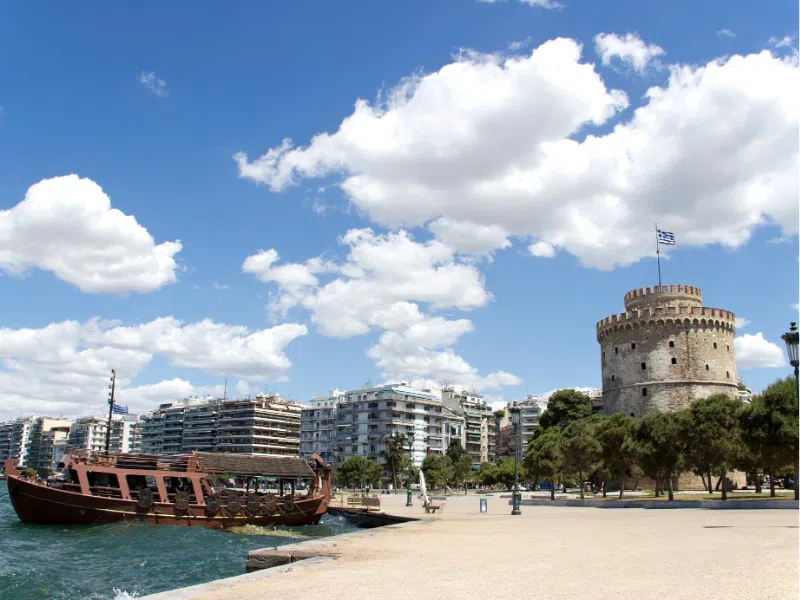
- The White Tower was once the Red Tower: under the Ottomans, the tower on the waterfront was a prison known as the Tower of Blood. A popular story says a prisoner whitewashed it in exchange for his freedom.
- A fire that redrew the map: in August 1917 a fire destroyed much of the city centre. The French architect Ernest Hébrard drew up a new plan, including the grand axis of Aristotelous Square leading down to the sea.
- A Sephardic city: after the Jews were expelled from Spain in 1492, many settled here, and for centuries Thessaloniki was one of the great Jewish cities of Europe. In 1943 around 50,000 of its Jews were deported, most of them to Auschwitz.
- Atatürk's birthplace: Mustafa Kemal Atatürk, the founder of modern Turkey, was born here in 1881. His family's house is now a museum next to the Turkish consulate.
- A fortress that was a prison until 1989: the Heptapyrgion, also called Yedi Kule, at the top of the upper town, held prisoners until 1989.
- Umbrellas by the sea: George Zongolopoulos's sculpture Umbrellas, on the waterfront east of the White Tower, went up in 1997, when Thessaloniki was European Capital of Culture.
Saint Demetrius, the city's protector
Demetrius was a Roman officer in Thessaloniki who, according to tradition, was martyred for his Christian faith around 306 AD, under Galerius. A church was built over the place of his death, and the crypt of today's Basilica of Agios Dimitrios stands on the remains of Roman baths where he is said to have been held. For centuries the people of Thessaloniki believed that Demetrius defended the city in person during sieges, and icons often show him as a soldier on horseback. The basilica burned in the fire of 1917 and was rebuilt around what survived. His feast day, 26 October, is also the anniversary of the city's liberation in 1912.
Ano Poli, the upper town
Ano Poli is the hillside quarter that the 1917 fire did not reach, so it keeps the steep lanes and timber-framed houses of Ottoman Thessaloniki. Long stretches of the old city walls still run along its edge, and the Vlatadon Monastery and the Heptapyrgion stand near the top. The views over the rooftops to the Thermaic Gulf are best in the late afternoon.
What to eat in Thessaloniki
- Bougatsa: filo pastry filled with semolina custard, cheese or minced meat. The sweet version comes with icing sugar and cinnamon and is the city's classic breakfast.
- Koulouri Thessalonikis: a sesame-covered bread ring sold from street stalls all day long.
- Trigona Panoramatos: crisp filo triangles soaked in syrup and filled with cream, named after the suburb of Panorama.
- Mussels: the Thermaic Gulf is known for its mussel farms, and you will find them steamed, fried or cooked in pilaf.
- Meze and tsipouro: small shared plates at an ouzeri, with tsipouro, the grape spirit of northern Greece.
Good to know before you go
- The Archaeological Museum and the Museum of Byzantine Culture are neighbours, which makes them an easy pair for a rainy day.
- Vergina, with the royal tombs of the ancient Macedonian kings, is an easy day trip, about an hour's drive away.
- On a clear day you can see Mount Olympus across the gulf from the waterfront.
- Dress modestly in churches and avoid wandering around during services.
Explore Thessaloniki with World City Trail
Our Thessaloniki scavenger hunt turns these sights into a game you play on your phone. The route links 10 stops and takes around two hours, with about 53 minutes of walking, and includes the Rotunda and the Church of Agios Dimitrios.
At each stop you solve a puzzle and hear a short story, at your own pace. You can start whenever you like and play in English, German, French, Italian or Greek.
Play the Thessaloniki scavenger hunt →
Facts checked in October 2026.