
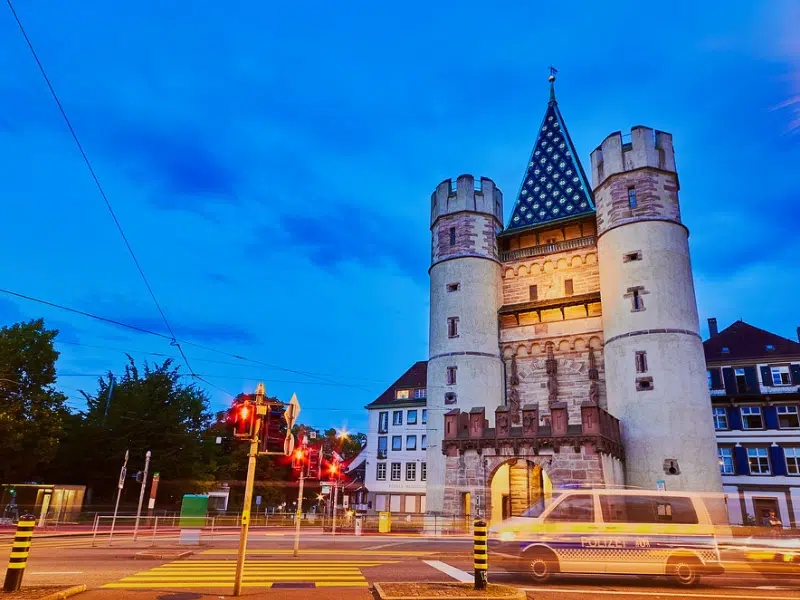
The Spalentor is the grandest of Basel's three surviving medieval city gates, a square tower with a steep roof of coloured glazed tiles flanked by two round towers. Built around 1398 on the road to Alsace, it was the city's most important entrance, and a Madonna with two prophets has watched over travellers from its façade since about 1400.
The Spalentor at a glance
- Where: at the western end of the Spalenvorstadt, on the edge of Basel's old town, next to the university's botanical garden.
- Built: around 1398 as part of the city's outer wall; reinforced with a forework during the Burgundian Wars of 1474–1477.
- What it is today: a protected monument and one of only three gates left from Basel's walls, with traffic passing beside it.
- Time needed: 10 to 15 minutes to walk through and look at both sides.
Gateway to Alsace
In the 14th century Basel built a new, wider ring of walls around its growing suburbs, and the Spalentor guarded the main road west towards Alsace and France. Goods, pilgrims and armies entered the city here, which is why it was given the most elaborate decoration of all the gates. In the 1470s, when Basel was caught up in the wars against Charles the Bold of Burgundy, the gate was strengthened with an outer forework.
In the 19th century Basel, like many European cities, pulled down most of its walls to make room for growth and traffic. The Spalentor survived, together with the St. Alban and St. Johann gates, and became a symbol of the old city. In the early 1930s the original sandstone figures on the façade were replaced with copies, and the originals went to the Historical Museum Basel.
What to look for
- The steep roof covered in green and yellow glazed tiles laid in patterns, a typical Upper Rhine detail.
- The two round towers with battlements on either side of the main tower.
- The Madonna and two prophets on the outer façade, copies of red sandstone figures from around 1400.
- The deep passage through the gate, where you can feel how heavy the defences were.
- The forework on the outer side, added during the Burgundian Wars.
Figures that survived the Reformation
In 1529, during the Reformation, crowds in Basel smashed religious images in the churches. The Madonna and prophets on the Spalentor survived, perhaps because they were part of a civic building rather than a church. Today the originals, carved in red sandstone around 1400, can be seen at the Historical Museum Basel, while the copies on the gate keep watch over the road as before.
Tips for your visit
- Look at the gate from the outer side first to see the figures and the forework, then walk through to the town side.
- Morning light falls well on the outer façade for photos.
- Watch out for trams and traffic around the gate; cross at the marked crossings.
- Combine it with a walk down the Spalenvorstadt into the old town, with its fountains and old houses.
Nearby
- Botanical Garden of the University of Basel: one of the oldest botanical gardens in Switzerland, right next to the gate.
- Spalenvorstadt: a street of old houses leading from the gate into the old town.
- Petersplatz: a large tree-shaded square by the university, a few minutes' walk away.
- Marktplatz and Town Hall: Basel's red town hall on the market square, about 15 minutes' walk east.
See Basel with World City Trail
Our Basel scavenger hunt turns the old town into a game you play on your phone. The route links 10 stops and takes around three hours, with about 44 minutes of walking, and it includes places such as the Strassburger Denkmal, the Offene Kirche Elisabethen and Basel Minster. You can play in English, German, French, Italian, Spanish or Chinese.
If you prefer a different format, Basel also has a self-guided walking tour and an outdoor escape game.
Play the Basel scavenger hunt →
Take the self-guided walking tour of Basel →
Play the outdoor escape game in Basel →
Facts checked in October 2026.