
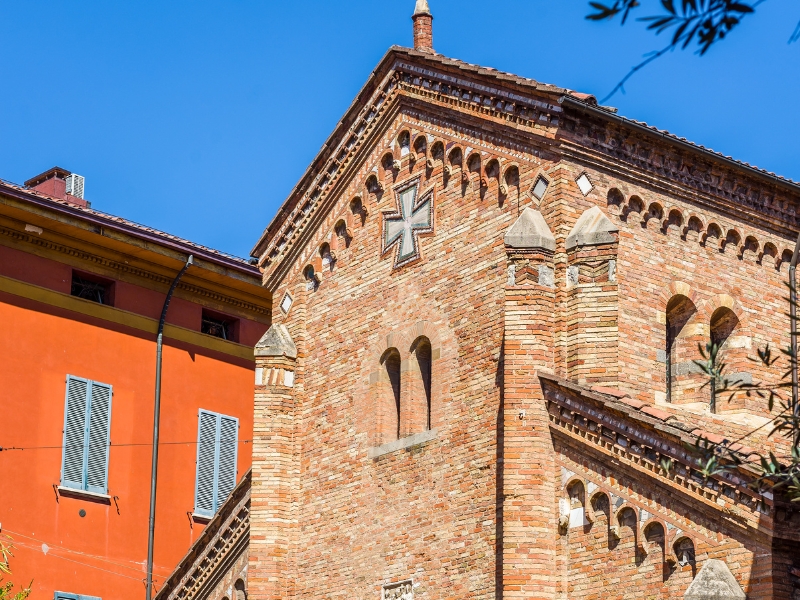
The Basilica of Saints Vitale and Agricola is one of the churches that make up the Santo Stefano complex in Bologna, known locally as the Seven Churches. It is considered the oldest part of the complex, built for the city's first two martyrs, and for about 70 years in the 15th century it was completely filled with earth on the orders of a pope.
Saints Vitale and Agricola at a glance
- Where: inside the Santo Stefano complex on Piazza Santo Stefano, a few minutes' walk south-east of the Two Towers.
- Built: early Christian origins; rebuilt in Romanesque form in the 12th century, with a 19th-century neo-Romanesque facade.
- What it is today: a church within the basilica of Santo Stefano, open to visitors along with the rest of the complex.
- Dedicated to: Vitale and Agricola, a servant and his master, martyred in Bologna in the early 4th century.
- Time needed: 15 minutes for this church; about an hour for the whole complex.
Martyrs, a false rumour and a buried church
According to tradition, Vitale was a servant and Agricola his master, both killed for their faith during the persecutions under Emperor Diocletian; Agricola was crucified. In 392–393 their remains were found in a Jewish cemetery, and Saint Ambrose of Milan took part in their solemn reburial, which made Bologna's martyrs known well beyond the city. A church was built for the relics on this site, which is why this building is seen as the oldest part of the Santo Stefano complex.
Its strangest episode came in the early 15th century. A Christian tomb inscribed with the name Symon was found here, and a rumour spread that it held Saint Peter. Pilgrims started coming to Bologna instead of Rome, so Pope Eugene IV had the church filled with earth to stop it. It stayed buried for about 70 years, until Giuliano della Rovere, then bishop of Bologna and later Pope Julius II, had it dug out and reopened; an inscription by the side door records this.
What to look for
- The plain Romanesque nave with its three apses at the end, very different from the decorated churches elsewhere in the city.
- Two early medieval sarcophagi in the side apses, traditionally linked to the two saints, carved with lions, deer and peacocks.
- Remains of a Roman mosaic floor, visible under glass.
- The main altar, an ancient pagan altar reused and turned around for Christian worship.
- The inscription by the side door recording the church's reopening after it had been filled with earth.
A Jerusalem in Bologna
Local tradition says Saint Petronius, Bologna's 5th-century bishop, built the Santo Stefano complex to recall the holy places of Jerusalem, over a temple of Isis. Historians treat this as legend, but the Jerusalem idea is visible all around: next door are a copy of the Holy Sepulchre and the courtyard called Pilate's Courtyard, with a stone basin from the 8th century that people still call Pilate's Basin.
Tips for your visit
- Enter from Piazza Santo Stefano and follow the route through the linked churches, which open into one another.
- Come early or late in the day for a quieter visit, and check opening times, as services take priority.
- Dress respectfully and keep your voice down: these are working churches.
- After your visit, sit on the triangular Piazza Santo Stefano to look at the facades of the complex together.
Nearby
- The Two Towers: Bologna's medieval leaning towers, Asinelli and Garisenda, a few minutes' walk away; the Garisenda has been fenced off for safety works since 2023.
- Basilica of San Petronio: the vast church on Piazza Maggiore, with its unfinished facade.
- The Archiginnasio: the old seat of the university, with its wooden anatomical theatre.
- The Quadrilatero: the narrow market streets off Piazza Maggiore, good for a food stop.
See Bologna with World City Trail
Our Bologna scavenger hunt turns the old town into a game you play on your phone. The route links 10 stops and takes around two hours, with about 33 minutes of walking. It includes places such as the Two Towers and the Biblioteca Salaborsa.
If you prefer a different format, Bologna also has a self-guided walking tour and an outdoor escape game.
Play the Bologna scavenger hunt →
Take the self-guided walking tour of Bologna →
Play the outdoor escape game in Bologna →
Facts checked in October 2026.