
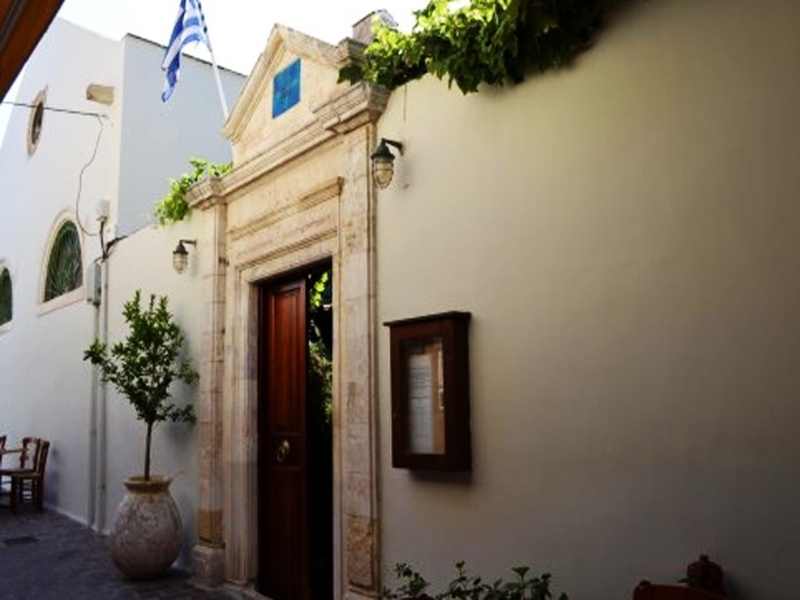
Etz Hayyim, Hebrew for Tree of Life, is the only surviving synagogue on Crete, tucked into a lane in the old Jewish quarter of Chania. It stood empty and in ruins after the city's Jewish community was destroyed in 1944, and was restored in the late 1990s as a place of prayer, memory and reconciliation that welcomes visitors of every faith.
Etz Hayyim at a glance
- Where: in a small alley off Kondylaki Street, in Evraiki, the former Jewish quarter of Chania's old town, a few minutes from the Venetian harbour.
- Built: the site was a 15th-century Catholic church; converted into a synagogue in the Venetian period (16th–17th century); reopened after restoration on 10 October 1999.
- What it is today: an active synagogue with Shabbat services, a memorial to Chania's lost Jewish community and a research library.
- Restored by: a campaign led by Nikos Stavroulakis, then director of the Jewish Museum of Greece.
- Time needed: 20–30 minutes.
From Venetian church to a synagogue reborn
The building began as a Catholic church in the 15th century, probably dedicated to Saint Catherine, and was badly damaged during the Ottoman attacks on the city in the 16th century. The Venetians then gave or sold it to the Jewish community, which turned it into a synagogue in the Romaniote tradition, the Greek-speaking Jewish community that had lived in the region since antiquity. For centuries it served Chania's Jews, alongside a second synagogue nearby, Beth Shalom, which was destroyed in the bombing of 1941.
In 1944 the German occupiers rounded up the Jews of Chania. They were shipped out on the freighter Tanais, together with Greek resistance fighters and Italian prisoners, and on 9 June 1944 the ship was torpedoed by a British submarine off Santorini. No one survived. The synagogue was then used as a store, a dump and a stable, and an earthquake in 1994 left it close to collapse. Nikos Stavroulakis raised funds internationally, restoration began in 1997, and Etz Hayyim reopened in 1999. In January 2010 two arson attacks destroyed some 2,500 books and parts of the archive, but the synagogue was repaired and carries on.
What to look for
- The plaque in the hallway listing the names of the Jews of Chania who died in 1944.
- The layout inside: a single vaulted hall with the Torah ark on the east wall and the reading platform facing it on the west wall, the Romaniote arrangement also found in Ioannina and Corfu.
- The southern courtyard with the mikveh, the ritual bath, and the graves of four rabbis.
- The northern courtyard with its fountain, rebuilt in 1995.
- The narrow lanes of Evraiki around it, which still follow the street plan of the old Jewish quarter.
A synagogue cared for by many
Today only a handful of Jews live on Crete, and most of the people who look after Etz Hayyim are not Jewish. An international team and volunteers keep it open, rabbis from Athens help at the high holidays, and services are held in Hebrew, Greek and English. Every year a memorial service remembers the people lost on the Tanais. The synagogue sees itself as a place for everyone, and visitors of all backgrounds are welcome.
Tips for your visit
- Opening times are limited and change around services and Jewish holidays; check before you go.
- Dress modestly, follow the guidance of the volunteers, and ask before taking photos of people.
- Take time over the memorial plaque and the courtyards rather than rushing through.
- Combine it with a walk along the harbour and through the lanes of the old town, which begin just outside.
Nearby
- Venetian harbour: Chania's crescent-shaped harbour with its lighthouse, a few minutes' walk away.
- Mosque of the Janissaries: the 17th-century domed mosque on the harbourfront, now used for exhibitions.
- Firkas Fortress: the Venetian bastion at the harbour entrance, home to the Maritime Museum of Crete.
- Topanas: the old Venetian quarter west of the harbour, with mansions, archways and steep lanes.
See Chania with World City Trail
Our Chania scavenger hunt turns the old town into a game you play on your phone. The route links 10 stops and takes around two hours, with about 42 minutes of walking. It includes places such as the Venetian harbour and the alleys of the old town. You can play in English, German, French, Italian, Dutch and Greek.
If you prefer a different format, Chania also has a self-guided walking tour and an outdoor escape game.
Play the Chania scavenger hunt →
Take the self-guided walking tour of Chania →
Play the outdoor escape game in Chania →
Facts checked in October 2026.