
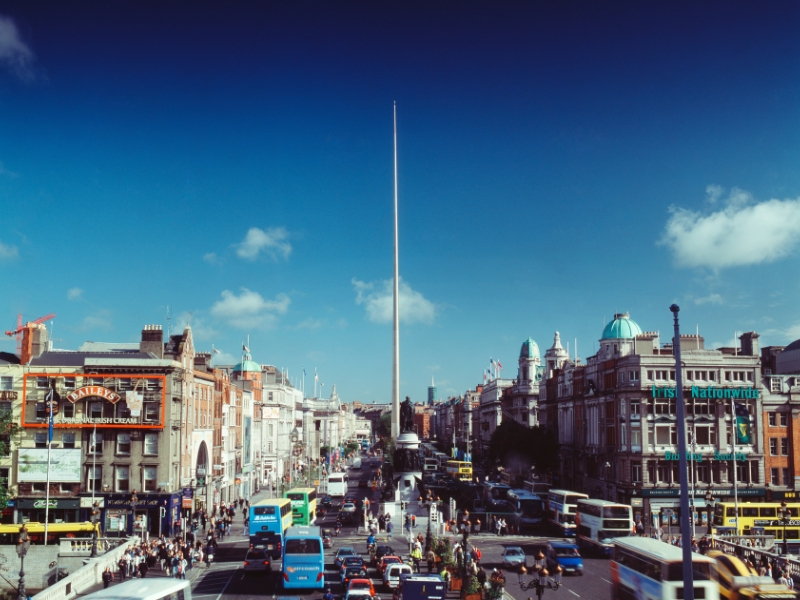
The Spire of Dublin is a stainless steel needle 120 metres tall in the middle of O'Connell Street, the city's main thoroughfare. Officially called the Monument of Light, it was put up in 2003 on the spot where Nelson's Pillar stood until it was blown up in 1966. It is 3 metres wide at the base and only 15 centimetres at the tip, which glows with LED lights after dark.
The Spire at a glance
- Where: in the centre of O'Connell Street, opposite the General Post Office, at the junction with Henry Street and North Earl Street.
- Built: the first section went up in December 2002 and the monument was completed in January 2003.
- By: designed by the architect Ian Ritchie of Ian Ritchie Architects, chosen from 205 entries in an international competition.
- What it is today: a monument and a meeting point in the city centre, often called simply the Spire or the Spike.
- Time needed: 10 minutes; longer if you combine it with the GPO across the street.
From Nelson's Pillar to the Monument of Light
For more than 150 years this spot was occupied by Nelson's Pillar, a column topped by a statue of the British admiral. In March 1966, around the 50th anniversary of the Easter Rising, a bomb planted by former IRA members destroyed the upper part, and the Irish army demolished the rest days later. The site stayed empty for years; in 1988 a fountain-sculpture of Anna Livia, the spirit of the river Liffey, was placed nearby for the Dublin Millennium celebrations.
In the late 1990s the city launched a plan to revive O'Connell Street, which had become rundown, with wider pavements, fewer traffic lanes and new paving. The centrepiece was to be a new monument for the millennium, and in 1998 Ian Ritchie's design won the competition. Legal challenges and an environmental impact study delayed it beyond 2000, so it was finally erected in 2002–2003, made in eight hollow steel sections by Radley Engineering in Dungarvan, County Waterford.
What to look for
- The surface of the steel: it was shot-peened, a treatment that changes how it reflects light, so the Spire looks different in sun, rain and dusk.
- The pattern around the lower 10 metres, inspired by a core sample of the rock under the site and by the DNA double helix.
- The tip at night: the top 10 metres are lit through nearly 12,000 small holes with LEDs shining through.
- The way it narrows from 3 metres at the base to 15 centimetres at the top, which makes it look even taller from street level.
- The General Post Office across the street, headquarters of the 1916 Easter Rising, with bullet marks still visible on its columns.
Dublin's nicknames
Like much public art in Dublin, the Spire quickly collected nicknames. Some of the best known are the Spike, the Stiletto in the Ghetto and the Stiffy by the Liffey. Many people disliked it at first, saying it had no link to the city's history; supporters compared it to the Eiffel Tower, which also had its critics. Two tuned mass dampers inside one of the steel sections, designed by the engineers Arup, keep it from swaying too much in the wind.
Tips for your visit
- Look at it from the south end of O'Connell Street, near O'Connell Bridge, to see it rising above the whole street.
- Come back at dusk, when the base is lit and the tip begins to glow.
- It is a busy junction: stand on the pedestrian plaza or the wide central island rather than in the road for photos.
- Combine it with a visit to the GPO, then walk down to the river Liffey and the Ha'penny Bridge.
Nearby
- General Post Office (GPO): the 1916 Rising headquarters, with an exhibition on the Rising, right opposite the Spire.
- James Joyce statue: a bronze of the writer with his cane on North Earl Street, a minute's walk away.
- O'Connell Monument and O'Connell Bridge: the statue of Daniel O'Connell at the south end of the street, by the river.
- Ha'penny Bridge: the 19th-century cast-iron footbridge over the Liffey, a few minutes' walk south-west.
See Dublin with World City Trail
Our Dublin scavenger hunt turns the city into a game you play on your phone. The route links 10 stops and takes around three hours, with about 59 minutes of walking. It includes places such as St Patrick's Cathedral, Christ Church Cathedral and Dublin Castle.
If you prefer a different format, Dublin also has a self-guided walking tour and an outdoor escape game.
Play the Dublin scavenger hunt →
Take the self-guided walking tour of Dublin →
Play the outdoor escape game in Dublin →
Facts checked in October 2026.