
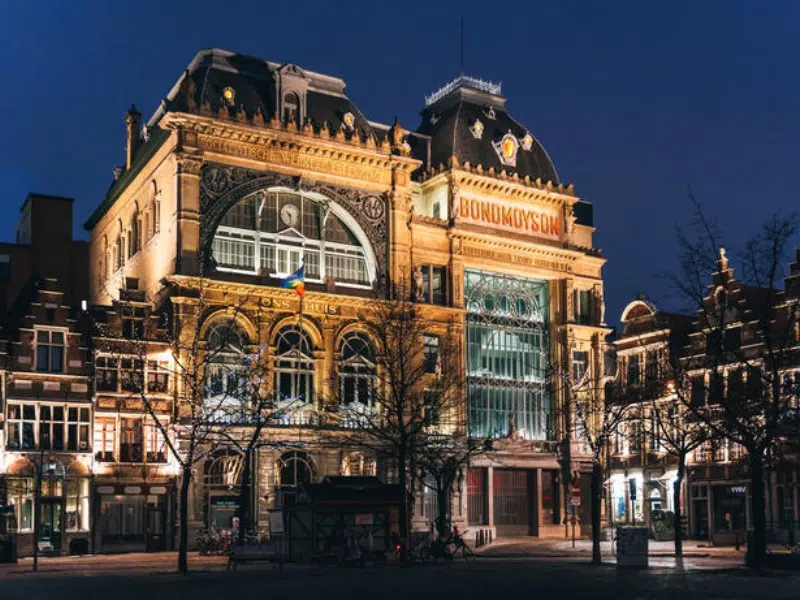
The Vrijdagmarkt, or Friday Market, is one of the oldest and largest squares in Ghent, a short walk north of the Belfry. It takes its name from the market that has filled it on Friday mornings since 1199, and it was here, in 1340, that the Ghent leader Jacob van Artevelde proclaimed the English king Edward III king of France.
The Vrijdagmarkt at a glance
- Where: in the historic centre of Ghent, between the Gravensteen area, St Jacob's Church and the river Leie.
- Created: a market square since at least the late 12th century; the Friday market dates back to 1199.
- Size: roughly 100 by 100 metres, one of the largest public squares in the city.
- What it is today: a busy square lined with guildhouses, cafés and terraces, with a market on Friday mornings and a car park underneath.
- Time needed: 15 to 30 minutes to look around, longer if you visit the market or sit down for a beer.
A square where Flemish history was made
For centuries the Vrijdagmarkt was Ghent's main stage for public life. The counts of Flanders were welcomed here, the guilds gathered here, and political conflicts were fought out here. Its most famous moment came on 26 January 1340, when Jacob van Artevelde, the cloth merchant who led Ghent at the time, proclaimed Edward III of England king of France on this square. It was the first formal declaration of Edward's claim to the French crown, at the start of the Hundred Years' War. Van Artevelde sided with England because Ghent's cloth industry depended on English wool. In 1345 he was killed in a riot.
The square changed with the city. Many of the guildhouses around it were rebuilt or restored in the 19th century, and around 1900 Ghent's socialist movement put up its headquarters in the northern corner. The two buildings of Ons Huis, the socialist people's house, were designed by the architect Ferdinand Dierkens and completed between 1899 and 1902. They still belong to the labour movement and house trade union and health insurance offices.
What to look for
- The Jacob van Artevelde statue in the middle of the square, unveiled in 1863 and made by the Ghent sculptor Pieter De Vigne. Artevelde stands with his arm stretched out, as if addressing the crowd.
- The pedestal of the statue, decorated with the coats of arms of Ghent's old guilds and trades: look for the tools and symbols of each craft.
- Het Toreken, the narrow house with a small corner tower on the square. It dates from the 15th century and belonged to the tanners' guild, which made it one of the oldest buildings here.
- Ons Huis in the northern corner: blue stone, cast iron and large windows in an eclectic style with strong Art Nouveau touches, a contrast to the gabled guildhouses.
- The rows of guildhouses with their stepped and bell-shaped gables, now mostly cafés and restaurants with terraces on the square.
Market days
The Friday morning market is still held here: bread, cheese, fish, fruit, vegetables and household goods, much as the name promises. On Saturday there is usually a market too. If you can, come on a Friday morning to see the square doing the job it was named for, then return later in the day when the terraces fill up.
Tips for your visit
- Come on Friday morning for the market, or in the late afternoon when the cafés on the square are at their liveliest.
- Stand on the north side to get the statue, the Toreken and the line of guildhouses in one view.
- Ghent is known for its beer cafés, and several of them are on or just off this square; it is a good place to try a local beer.
- Combine the square with the Gravensteen and the Patershol district, both a few minutes' walk away.
Nearby
- Dulle Griet: the giant red iron cannon from the 15th century lies just off the square, on the corner towards the Leie.
- St Jacob's Church: a Romanesque and Gothic church a few minutes' walk east, with a weekend flea market on the square around it.
- Gravensteen: the castle of the counts of Flanders, with moat and battlements, a short walk west across the Leie.
See Ghent with World City Trail
Our Ghent scavenger hunt turns the old town into a game you play on your phone. The route links 11 stops and takes around 3 hours, with about 30 minutes of walking. It includes St Michael's Church, St Michael's Bridge, the Belfry and St Bavo's Cathedral.
If you prefer a different format, Ghent also has a self-guided walking tour and an outdoor escape game.
Play the Ghent scavenger hunt →
Take the self-guided walking tour of Ghent →
Play the outdoor escape game in Ghent →
Facts checked in October 2026.