
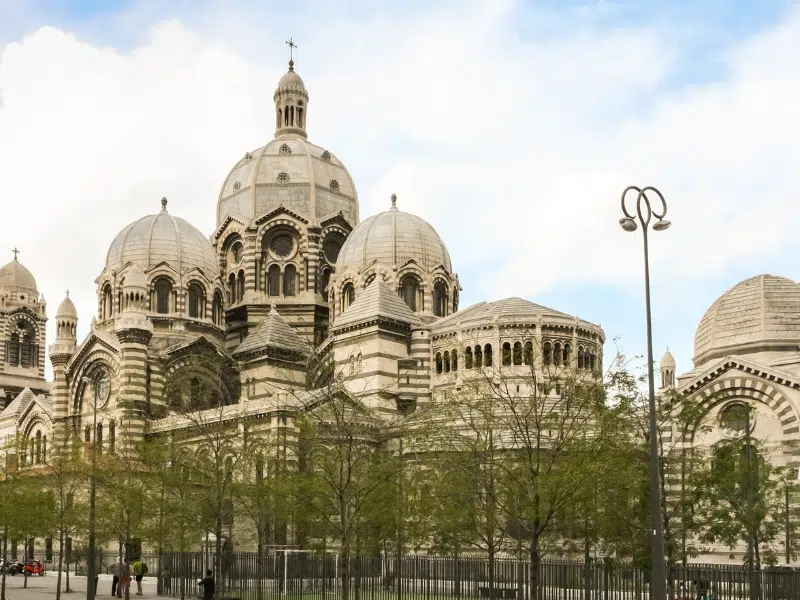
La Major, officially the Cathedral of Notre-Dame-de-la-Major, is Marseille's cathedral, a vast striped church on the waterfront between the Old Port and the modern docks of La Joliette. Built between 1852 and 1893, it is one of the largest cathedrals put up in France since the Middle Ages, and right beside it survives a small piece of the 12th-century cathedral it replaced.
La Major at a glance
- Where: on the Esplanade Jean-Paul II in the 2nd arrondissement, below the Panier district and a few minutes from the Mucem.
- Built: 1852 to 1893; made a minor basilica in 1896 and consecrated in 1897.
- By: Léon Vaudoyer, followed by Henri-Jacques Espérandieu and finally Henri Révoil, who completed the decoration.
- What it is today: the working cathedral of the Archdiocese of Marseille, free to enter.
- Time needed: 30 minutes to an hour inside, plus time on the esplanade.
From a Romanesque church to a 19th-century giant
Churches have stood on this spot since the 5th century. Digging the foundations of the new cathedral uncovered an early Christian church and a baptistery that was among the largest known in Gaul. The 12th-century Romanesque cathedral, now called the Vieille Major, was meant to be demolished, but after protests its choir and one bay of the nave were kept. They still stand next to the new building.
The new cathedral was the project of Bishop Eugène de Mazenod. Louis-Napoléon Bonaparte, soon to be Emperor Napoleon III, laid the first stone on 26 September 1852. Vaudoyer designed a Latin-cross plan in a Romano-Byzantine style, deliberately mixing bell towers from the West with domes from the East. He died in 1872 and Espérandieu, his former pupil, carried on until his own death in 1874, building the metal roof frames and the domes. Révoil finished the job and handed the cathedral over in 1893. It has been a listed historic monument since 1906.
What to look for
- The stripes: the walls alternate bands of green and white stone, which makes La Major instantly recognisable from the sea and from the hills above the port.
- The domes: the main dome rises about 70 metres, and the building is more than 140 metres long.
- The materials: inside you will find white Carrara marble, green stone from Florence, onyx from Italy and Tunisia and Venetian mosaics, with marble and porphyry setting the tone.
- Borrowed ideas: details of the domes and balustrades were taken from the cathedrals of Lucca and Siena.
- Bishop Belsunce: a bronze statue honours the bishop who stayed in the city during the plague of 1720.
- The Vieille Major: look along the side of the new cathedral for the lower, plainer Romanesque building. It is normally closed to visitors, but you can see it from outside.
A cathedral that is still being finished
La Major took four decades to build, and even today not all of the coverings planned for the vaults and domes were ever completed. Restoration has been going on in phases since 2016: the two bell towers on the south front and the central roof have been done, and work on the roofs and domes continues, so expect scaffolding on part of the building. The new cathedral is one of only a handful built in France in the 19th century.
Tips for your visit
- Come in the late afternoon, when the low sun warms the striped stone and the view from the esplanade over the port is at its best.
- Dress modestly and keep your voice down inside; La Major is an active cathedral, so check for services before you go.
- Have a drink or a meal in the Voûtes de la Major, the 19th-century warehouses built into the vaults under the esplanade.
- Combine your visit with the Mucem and a climb up into the lanes of Le Panier.
Nearby
- Mucem: the museum of Mediterranean civilisations, with its lace-like concrete facade and a footbridge to Fort Saint-Jean; a few minutes' walk.
- Le Panier: Marseille's oldest neighbourhood, a maze of steep lanes, small squares and street art just above the cathedral.
- La Vieille Charité: a 17th-century former almshouse with a domed chapel in the middle of a three-storey courtyard, now home to museums.
- Old Port (Vieux-Port): the city's historic harbour, with fishing boats, the fish market in the morning and Norman Foster's mirror canopy.
See Marseille with World City Trail
Our Marseille scavenger hunt turns the old town into a game you play on your phone. The route links 10 stops and takes around 3 hours, with about 51 minutes of walking, and includes places such as the Old Port and Le Panier.
If you prefer a different format, there is also a self-guided walking tour of Marseille and an outdoor escape game in the city.
Play the Marseille scavenger hunt →
Take the self-guided walking tour of Marseille →
Play the outdoor escape game in Marseille →
Facts checked in October 2026.