
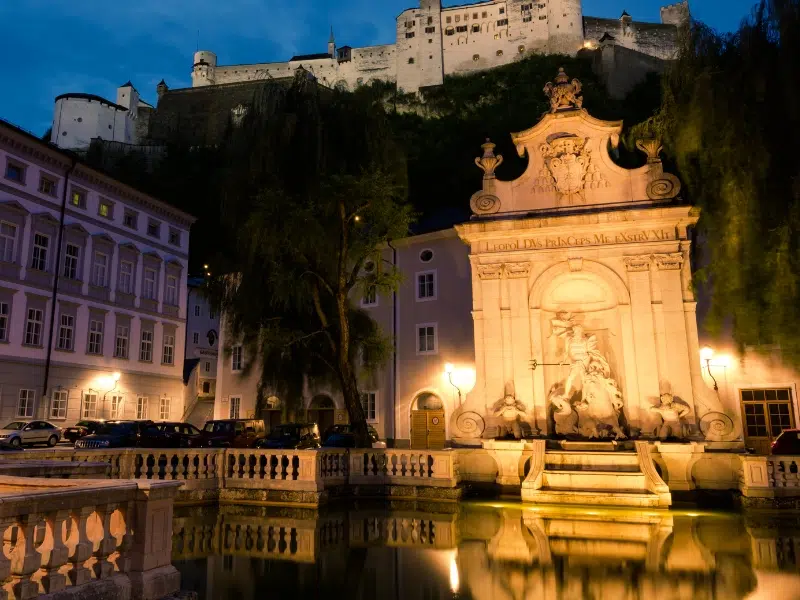
The Kapitelschwemme is the Baroque horse pond on Kapitelplatz, the square just behind Salzburg Cathedral. It looks like a grand fountain, but it was built as a place to wash and cool horses, and its centrepiece is Neptune himself, riding a seahorse that spouts water into the basin.
Kapitelschwemme at a glance
- Where: on Kapitelplatz, between the cathedral and the foot of the Festungsberg, on the way to the fortress funicular.
- Built: in its present form in 1732, under Prince-Archbishop Leopold Anton von Firmian; a horse pond stood on the square long before that.
- By: designed by Franz Anton Danreiter; the Neptune group is by the sculptor Josef Anton Pfaffinger.
- What it is today: a monument and backdrop on one of the old town's busiest squares, still filled with water, but no longer used for horses.
- Time needed: 10 minutes, or longer if you stay for the giant chess games on the square.
From chapter horses to Baroque showpiece
Kapitelplatz takes its name from the cathedral chapter, the body of canons who ran the cathedral and lived around this square until the archbishopric was dissolved in 1803. Their horses needed water and care, and a pond for them is recorded here from the Middle Ages. A horse pond, or Schwemme, was a practical thing: after work the animals were led into the water to be cleaned, and in summer to cool down.
In 1732 Archbishop Firmian, the same ruler who expelled Salzburg's Protestants and built Schloss Leopoldskron, had the pond rebuilt as a showpiece. Danreiter's design, inspired by the fountains of Rome, framed the water with a marble balustrade and a niche, and Pfaffinger's Neptune turned a utility into a stage. Firmian also had the city's other big horse pond, the Pferdeschwemme by the Marstall, redesigned.
What to look for
- Neptune in the central niche, crowned and holding his trident, riding a rearing seahorse with water pouring from its mouth.
- The water-spouting tritons at the sides, half man and half fish, part of the sea-god theme.
- Firmian's coat of arms above the niche, with a Latin inscription that is a chronogram: its capital letters add up to the year of construction.
- The marble balustrade around the basin, which horses were once led into to be washed and cooled.
- Stephan Balkenhol's Sphaera on the same square: a huge golden ball with a man standing on top, a modern counterpoint to the Baroque fountain.
Reading the chronogram
Chronograms were a favourite Baroque puzzle in Salzburg. The letters that are also Roman numerals (I, V, X, L, C, D, M) are written larger than the rest, and if you add them up you get the year the work was finished. Try it on the Kapitelschwemme inscription with your phone's calculator: it is a good way to slow down and actually read a monument most people only photograph.
Tips for your visit
- Come early in the morning, before the groups heading for the fortress fill the square.
- For a photo with the fortress above it, step back towards the cathedral and frame Neptune with Hohensalzburg on the hill behind.
- Don't climb on the balustrade or into the basin; it is a protected monument.
- Combine it with the walk or funicular up to the fortress, which starts a minute away.
Nearby
- Salzburg Cathedral: the Baroque cathedral whose dome closes the south side of the square.
- Hohensalzburg Fortress funicular: the Festungsbahn starts just off Kapitelplatz and takes you up to the fortress.
- St Peter's Cemetery: one of the oldest cemeteries in the city, with catacombs cut into the cliff, a couple of minutes' walk away.
- Residenzplatz: the grand square with the Residence Fountain, on the other side of the cathedral.
See Salzburg with World City Trail
Our Salzburg scavenger hunt turns the old town into a game you play on your phone. The route links 10 stops and takes around 2 hours, with about 31 minutes of walking. The Kapitelschwemme is not one of the stops, but the route includes Salzburg Cathedral, Mozart's Birthplace and Mirabell Palace and Gardens.
If you prefer a different format, there is also a self-guided walking tour and an outdoor escape game in Salzburg.
Play the Salzburg scavenger hunt →
Take the self-guided walking tour of Salzburg →
Play the outdoor escape game in Salzburg →
Facts checked in October 2026.