
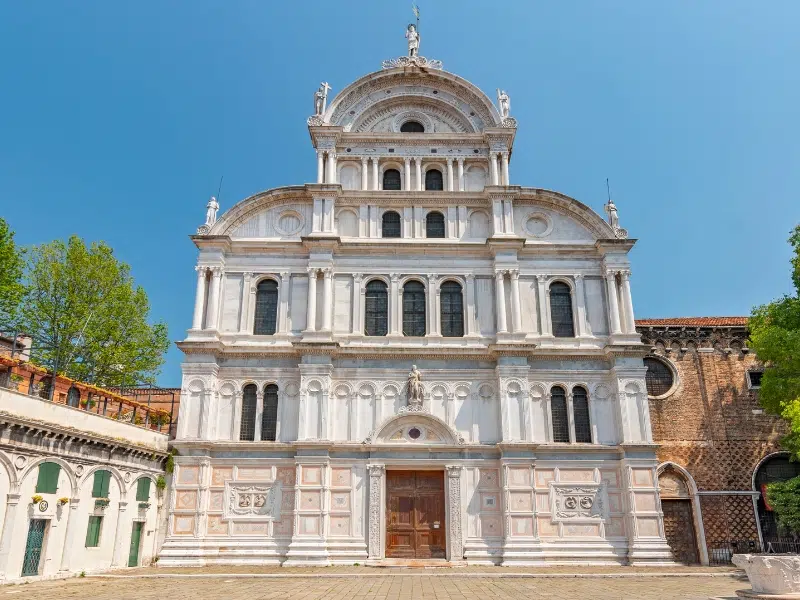
San Zaccaria is a former convent church a few steps behind the waterfront east of St Mark's Square, with a white stone facade that marks the shift from Gothic to Renaissance in Venice. Inside hangs one of Giovanni Bellini's greatest altarpieces, and under a side chapel lies a crypt where eight early doges are buried and the lagoon water often covers the floor.
San Zaccaria at a glance
- Where: on Campo San Zaccaria in the Castello district, just off the Riva degli Schiavoni and a few minutes' walk from St Mark's Square.
- Built: the present church between 1458 and 1515; the bell tower dates back to the 12th century.
- By: Antonio Gambello began it in the Gothic style; Mauro Codussi completed the upper facade and interior in early Renaissance style.
- What it is today: a parish church, with its side chapels and crypt usually visited as a separate section.
- Time needed: 30 to 45 minutes.
A church for the doges and their daughters
The first church here was founded in the early 9th century by Doge Giustiniano Participazio to house the relics of Zechariah, father of John the Baptist, a gift from the Byzantine emperor Leo V. Beside it stood a Benedictine convent whose nuns mostly came from the city's leading families. Every Easter, the doge and his court came to visit, a custom that lasted until 1797, when Napoleon's troops ended the Republic and suppressed the convent.
The church was rebuilt in the 1170s and again in the 15th century. The Gothic church of that time still survives, because the new one was built next to it rather than on top of it, and parts of it now form the chapels of Sant'Atanasio and San Tarasio. Gambello started the new building in 1458, and after his death Codussi finished the facade, with its tiers of columns and a semicircular top, and the upper parts of the interior.
What to look for
- Bellini's altarpiece: the Virgin and Child with four saints, painted in 1505, on an altar along the left side of the nave. Napoleon took it to Paris, and it came back in 1817.
- The facade: Gambello's lower levels are Gothic in spirit, while Codussi's upper storeys and rounded crown are fully Renaissance.
- The San Tarasio chapel: its vault holds frescoes dated 1442 by Andrea del Castagno and Francesco da Faenza, Castagno's earliest surviving work.
- The crypt: a 10th-century crypt with low columns beneath the San Tarasio chapel, where eight early doges are buried and the lagoon water often seeps in.
- The body of Zechariah: the relics given by Leo V lie under the second altar on the right.
- The ambulatory: behind the high altar, a walkway with tall Gothic windows runs around the apse, a layout found in northern European churches and unique in Venice.
Nuns, doges and a fire
The convent had a lively reputation: its nuns, from the richest families, were known for not keeping strictly to the cloister. According to chroniclers, a fire in 1105 swept through the convent and about a hundred nuns who had sheltered in the cellars died. In 855 Pope Benedict III took refuge here, and in thanks he gave the nuns a large collection of relics. Tradition also holds that the convent gave the land on which St Mark's Basilica was built, which is why the doge visited every Easter.
Tips for your visit
- Come in the morning, before the crowds from St Mark's Square spread along the Riva.
- Look closely at the Bellini: the lighting is sometimes coin-operated, so have a little change if you want to see it at its best.
- Allow extra time for the side chapels and crypt, which are usually visited as a separate section of the church.
- Combine San Zaccaria with St Mark's Square and a walk along the Riva degli Schiavoni.
Nearby
- St Mark's Square: the city's great square with St Mark's Basilica and the Campanile; a few minutes' walk.
- Doge's Palace: the seat of the Republic's government, next to the basilica.
- Bridge of Sighs: the enclosed bridge between the Doge's Palace and the prisons, best seen from the Ponte della Paglia on the waterfront.
- Riva degli Schiavoni: the broad waterfront promenade with views across to San Giorgio Maggiore.
See Venice with World City Trail
Our Venice scavenger hunt turns the old town into a game you play on your phone. The route links 10 stops and takes around 2 hours, with about 41 minutes of walking, and includes places such as the Frari Basilica, the Rialto Bridge and St Mark's Square.
If you prefer a different format, there is also a self-guided walking tour of Venice and an outdoor escape game in the city.
Play the Venice scavenger hunt →
Take the self-guided walking tour of Venice →
Play the outdoor escape game in Venice →
Facts checked in October 2026.