
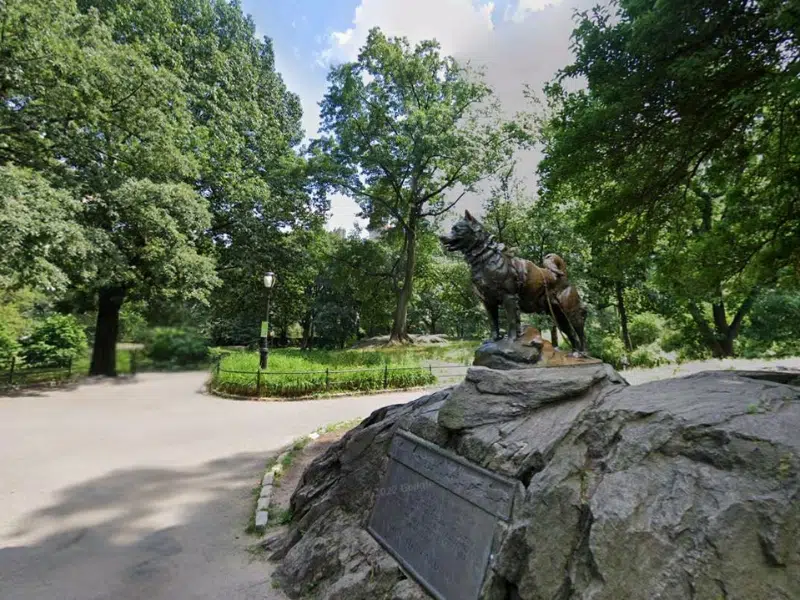
The Balto statue is a bronze sled dog on a rock outcrop in Central Park, near East Drive and 67th Street. It honours the dogs of the 1925 serum run, which carried diphtheria antitoxin across Alaska to the town of Nome, and Balto, the dog who led the final team into town. When it was dedicated on 17 December 1925, Balto himself was in the crowd, and he is said to be the only subject of a Central Park statue who attended its unveiling.
The Balto statue at a glance
- Where: on a rocky outcrop beside East Drive at about 67th Street, just north of the Central Park Zoo.
- Created: dedicated on 17 December 1925, less than a year after the serum run.
- By: the sculptor Frederick George Richard Roth, paid for by a group of New York artists led by the painter Cecilia Beaux.
- What it is today: one of the most popular statues in the park, especially with children, who climb on it every day.
- Time needed: 10–15 minutes, longer if you have children with you.
Six hundred miles to Nome
In January 1925 a diphtheria outbreak hit Nome, a town on the coast of Alaska that could not be reached by ship in winter. The antitoxin was sent by train from Anchorage to Nenana, about 674 miles from Nome, and from there dog teams carried it in relay. About 20 mushers and more than 150 dogs took part, most teams covering around 30 miles before handing on the package, and the whole relay took about five and a half days.
Balto led the team of the musher Gunnar Kaasen on the final 53-mile stretch and reached Nome at 5:30 in the morning on 2 February 1925. Because his team arrived in town, Balto became the face of the run in newspapers across the United States. Within months the artists' committee had commissioned a statue, and Kaasen and Balto travelled to New York for the dedication.
What to look for
- Balto himself: Roth reportedly used a malamute from New Hampshire named Chinook as his model, so the bronze dog is not an exact portrait of the real Balto.
- The shine: the bronze on his back and ears is polished smooth by the hands of children. The Central Park Conservancy applies a coat of hot wax every year, and it has made a 3D scan of the statue as a record in case of damage.
- The plaque: the text is dedicated “to the indomitable spirit of the sled dogs that relayed antitoxin six hundred miles over rough ice, across treacherous waters, through Arctic blizzards from Nenana to the relief of stricken Nome in the Winter of 1925”, and ends with three words: “Endurance · Fidelity · Intelligence”.
- The relief on the base: a bas-relief shows a dog team pulling a sled through the snow on the run to Nome.
Balto or Togo?
Balto got the statue, but many people who know the story say the real hero was Togo. He led the team of Leonhard Seppala, Balto's owner, over 91 miles, the longest and most dangerous stretch of the run, including the crossing of the sea ice of Norton Sound. Balto's later life was less glorious: he and six teammates ended up on show in a dime museum in Los Angeles until a campaign by the Cleveland Plain Dealer raised money to bring them to Cleveland in 1927. Balto lived at the Brookside Zoo there until his death in 1933, and his preserved body is displayed at the Cleveland Museum of Natural History.
Tips for your visit
- Enter from Fifth Avenue in the East 60s and follow East Drive north from the zoo; the statue stands on a rock just off the path.
- Come early in the morning if you want a photo without children on Balto's back. Later in the day, be patient and let them have their turn.
- Watch the 1995 animated film “Balto” with your children before you go: its final scene takes place at this statue.
Nearby
- Central Park Zoo: right next door, with sea lions, penguins and snow leopards, and the Tisch Children's Zoo for younger visitors.
- Delacorte Musical Clock: the clock above the zoo arcade, where bronze animals playing instruments circle while it chimes.
- The Mall and Literary Walk: the elm-lined promenade a few minutes west, with statues of Shakespeare, Robert Burns and Walter Scott.
- Bethesda Terrace and Fountain: at the north end of the Mall, with the Angel of the Waters statue and the lake behind it.
See Central Park with World City Trail
Our Central Park scavenger hunt turns the park into a game you play on your phone. The route links 10 stops and takes around 3 hours, with about 43 minutes of walking. It includes Cleopatra's Needle, Belvedere Castle and the Delacorte Theater. You can play in English, German, French, Italian, Spanish or Dutch.
If you prefer a different format, there is also a self-guided walking tour and an outdoor escape game in Central Park.
Play the Central Park scavenger hunt →
Take the self-guided walking tour of Central Park →
Play the outdoor escape game in Central Park →
Facts checked in October 2026.