
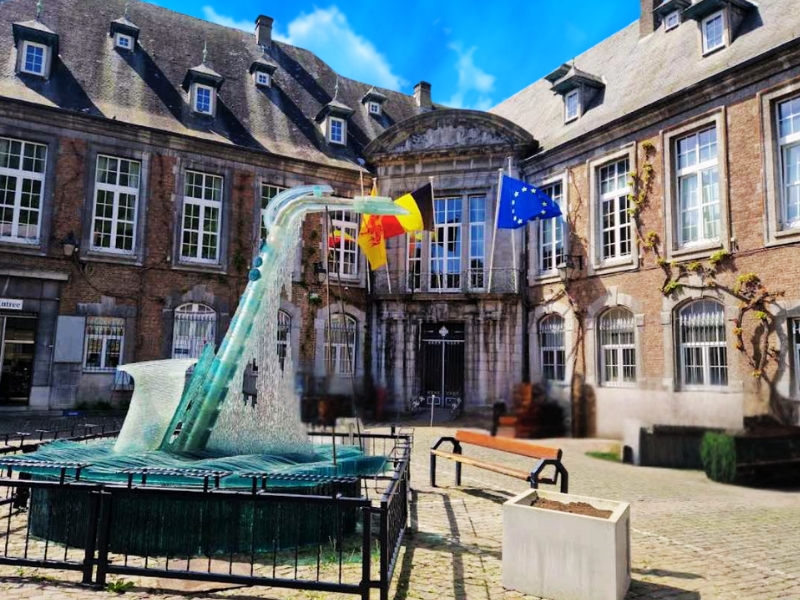
The saxophone water clock, known locally as La Clepsydre de Monsieur Sax, is a glass sculpture in the courtyard of Dinant's town hall. Made by the Belgian master glassmaker Bernard Tirtiaux, it takes the shape of a saxophone and works as a water clock, a playful tribute to Adolphe Sax, the inventor of the saxophone, who was born in Dinant in 1814.
The saxophone water clock at a glance
- Where: in the inner courtyard of the Hôtel de Ville, Dinant's town hall, on the right bank of the Meuse in the town centre.
- Created: as one of Dinant's tributes to Adolphe Sax; the town's own guides do not give an exact year.
- By: Bernard Tirtiaux, a Belgian stained-glass artist and novelist.
- What it is today: a work of public art and a working water clock, whose bluish glass changes colour with the light and the flowing water.
- Time needed: 10 minutes, or a little longer if you also look at the rest of the town hall courtyard.
Sax, the Meuse and a palace for a town hall
Adolphe Sax was born in Dinant in 1814, the son of an instrument maker, and moved to Paris, where he patented the saxophone in 1846. For a long time his home town made little of him, but in recent decades Dinant has turned itself into the saxophone's capital: there are giant painted saxophones on the bridge over the Meuse, a statue of Sax on a bench, an interpretation centre at the site of his birthplace and, here in the town hall courtyard, a saxophone made of glass and water.
The setting is part of the story. Dinant's town hall occupies the former residence of the prince-bishops of Liège, who ruled the town for centuries. The building was burnt in August 1914, when German troops destroyed much of Dinant and killed hundreds of its inhabitants, and was rebuilt after the war. A monument to the dead of both world wars stands in the same courtyard.
What to look for
- The shape: a saxophone recognisable at once, but built in glass rather than brass, so you can see the water inside.
- The colours: Tirtiaux worked with blue tones that shift as the sun moves and the water flows, so the piece looks different at every hour.
- The water itself, which turns a musical instrument into an instrument for measuring time.
- The town hall façade around the courtyard, a stately building in brick and limestone, the local stone of the Meuse valley.
Why a water clock?
A clepsydra, or water clock, is one of the oldest ways of measuring time: water drips or flows at a steady rate, and the level shows how much time has passed. Combining it with a saxophone links two things Dinant is proud of: the Meuse, the river that made the town, and the instrument its most famous son invented. Tirtiaux, who is also a novelist, has often written about glass and light, and the piece is meant to be watched slowly rather than photographed in passing.
Tips for your visit
- Come on a sunny day if you can: the light passing through the glass is the whole point of the work.
- The courtyard belongs to a working town hall, so keep noise down and respect any areas closed to the public.
- Look at the clock from several angles; the colours change noticeably as you walk around it.
- Combine it with a Sax-themed walk: the bridge saxophones, the Maison de Monsieur Sax and the Sax statue are all in the town centre.
Nearby
- Maison de Monsieur Sax: a small interpretation centre on Rue Sax, on the site of the house where Adolphe Sax was born.
- Adolphe Sax monument: the bronze Sax sitting on a bench outside his birthplace, a favourite photo stop.
- Charles de Gaulle Bridge: lined with large painted saxophones representing different countries, with views of the collegiate church and the citadel.
- Collegiate Church of Notre-Dame: the Gothic church with the onion-shaped spire, set against the cliff below the citadel.
See Dinant with World City Trail
Our Dinant scavenger hunt turns the old town into a game you play on your phone. The route links 10 stops and takes around 2 hours, with about 25 minutes of walking. The saxophone water clock is not one of the stops, but the route includes the Adolphe Sax monument and the Maison de Monsieur Sax. You can play in English, German, French, Italian, Spanish and Dutch.
If you prefer a different format, there is also a self-guided walking tour and an outdoor escape game in Dinant.
Play the Dinant scavenger hunt →
Take the self-guided walking tour of Dinant →
Play the outdoor escape game in Dinant →
Facts checked in October 2026.