
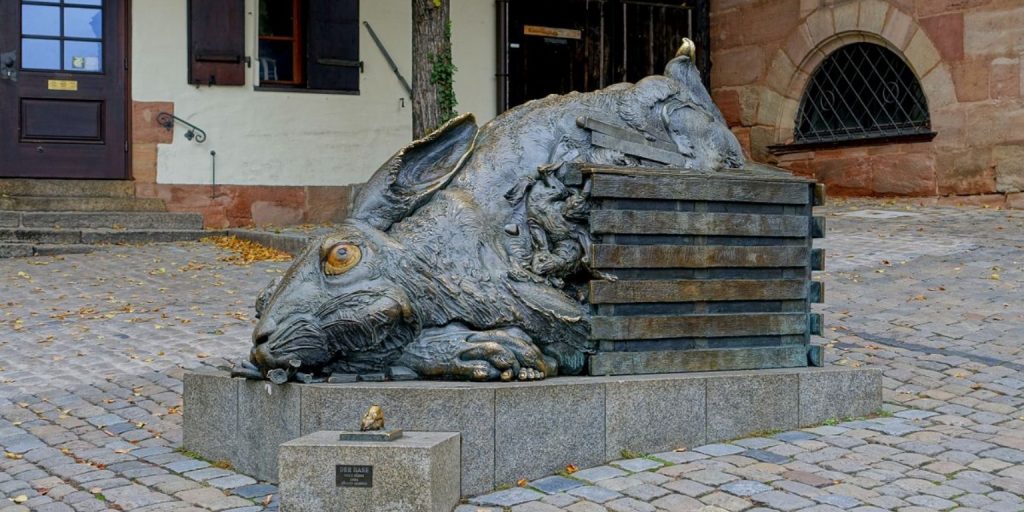
Perched on the cobbled square of Tiergärtnertorplatz, just outside the house of Nuremberg’s most famous son, stands a piece of public art that is as captivating as it is controversial. The Der Hase sculpture in Nuremberg, a massive bronze hare created by artist Jürgen Goertz, is a powerful and unsettling tribute to Renaissance master Albrecht Dürer. This unique monument, officially titled Hase-Hommage an Dürer (Hare – Homage to Dürer), is a testament to the city’s rich artistic heritage and its willingness to embrace bold, contemporary expression. It is a must-see landmark that challenges visitors to look beyond the surface and engage with a piece of art that reinterprets a classic masterpiece for the modern age.
A Bold Reinterpretation of a Timeless Classic
The story of the der-hase-sculpture-in-Nuremberg begins with one of the most beloved artworks of the Northern Renaissance: Albrecht Dürer’s 1502 watercolor, Young Hare (Feldhase). This piece is celebrated for its incredible realism, its delicate detail, and Dürer’s profound observational skill. The small, fragile animal in the painting is a symbol of natural beauty and an early example of art for art’s sake.
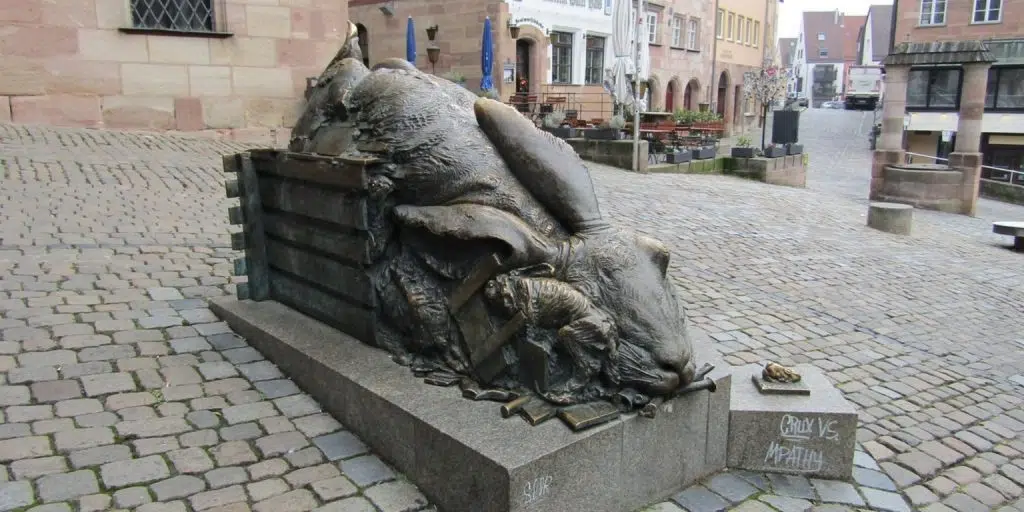
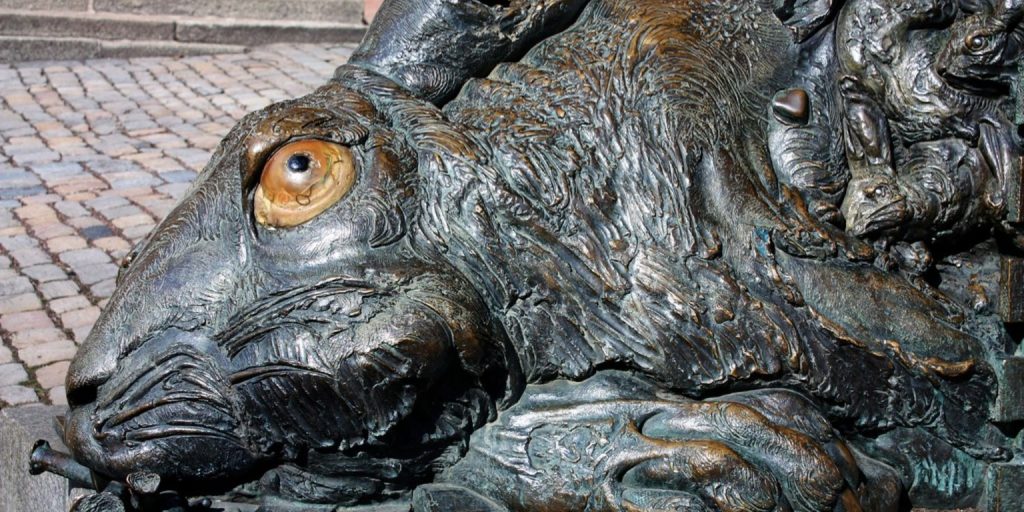
Fast forward to 1984, when the city of Nuremberg commissioned a sculpture to mark the 500th anniversary of Dürer’s birth. Jürgen Goertz’s creation was a radical departure from the original. His hare is monstrous and grotesque, seemingly bursting forth from a decaying wooden crate. Its unsettling eyes, powerful claws, and a human foot crushed beneath its paw create a surreal and dark tableau.
Rather than a beautiful, serene portrait, Goertz’s hare is a wild and aggressive force of nature, a striking contrast to Dürer’s gentle animal. The sculpture’s intent, while never explicitly stated by the artist, is widely interpreted as a commentary on the commercialization of art and the violent energy that can exist in nature and within the creative process itself.
A Strategic Location and Artistic Dialogue
The placement of the Der Hase sculpture in Nuremberg is no accident. It is located on Tiergärtnertorplatz, a charming square directly in front of the Albrecht Dürer House. This strategic positioning creates an immediate and compelling dialogue between the two landmarks. The quaint, half-timbered house where Dürer lived and worked for nearly two decades is a symbol of Nuremberg’s golden age, while the modern sculpture represents a provocative and challenging re-evaluation of that history. The juxtaposition forces visitors to contemplate the artist’s enduring legacy and how his influence continues to inspire and evolve centuries after his death.
The sculpture, towering and imposing, has become a conversation starter and a subject of both admiration and criticism. When it was first unveiled, it sparked public outrage and debate, with many finding it bizarre and out of place. Over time, however, it has grown to be an iconic landmark, embraced by the city and its visitors. The hare’s powerful presence on the square serves as a constant reminder that art is meant to challenge and provoke as much as it is to please.
The Enduring Legacy of Der Hase
Today, the Der Hase sculpture in Nuremberg is more than just a public artwork; it is a symbol of the city’s dynamic character. It embodies Nuremberg’s ability to honor its past while simultaneously embracing the future. It stands as a testament to the fact that great art can spark discussion, challenge norms, and reinterpret history in new and unexpected ways.
The bronze hare has become an essential part of any tour of the old town, captivating visitors who are fascinated by its unique and powerful symbolism. It is a landmark that encourages deep thought and personal interpretation, a fitting tribute to an artist who pushed the boundaries of his own time. So, when you visit Nuremberg, take a moment to stand before this monumental hare. It’s a chance to see a timeless piece of history through a truly modern and unforgettable lens.