
In the heart of Padua stands a monument that is a testament to the power of a good story. The Tomb of Antenor, a solemn, medieval structure in Piazza Antenore, commemorates a legendary Trojan prince said to have founded the city. While modern science has cast serious doubt on its authenticity, the monument remains a cherished symbol of Padua’s identity, a tangible link to a glorious past. The tomb-of-antenor-in-padova is a perfect example of how a city’s history is not just about facts, but about the myths and legends it chooses to believe.

From Trojan Prince to City Founder
The legend of Padua’s founding dates back to the great classical epics. According to the Roman poet Virgil’s Aeneid, the Trojan prince and wise counselor Antenor escaped the fall of Troy and, after a long and arduous journey, arrived in northern Italy. He founded the city of Patavium, which would become modern-day Padua, and established a new home for his people. This foundational myth provided Padua with a prestigious lineage, linking it directly to the most famous city of antiquity and placing it on par with Rome itself, which was founded by another Trojan hero, Aeneas.
Centuries later, this legend became a powerful reality for the citizens of Padua. In 1274, during construction work, an ancient sarcophagus was unearthed. A local scholar and poet named Lovato dei Lovati, a prominent figure in the pre-humanist movement, examined the find and, with a combination of scholarly deduction and civic pride, declared the remains to be those of the legendary founder, Antenor. Eager to legitimize their city’s origins with a hero of such renown, the city’s leaders decided to honor the find with a permanent monument.
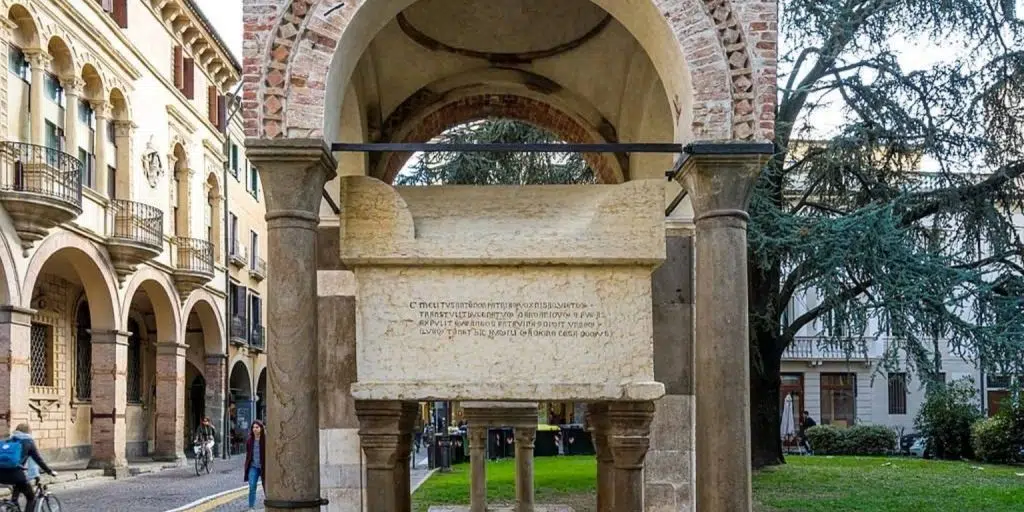
A Medieval Monument for an Ancient Hero
The magnificent medieval monument was built in 1283 to house the ancient sarcophagus. The structure itself is a simple yet elegant work of art, a brick-and-stone tabernacle with open arches, designed to protect the “tomb” while allowing it to be seen by the public. The design is characteristic of the period, a testament to the skill of Padua’s medieval artisans. For centuries, the Tomb of Antenor stood as a sacred site, a destination for scholars and citizens alike who wished to pay homage to the city’s heroic founder.
However, the truth of the monument was called into question in 1985. During restorations, the sarcophagus was opened and the remains were subjected to modern scientific analysis. Carbon dating revealed that the bones belonged not to a mythical figure from the Trojan War, but to a man who died in the 3rd or 4th century AD, likely a wealthy Hungarian warrior or a high-ranking Germanic soldier. The findings, while dispelling the legend, did not diminish the monument’s importance. It transformed the tomb from a literal resting place of a hero into a powerful symbol of a city’s cherished identity.
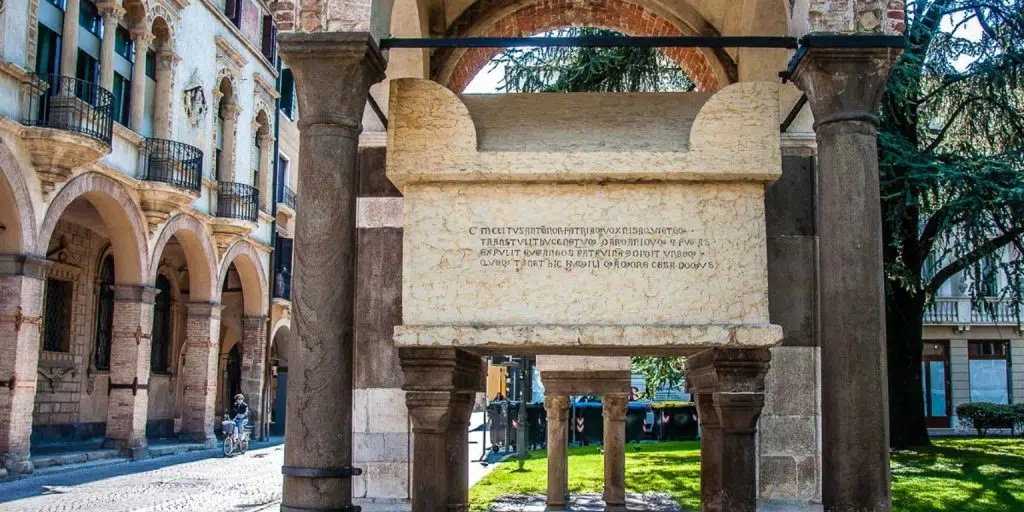
An Enduring Symbol of Paduan Identity
Today, the Tomb of Antenor stands not as a monument to a Trojan prince but as a monument to a city’s will to create its own glorious history. It is a reminder that the stories we tell ourselves about our origins are often more important than the literal truth. The monument’s location in a bustling public square, a short walk from the University of Padua’s historic Palazzo del Bo, ensures it remains a central part of the city’s life. It is a must-see for visitors, not for the bones it contains, but for the fascinating story it represents.
The Tomb of Antenor is a powerful testament to the legacy of scholarship, ambition, and pride that defines Padua. It celebrates the city’s deep roots and its long-standing connection to the grand narratives of classical antiquity. It is a place where history and legend gracefully converge, inviting all who see it to consider the rich and complex layers of a city’s past.