
This guide covers ten places in Austin. Nine of them line one walk south from the University of Texas campus, down Congress Avenue to the Capitol grounds and on to downtown: the UT Tower, the George Washington statue, Littlefield Fountain, the Bullock Texas State History Museum, four monuments around the Capitol and St. Mary Cathedral. The tenth, the Circuit of the Americas, lies outside the city and is where Austin hosts the Formula 1 United States Grand Prix.
UT Tower
The tower of the Main Building is the symbol of the University of Texas at Austin. It was designed by the French-born architect Paul Philippe Cret and built between 1934 and 1937, and it rises 307 feet over the campus. At the top hangs a carillon of 56 bells, the largest in Texas, which is played regularly. The tower is lit orange in the evening to mark university events and sports wins, a custom that goes back to 1937. On 1 August 1966 a gunman fired from the observation deck and killed 14 people; a memorial garden on the campus remembers the victims. The deck reopened to visitors in 1999 and can be seen on guided tours.
- What to look for: the words above the south entrance, "Ye shall know the truth and the truth shall make you free", and the clock faces near the top.
George Washington statue
A bronze George Washington stands on the South Mall in front of the Main Building. It is the work of Pompeo Coppini, the Italian-born sculptor who made many of the monuments in Austin, and it was installed in February 1955. It was Coppini's third statue of Washington, after one in Mexico City in 1911 and one in Portland, Oregon, in 1926.
- What to look for: the view from the statue down the South Mall towards the Capitol dome, which lines up with the campus axis.
Littlefield Fountain
At the southern entrance of the South Mall, Littlefield Fountain is a memorial to the students and alumni of the university who died in the First World War. It was paid for by George W. Littlefield, a cattleman and former regent of the university, and designed by Pompeo Coppini; it was dedicated on 29 April 1933. Littlefield had first wanted a memorial to the Confederate dead, and Coppini talked him into the change.
The central bronze shows the prow of a ship with the winged figure of Columbia, flanked by a soldier and a sailor. Coppini also made six statues of historical figures for the setting; they were later moved to the South Mall, and the university removed them between 2015 and 2017. The fountain is the second stop of our scavenger hunt, right after the tower and the Washington statue.
Bullock Texas State History Museum
A few blocks north of the Capitol on Congress Avenue, the Bullock Museum tells the story of Texas across three floors of galleries. It opened in April 2001 and is named after Bob Bullock, the lieutenant governor who pushed for it and who died in 1999, before it was finished. The centrepiece is La Belle, the ship of the French explorer La Salle, which sank off the Texas coast in 1686 and was recovered by archaeologists with thousands of objects; the building was designed around its hull.
- What to look for: the giant bronze star in front of the entrance, which you walk under on the way in.
Texas Peace Officers Memorial
On the Capitol grounds, the Texas Peace Officers Memorial honours law enforcement officers who died on duty in Texas, with names going back to 1823. It was set up in 1999 by the state's law enforcement commission and the State Preservation Board.
Its design, by Linda Johnson, places two granite spires side by side so that together they read as an obelisk, standing on a base with the Lone Star. The names are carved on the granite walls around it; since 2017 new names have been added in order of date on numbered panels.
Confederate Soldiers Monument
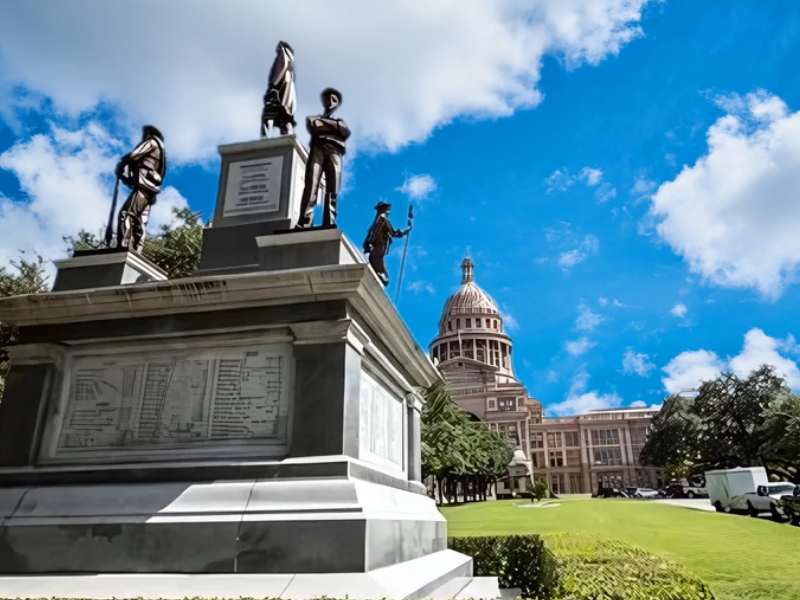
The Confederate Soldiers Monument on the Capitol grounds was put up in 1903. The bronze figures are by Pompeo Coppini, the base was designed by Frank Teich, and the casting was done by Roman Bronze Works in New York. Five figures around the base stand for the infantry, cavalry, artillery and navy, and a statue of Jefferson Davis stands on top. It is one of several Confederate monuments at the Capitol.
Read the inscriptions with care: historians point out that the troop numbers listed are wrong, and that the "states' rights" wording contradicts Texas's own 1861 declaration of secession, which named the defence of slavery as the cause. The area of the grounds around it is one of the stops on our route.
Texas African American History Memorial
Unveiled on the south lawn of the Capitol on 19 November 2016, this bronze and granite memorial traces the history of African Americans in Texas from the 1500s to the present. It was made by the Denver sculptor Ed Dwight after more than two decades of efforts by lawmakers to put such a monument on the Capitol grounds.
Its central scene is Juneteenth, 19 June 1865, when Union troops in Galveston announced that enslaved people in Texas were free. Around it are figures from later Black history in Texas, among them Barbara Jordan, and reliefs showing the work of Black Texans in the cattle, cotton and oil industries.
Tejano Monument
Unveiled on the south lawn of the Capitol in March 2012, the Tejano Monument was the first on the grounds to honour the role of Tejanos, Texans of Mexican and Spanish descent, in founding and building the state. The sculptor was Armando Hinojosa of Laredo.
Life-size bronzes show a Spanish explorer, a vaquero on his mustang, a longhorn bull and cow, and a settler family, on a large base of Texas sunset red granite, the same stone as the Capitol. Plaques around it tell Tejano history in short chapters.
St. Mary Cathedral
A few blocks east of Congress Avenue on 10th Street, St. Mary Cathedral is a Gothic Revival church with Victorian touches. It was the first independent commission of Nicholas J. Clayton, an Irish-born architect who later shaped much of Galveston. Building began in 1872 and the church was dedicated in 1884; the towers and spires were only finished in 1907. It became the cathedral of the new Diocese of Austin in the late 1940s.
- What to look for: the rose window, restored together with the stonework in 2013, and the stained glass added in the 1890s, and the large bell given by the family of Michael Butler. The cathedral is the last stop of our scavenger hunt.
Circuit of the Americas and the US Grand Prix
South-east of the city, the Circuit of the Americas opened in October 2012 and held its first United States Grand Prix in November that year; Lewis Hamilton won it for McLaren. The layout was conceived by the promoter Tavo Hellmund and the motorcycle world champion Kevin Schwantz, with the help of the German track designer Hermann Tilke.
The best-known corner is the first: cars climb a steep hill to a tight left-hander at the highest point of the track, called Big Red since 2020. Beside it stands an observation tower with a viewing platform high above the circuit, and at its base an amphitheatre that hosts concerts. The circuit is outside the walking area, so plan it as a separate trip, ideally on a race weekend.
How to see them in one walk
Start at the UT Tower and the George Washington statue in front of it, then walk down the South Mall to Littlefield Fountain. Leave the campus southwards and follow Congress Avenue to the Bullock Museum. Carry on to the Capitol grounds, where the Peace Officers Memorial, the Confederate monument, the African American History Memorial and the Tejano Monument all stand close to each other around the Capitol. From the south side of the grounds, head east a few blocks to St. Mary Cathedral. Keep the Circuit of the Americas for another day.
See Austin with World City Trail
Our Austin scavenger hunt turns the university and the Capitol district into a game you play on your phone. The route links 10 stops, from the UT Tower to St. Mary Cathedral, and nine of the places in this guide are stops: the UT Tower, the George Washington statue, Littlefield Fountain, the Bullock Museum, the Peace Officers Memorial, the Confederate Memorial lawn, the African American History Memorial, the Tejano Monument and St. Mary Cathedral, along with the Texas Capitol itself.
There is also a self-guided walking tour and an outdoor escape game in Austin, for people who prefer a different format.
Play the Austin scavenger hunt →
Take the self-guided walking tour of Austin →
Play the outdoor escape game in Austin →
Facts checked in October 2026.