
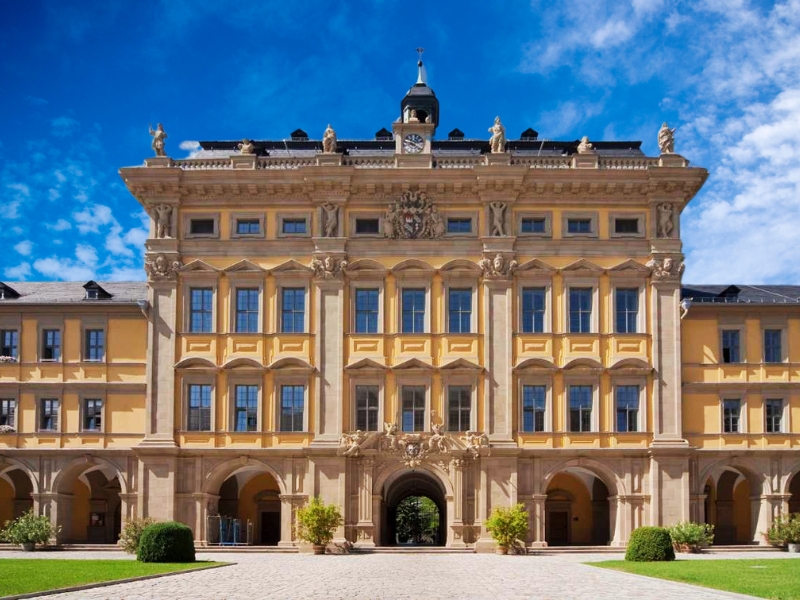
Würzburg was ruled for centuries by prince-bishops, and they left two great foundations on either side of the old town: the Juliusspital, a hospital that is still at work, and the Residence, their palace on a vast square. This guide covers both, plus the Old Main Bridge that links the town to the river, the Frankonia Fountain on Residenzplatz and the Court Garden behind the palace. Three of them are stops on our scavenger hunt.
Juliusspital
The Juliusspital is a charitable foundation with a long name and a long memory. Prince-Bishop Julius Echter von Mespelbrunn laid its foundation stone on 12 March 1576, signed its charter in 1579, and in 1580 the hospital took in its first 21 patients. More than four centuries later it still does what Echter intended: the foundation runs a care home for the elderly and a palliative ward, and it co-owns one of the city's hospitals.
It pays for much of this with wine. The Juliusspital owns vineyards around Würzburg and is described as the second-largest wine estate in Germany; its cellars lie under the main building, and its wine tavern is a Würzburg institution. The long baroque front facing the garden, the Fürstenbau, was built in the early 18th century and rebuilt after a fire in 1745 with advice from Balthasar Neumann. Much of the complex was destroyed in the bombing of March 1945 and rebuilt afterwards.
- The baroque garden behind the Fürstenbau, one of the finest in Franconia.
- The Four Streams Fountain (Vierströmebrunnen) in the garden, finished in 1708 by the court sculptor Jacob van der Auwera.
- The Rococo pharmacy inside the Fürstenbau, with stucco by Antonio Giuseppe Bossi; it is shown on tours of the wine estate.
Old Main Bridge (Alte Mainbrücke)
The Old Main Bridge, built between 1473 and 1543 to replace an older Romanesque bridge, links the old town with the former fishermen's quarter on the left bank of the Main. Around 1730 twelve statues of saints were set on its piers, and they now watch over one of the busiest meeting points in town. Cars no longer cross: it is a footbridge, and on summer evenings it fills with people standing at the parapet with a glass of Franconian wine.
- The view up to Marienberg Fortress on the hill across the river, the vineyards below it and the pilgrimage church of the Käppele.
- The statues of saints on the piers, with St Kilian, the missionary and patron of Würzburg, among them.
Residenzplatz and the Frankonia Fountain
Residenzplatz is the huge square in front of the Residence, laid out so that visitors would see the full width of the palace as they arrived. It belongs, together with the palace and the Court Garden, to the UNESCO World Heritage site. On ordinary days much of it is used as a car park, which makes its scale easy to underestimate.
In front of the palace stands the Frankonia Fountain, unveiled on 3 June 1894 in the presence of Prince Regent Luitpold of Bavaria, in whose honour the city built it. The architect Gabriel von Seidl designed it and Ferdinand von Miller made the bronze figures. On top stands Frankonia, the armoured allegory of Franconia, with a banner in her hand; below her sit three famous Franconians.
- The three figures at the base: the medieval poet Walther von der Vogelweide, the painter Matthias Grünewald and the sculptor Tilman Riemenschneider.
- The view of the whole palace front from the middle of the square, the classic photo of Würzburg.
The Residence (Würzburger Residenz)
The Residence was begun in 1720 for Prince-Bishop Johann Philipp Franz von Schönborn, and its shell was finished in 1744; the interiors took until around 1780. Its main architect was Balthasar Neumann. The most famous room is the staircase hall: Neumann covered it with a single vault without supporting columns, and in 1752–53 the Venetian painter Giovanni Battista Tiepolo, helped by his sons, painted on it one of the largest ceiling frescoes in the world.
The fresco shows the four continents known at the time paying homage to the prince-bishop. In March 1945 a British air raid set the palace on fire and the roofs were lost, but the stone vaults of the central block held, and the fresco survived. Rebuilding the rest of the palace lasted until 1987. The Residence was listed as a UNESCO World Heritage site in 1981.
- In the fresco, the figures of America, Africa, Asia and Europe along the edges of the vault; Tiepolo included portraits, among them Neumann himself.
- The Imperial Hall (Kaisersaal), with more frescoes by Tiepolo.
Court Garden (Hofgarten)
Behind the Residence, the Court Garden was laid out mainly between 1759 and 1770, with formal baroque terraces close to the palace and a more natural, English-style landscape further out. Many of its sculptures, putti, vases and two large groups, The Rape of Europa and The Abduction of Proserpina, are by the court sculptor Johann Peter Wagner. In the South Garden, a seated male figure from Wagner's workshop of the 1770s is thought to represent Chronos, the god of time.
- The terraces and the view back to the garden front of the palace.
How to see them in one walk
Start at the Juliusspital and its garden, then walk down to the river and follow the bank to the Old Main Bridge. From the bridge, Domstraße leads up through the old town to the cathedral; from there Hofstraße runs straight to Residenzplatz and the Frankonia Fountain. Visit the Residence, then walk round the building into the Court Garden to finish.
See Würzburg with World City Trail
Our Würzburg scavenger hunt turns the old town into a game you play on your phone. The route links 10 stops, starting at the Juliusspital and finishing on Residenzplatz, and the Old Main Bridge is a stop too. On the way it also takes in the Old Crane, the Four Tubes Fountain, the City Hall, the Marktplatz, the Falkenhaus and the cathedral. At each stop you solve a puzzle and learn a story, at your own pace.
There is also a self-guided walking tour and an outdoor escape game in Würzburg, for people who prefer a different format.
Play the Würzburg scavenger hunt →
Take the self-guided walking tour of Würzburg →
Play the outdoor escape game in Würzburg →
Facts checked in October 2026.