
This guide follows Meeting Street, the main north–south street of old Charleston, from the Charleston Museum down to the harbour. On the way it covers Marion Square and its Saturday farmers market, the City Market, the Gibbes Museum of Art, Washington Square behind City Hall, the Heyward-Washington House, the Old Exchange and Provost Dungeon and Waterfront Park. Together they tell the city's story from colonial port to Revolution and on to today.
The Charleston Museum
Founded on 12 January 1773, the Charleston Museum is considered the oldest museum in the United States; it opened to the public in 1824. Its present building on Meeting Street was finished in 1980. The collections range from natural history to Charleston silver and furniture, Lowcountry textiles and a small Egyptian section, and it holds the only known fossil of Pelagornis sandersi, an extinct seabird that may have had one of the widest wingspans of any flying bird. The museum also runs two historic houses, the Heyward-Washington House further south and the Joseph Manigault House across the street.
- What to look for: the cases of locally made silver and the Charleston-made furniture, which show how rich the colonial port was.
Marion Square and the farmers market
Marion Square, about ten acres of lawn on Meeting Street, is named after Francis Marion, a commander of the American Revolution. It was long called Citadel Green: the State Arsenal on its edge housed The Citadel, the military college, from 1843 until 1922, when the college moved to the west side of the city. The square is still owned by two old militia units, the Washington Light Infantry and the Sumter Guards. A tall statue of the politician John C. Calhoun stood here until the city council removed it in June 2020.
- The Charleston Farmers Market fills the square on Saturdays in the warmer months, with local produce, food stalls and crafts.
- Also on the square: the Holocaust memorial, the obelisk for Wade Hampton, and remains of a defensive wall from 1758 built with lime and oyster shell.
Charleston City Market
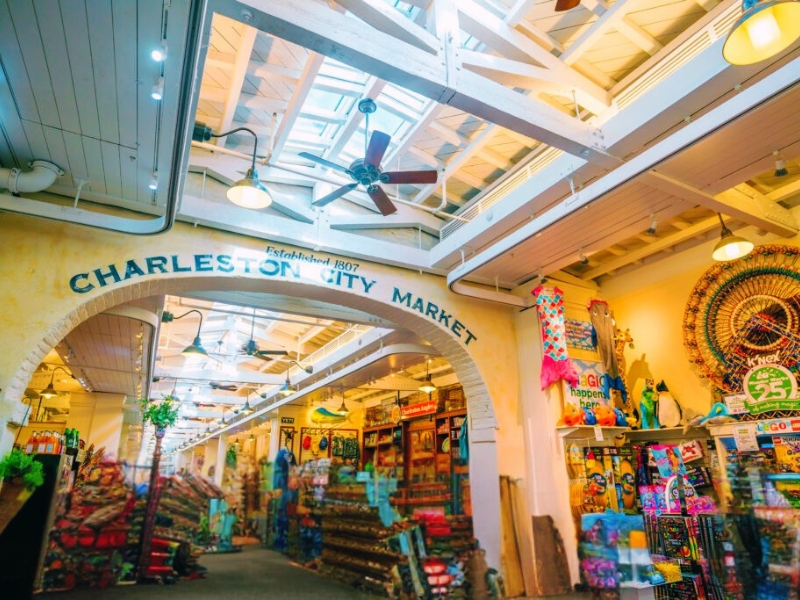
The City Market runs for several blocks from Meeting Street towards the harbour. In 1788 Charles Cotesworth Pinckney and other landowners gave the city a strip of reclaimed marsh for a market, on condition that it was always used for one; the first sheds went up around 1790. At the Meeting Street end stands the Market Hall, a Greek Revival temple completed in 1841 to designs by the Charleston architect Edward B. White, with a Doric portico on a raised arcade.
- Behind it, a row of long, low sheds still houses stalls; look for the Gullah sweetgrass baskets, a craft brought from West Africa and kept alive in the Lowcountry.
- A common myth says enslaved people were sold here. They were not: the City Market sold food and goods, and slave auctions took place elsewhere, for example at the Old Slave Mart on Chalmers Street.
Gibbes Museum of Art
The Gibbes Museum of Art opened on 11 April 1905 in a Beaux-Arts building on Meeting Street designed by Frank Pierce Milburn for the Carolina Art Association, founded in 1858. Its collection of more than 10,000 works is mostly American, with a strong focus on Charleston and the South, from colonial portraits by Henrietta Johnston and Jeremiah Theus to miniatures by Charles Fraser. After a two-year renovation it reopened in May 2016.
- What to look for: the domed rotunda at the centre of the building and the cabinets of portrait miniatures, one of the museum's specialities.
Washington Square
Behind City Hall, on the corner of Meeting and Broad Streets, Washington Square opened as a city park in 1818 on the site of an old tavern. It was called City Hall Park until 1881, when it was renamed after George Washington. The corner it sits on is known as the Four Corners of Law, after the city, county, federal and church buildings that face each other here.
- In the centre: a granite obelisk modelled on the Washington Monument, unveiled in 1891 by the Washington Light Infantry, with the names of the unit's battles and Civil War dead.
- The statue of George Washington, unveiled in 1999 on the pedestal that once held William Pitt the Elder, and a bust of the poet Henry Timrod from 1901.
Heyward-Washington House
This brick Georgian double house on Church Street was built in 1772 and belonged to Thomas Heyward Jr., one of the signers of the Declaration of Independence. When George Washington spent a week in Charleston in May 1791, the city rented the house for him, which is how it got its name. The Charleston Museum bought it in 1929 and opened it the following year as the first historic house museum in the city.
- Inside: the Holmes bookcase, made in Charleston and counted among the finest pieces of American colonial furniture.
- Behind the house: a kitchen building from the 1740s, the only historic one of its kind in Charleston open to visitors, and a formal garden planted with species used in the Lowcountry in the late 18th century.
Old Exchange and Provost Dungeon
At the end of Broad Street, facing the harbour on East Bay Street, the Old Exchange was built between 1767 and 1771 by the colonial government as a customs house, market and meeting place. Confiscated tea was stored here in 1774; after the British took Charleston in 1780 they used the building as a barracks and its basement as a prison for patriots. In 1788 South Carolina's convention met here to ratify the U.S. Constitution, and in 1791 crowds welcomed George Washington here, with the new president appearing on the balcony.
- What to look for: in the dungeon, the remains of the Half-Moon Battery, part of the city's fortifications from 1698, found under the building in 1965. The Daughters of the American Revolution have looked after the building since 1913.
Waterfront Park
Waterfront Park lines the Cooper River north of the Old Exchange. The shore here was once crowded with wharves and shipping terminals, and after a fire in 1955 it fell into decline. Mayor Joseph P. Riley Jr. began planning a park soon after taking office in 1975, and it opened on 11 May 1990, designed by Stuart O. Dawson of Sasaki Associates with Edward Pinckney Associates.
- What to look for: the Pineapple Fountain on the lawn, a symbol of welcome, and the shaded swings on Vendue Wharf, the wooden pier that runs out into the river.
How to see them in one walk
Start at the Charleston Museum and cross to Marion Square; on a Saturday morning, walk through the farmers market. Follow Meeting Street south past the Market Hall, taking a detour through the City Market sheds, and carry on to the Gibbes Museum. At Broad Street, step into Washington Square behind City Hall, then walk a block east to Church Street for the Heyward-Washington House. Return to Broad Street and follow it down to the Old Exchange, then walk north along the water to finish in Waterfront Park.
See Charleston with World City Trail
Our Charleston scavenger hunt turns the old city into a game you play on your phone. The route links 10 stops, from the Charleston Museum to Waterfront Park, and all eight places in this guide are on it: the Charleston Museum, Marion Square at 329 Meeting Street, the City Market, the Gibbes Museum, Washington Square, the Heyward-Washington House, the Old Exchange and Waterfront Park. The route also passes the Old Slave Mart Museum and Rainbow Row.
There is also a self-guided walking tour and an outdoor escape game in Charleston, for people who prefer a different format.
Play the Charleston scavenger hunt →
Take the self-guided walking tour of Charleston →
Play the outdoor escape game in Charleston →
Facts checked in October 2026.