
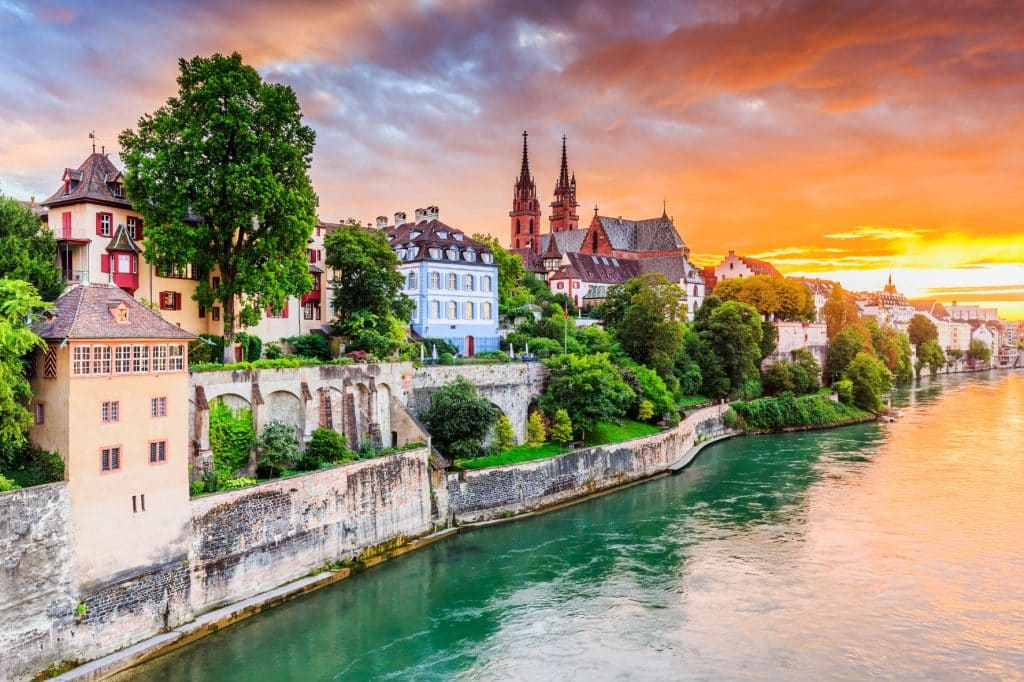
This guide covers six places in Basel that fit into one day: the red Town Hall on the Marktplatz, the Spalentor city gate, the Mittlere Brücke, the Rhine itself, the Kunstmuseum and, on the edge of the centre, Basel Zoo. Together they show the medieval trading town, the river that made it rich, and the art collection and animals that bring visitors back today.
Basel Town Hall (Rathaus)
You can't miss Basel's Town Hall: its sandstone facade is a deep red, and in local dialect it is the Roothus, which also sounds like 'red house'. It was built between 1504 and 1514 to mark Basel's entry into the Swiss Confederation in 1501, and the coats of arms of the cantons were set along its battlements. The town's earlier courthouse had been lost in the great earthquake of 1356.
The building grew over four centuries. Hans Holbein the Younger painted the Great Council Chamber in the 1520s; those murals are lost, but fragments and drawings survive in the Kunstmuseum. Hans Bock the Elder painted the facade and the courtyard in the early 1600s, and the tower on the right and the left wing were added between 1898 and 1904. The cantonal parliament and government of Basel-Stadt still meet here. The Town Hall is one of the stops on our scavenger hunt.
- The ornate clock on the main facade, made by a clockmaker known as Master Wilhelm in 1511.
- In the courtyard, the statue of Lucius Munatius Plancus, the Roman founder of nearby Augusta Raurica, carved by Hans Michel in 1580, and the Last Judgment painted above the staircase by Hans Bock.
- The painting on the tower from 1901, which shows Hans Bär, a Basel banner bearer who fell at the Battle of Marignano in 1515.
Spalentor
The Spalentor is the grandest of Basel's old city gates. It was first mentioned in 1387 and finished around 1400, as part of the outer wall the city built after the 1356 earthquake. In the second half of the 19th century Basel tore down most of its walls, towers and gates because they blocked the growing city, but three gates survived: the Spalentor, the St. Johanns-Tor and the St. Alban-Tor. The Spalentor was restored in 1933 and is protected as a historic monument. It is one of the stops on our scavenger hunt.
- The steep roof of the square main tower, covered in brightly glazed tiles.
- Above the arch, two lions holding the Basel coat of arms, and higher up a life-size Madonna and Child standing on a crescent moon between two prophets. These are copies; the originals are in the Historical Museum.
- The portcullis in front of the heavy wooden gate, which could be dropped to close the road.
Mittlere Brücke
The 'Middle Bridge' stands on the site of the first bridge across the Rhine in Basel, built in the first half of the 13th century; the first solid evidence that it was finished dates from 1244. At the time it was the lowest fixed crossing on the river all the way to the sea, and until the Wettstein Bridge opened in 1879 it remained Basel's only bridge. The stone bridge you walk on today was built between 1903 and 1905 from Gotthard granite, to designs by Emil Faesch and Friedrich von Thiersch, and opened on 11 November 1905.
On the middle pillar stands the Käppelijoch, a small chapel. It is a copy of one first built on the old bridge in 1392, the year Grossbasel and Kleinbasel were united. The spot had a grim role: condemned people were thrown into the river from here, bound hand and foot, and those who were pulled out alive downstream were pardoned and banished. Drowning was replaced by beheading in 1634. The bridge is one of our scavenger hunt stops.
- The Lällekönig, a crowned head that sticks out its tongue and rolls its eyes towards Kleinbasel, on a building at the Grossbasel end of the bridge. It is a copy; the copper original from around 1640 hung on the old Rhine Gate and is now in the Historical Museum.
- The view upstream to the red towers of the Minster above the river bank, and downstream to the Kleinbasel waterfront.
The Rhine
The Rhine makes a wide bend through Basel and splits the city in two: Grossbasel, the old town on the hill on the left bank, and Kleinbasel on the right bank, with a long riverside promenade. The river is one of the stops on our scavenger hunt, and it is where Basel spends its summer.
Between the bridges, four small wooden ferries called Ueli, Wilde Maa, Leu and Vogel Gryff, named after figures from Kleinbasel tradition, cross the river with no engine: a cable holds them while the current pushes them from bank to bank. Ferries have crossed here for more than 150 years. In summer many people swim in the Rhine, letting the current carry them downstream and keeping their clothes in a Wickelfisch, a colourful waterproof bag shaped like a fish. The current is strong, so only swim if you are confident in open water.
Kunstmuseum Basel
In 1661 the city of Basel bought the Amerbach Cabinet, the collection of a family of scholars, and opened it to the public ten years later. The Kunstmuseum describes this as the oldest public art collection in the world. Its main building on St. Alban-Graben, by Rudolf Christ and Paul Bonatz, was completed in 1936, and in 2016 a new building by the Basel architects Christ & Gantenbein opened across the street. The museum is one of the stops on our scavenger hunt.
The collection is especially strong on Hans Holbein the Younger, who worked in Basel. In 1967 the citizens of Basel voted in a referendum to buy two paintings by Pablo Picasso; moved by the vote, Picasso gave the museum four more works.
- Holbein's The Body of the Dead Christ in the Tomb, a long, narrow painting of Christ's body seen as a real corpse.
- Rodin's bronze Burghers of Calais in the courtyard of the main building, and Arnold Böcklin's Isle of the Dead, the first of his five versions.
Basel Zoo
Basel Zoo, the Zolli to locals, opened on 3 July 1874 and is the oldest zoo in Switzerland. It lies just outside the centre, along the valley of the Birsig stream. It is famous for breeding rare animals: the first Indian rhinoceros ever born in a zoo was born here in 1956, okapis have been bred here since 1957, and the zoo says all Somali wild asses in zoos around the world come from its herd. The zoo is not on our scavenger hunt route.
- Etoscha, the African area named after Namibia's Etosha National Park, opened in 2001.
- The Vivarium, the zoo's aquarium, and the Antelope House from 1910, the oldest building in the zoo.
How to see them in one walk
Start at the Spalentor and walk down through the old town lanes to the Marktplatz and the Town Hall. From there it is a short walk to the Mittlere Brücke: look for the Lällekönig, cross to Kleinbasel and follow the riverside promenade upstream. Take one of the ferries back to the Grossbasel side below the Minster and walk on to the Kunstmuseum on St. Alban-Graben. The zoo is on the other side of the centre, near the main railway station, so it works best as a separate morning or afternoon.
See Basel with World City Trail
Our Basel scavenger hunt turns the old town into a game you play on your phone. The route links 10 stops, from the Strassburger Memorial to the Rhine, and the Town Hall, the Spalentor, the Mittlere Brücke, the Kunstmuseum and the Rhine are all stops, along with the Offene Kirche Elisabethen, Basel Minster, the Natural History Museum and St. Peter's Church. At each stop you solve a puzzle and learn a story, at your own pace.
There is also a self-guided walking tour and an outdoor escape game in Basel, for people who prefer a different format.
Play the Basel scavenger hunt →
Take the self-guided walking tour of Basel →
Play the outdoor escape game in Basel →
Facts checked in October 2026.