
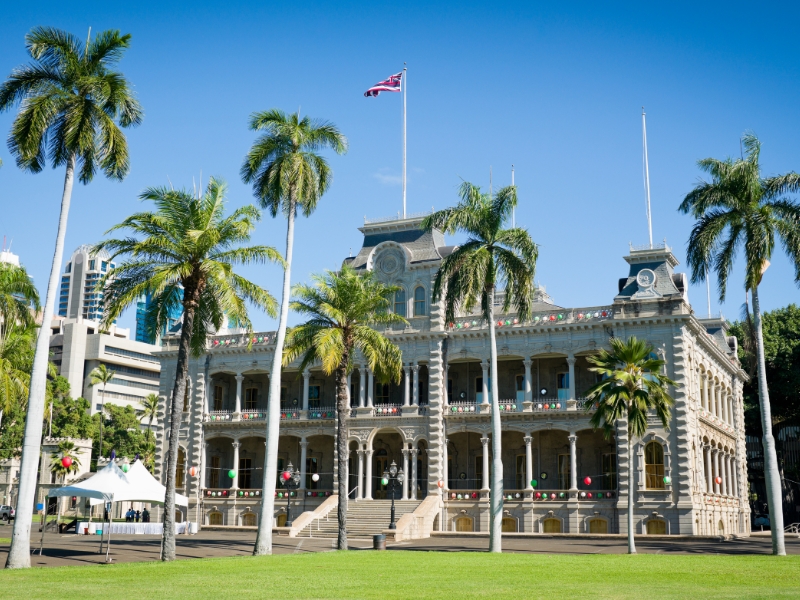
Before Hawaiʻi was a US state or even a territory, it was a kingdom, and its capital was a few blocks of downtown Honolulu. This guide covers six places from that royal story: ʻIolani Palace, the ʻIolani Barracks, the King Kamehameha Statue, Honolulu Hale, the Mission Houses and Washington Place, the home of the last queen. They stand within a short walk of each other, and three of them are stops on our Honolulu scavenger hunt.
ʻIolani Palace
King David Kalākaua laid the cornerstone of the present palace on 31 December 1879, and the building was finished in November 1882. It replaced an older and simpler royal house on the same grounds, Hale Aliʻi, which dated from the 1840s. The design, credited mainly to Thomas J. Baker with details by Charles J. Wall and Isaac Moore, is usually called American Florentine: a square block with towers at the corners and deep verandas on two floors. The palace describes itself as the only official royal residence in the United States.
The building's later history is less happy. After the overthrow of the monarchy in 1893, the palace became the seat of the new governments and stayed the capitol of the republic, the territory and then the state until 1969. In 1895, after a failed uprising by royalists, Queen Liliʻuokalani was tried in her own throne room and held for months in a small room upstairs, where she and her companions worked on a quilt now known as the Imprisonment Quilt. Restoration began in the 1960s and 1970s, and the palace opened as a museum in 1978.
- The Coronation Pavilion, Keliʻiponi Hale, on the south-west corner of the grounds: it was built for Kalākaua's coronation and now serves as a bandstand for the Royal Hawaiian Band.
- The grassy mound on the grounds that marks Pohukaina, an old burial place of chiefs. Many royal coffins were moved to the Royal Mausoleum in Nuʻuanu in 1865, but chiefs are still buried here, so treat it with respect.
- The upper floor, where the queen was confined: a visit inside takes you through the throne room and the restored royal rooms.
ʻIolani Barracks
The small white castle on the palace grounds is the ʻIolani Barracks, built in 1870 under King Kamehameha V to a design by Theodore Heuck. It housed around 80 men of the Royal Guard until 1893, when the guard was disbanded after the overthrow. It first stood a block inland, but in 1965 it was taken down and rebuilt stone by stone in its present place to make room for the new State Capitol. Today it is the palace's visitor centre, where you get tickets and can watch an introductory film.
- Look at the crenellated parapets and towers on the coral-block walls, an unusual piece of medieval revival in the tropics.
King Kamehameha Statue
The bronze figure in front of Aliʻiōlani Hale honours Kamehameha I, who united the Hawaiian Islands in the early 19th century. It has an adventurous history. The statue was planned in 1878, sculpted by Thomas R. Gould, a Boston artist living in Florence, and cast in Paris in 1880. The ship carrying it to Hawaiʻi was wrecked near the Falkland Islands, and the statue was given up for lost, so a second cast was ordered. That second cast is the statue you see in Honolulu, which arrived in 1883.
The original was later recovered by Falkland Islanders, repaired and sent to Hawaiʻi after all. It stands today in Kapaʻau, in the Kohala district of Hawaiʻi Island, where Kamehameha was born. Every year on or around Kamehameha Day, 11 June, the Honolulu statue is draped in very long fresh flower lei. The statue is one of the stops on the scavenger hunt.
- The pose: Gould was studying Roman sculpture in Italy and gave the king the stance of a Roman general, with a gesturing hand, a spear and a cape.
- The sash at the king's waist, a symbolic rendering of the Sacred Sash of Līloa, a revered ruler of old Hawaiʻi.
Honolulu Hale
Honolulu Hale, the city hall of the City and County of Honolulu, was completed in 1928 and opened for business in 1929. It was designed by a group of local architects including C. W. Dickey and Hart Wood in an Italianate Spanish Colonial Revival style that was popular in the islands at the time. Its interior courtyard, staircase and ceiling open to the sky were modelled on the Bargello, the medieval palace in Florence.
The building is still in daily use as the seat of the mayor and the city council, so behave as you would in any working office. Two three-storey wings were added in 1951. It is one of the stops on our scavenger hunt.
- The frescoes inside by Einar Peterson and the stonework by Mario Valdastri.
- Sky Gate, a large abstract sculpture by Isamu Noguchi, on the grounds of the civic centre next to the building.
Mission Houses
Across the street from Kawaiahaʻo Church stand the oldest buildings of the American missionaries who arrived in Hawaiʻi in 1820. The Frame House, Ka Hale Lāʻau, built in 1821, is made of timber that was cut and measured in Boston and shipped around Cape Horn. Next to it are the Chamberlain House of 1831, built of coral blocks cut from the reef, and the Print House of 1841.
Today they form the Hawaiian Mission Houses Historic Site and Archives. The Print House shows how missionaries and Native Hawaiians produced the first printed texts in the Hawaiian language, a story that shaped the islands as much as any king. The houses are not scavenger hunt stops, but they sit right on the way between Honolulu Hale and Kawaiahaʻo Church.
- The contrast between the wooden New England house and the coral walls next to it, the first sign of how the missionaries adapted to the islands.
Washington Place
Washington Place was built in 1847 by the master carpenter Isaac Hart and the Italian mason Daniel Jenner for the sea captain John Dominis, who was lost at sea before it was finished. The house was named after George Washington, with the approval of King Kamehameha III. When Liliʻuokalani married the captain's son, John Owen Dominis, in 1862, it became her home, and it remained so for the rest of her life. It was here, in January 1895, that weapons were found that led to her arrest and imprisonment in the palace. She died in the house in 1917.
From 1921 the house was the official residence of the governors of Hawaiʻi, and since 2002 it has been a historic house museum. It is not a scavenger hunt stop, but it lies on Beretania Street in the same historic capital district as the State Capitol, so it fits easily into a walk around the palace district.
How to see them in one walk
Start at Washington Place, then cross towards the State Capitol and the palace grounds, where the ʻIolani Barracks is your first stop for tickets. Visit ʻIolani Palace and walk round the grounds past the Coronation Pavilion. Leave by the gate facing King Street to see the King Kamehameha Statue in front of Aliʻiōlani Hale, then walk along King Street to Honolulu Hale. Finish at the Mission Houses next to Kawaiahaʻo Church. If you have time, continue to the waterfront and the Aloha Tower.
See Honolulu with World City Trail
Our Honolulu scavenger hunt turns downtown into a game you play on your phone. The route links 10 stops, from the Cathedral of St Andrew to the Aloha Tower, and ʻIolani Palace, Honolulu Hale and the King Kamehameha Statue are all stops, along with Capitol Modern, the Hawaiʻi State Capitol, Kawaiahaʻo Church and Aliʻiōlani Hale. At each stop you solve a puzzle and learn a story, at your own pace.
There is also a self-guided walking tour and an outdoor escape game in Honolulu, for people who prefer a different format.
Play the Honolulu scavenger hunt →
Take the self-guided walking tour of Honolulu →
Play the outdoor escape game in Honolulu →
Facts checked in October 2026.