
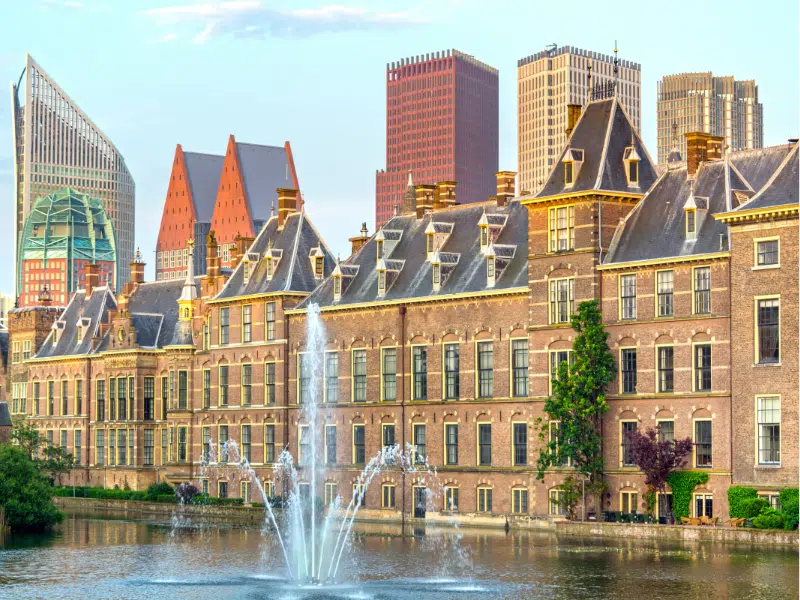
The Hague is where the Netherlands is actually run: the parliament, the government and the King's working palace are all here, even though Amsterdam is the capital. It is also a city of international courts, a royal art museum and a long North Sea beach, all within a short tram ride. Here are the facts and stories behind it.
10 fun facts about The Hague
- Seat of power, but not the capital: the Dutch constitution names Amsterdam as the capital, yet the parliament, the government and most embassies are in The Hague.
- A village for centuries: The Hague never received medieval city rights. It only became a city officially in 1806, when Louis Napoleon, Napoleon's brother and king of Holland, declared it one.
- Counts who bought a court: around 1230, Count Floris IV of Holland bought land here and built a residence. The name Den Haag, short for 's-Gravenhage, means the count's hedge or enclosure.
- A stork on the coat of arms: the city's symbol is a stork holding an eel in its beak, and you will spot it on lampposts, bollards and buildings.
- A world-famous girl: the Mauritshuis, built in the 1630s and 1640s for Johan Maurits of Nassau-Siegen, has been a museum since 1822. Its stars include Vermeer's Girl with a Pearl Earring and Carel Fabritius's The Goldfinch from 1654.
- The city of peace and justice: the Peace Palace, paid for by Andrew Carnegie and opened in 1913, houses the International Court of Justice, the main court of the United Nations.
- A painting you stand inside: Panorama Mesdag, painted by Hendrik Willem Mesdag in 1881, is 14 metres high and at least 120 metres around. It is the oldest panorama in the world still in its original place.
- A miniature country with a hero's name: Madurodam, opened in 1952, is named after George Maduro, a Curaçao-born law student and resistance fighter who died in Dachau in 1945.
- A tongue-twister test: it is said that during the Second World War, the Dutch asked suspected German spies to pronounce Scheveningen, because the Dutch sch sound is hard to fake.
- Escher in a royal palace: the Lange Voorhout Palace, once a winter residence of Queen Emma, now holds Escher in Het Paleis, a museum of M.C. Escher's impossible worlds.
The darkest day of The Hague
On 20 August 1672, the Dutch Republic's 'disaster year', the former leader of the country, Johan de Witt, went to the Gevangenpoort prison gate to collect his brother Cornelis, who had been falsely accused of plotting against William III of Orange. An angry crowd and members of the civic guard dragged both brothers out and lynched them in the street. The philosopher Spinoza, who lived in The Hague, was so shocked that he wrote a placard reading 'Ultimi barbarorum', the lowest of barbarians, and wanted to put it up at the scene. His landlord locked the door to stop him, which probably saved his life. The Gevangenpoort still stands and is now a prison museum.
The Binnenhof, explained
The Binnenhof grew out of the counts' court of the 13th century and is one of the oldest parliament buildings in the world still in use. At its heart stands the Ridderzaal, the Gothic Hall of Knights, where the King has traditionally read the speech from the throne on Prinsjesdag, the third Tuesday in September. The whole complex is now closed for a major renovation that is not expected to finish until the early 2030s, and parliament meets elsewhere in the meantime. You can still walk along the Hofvijver pond for the classic view of its towers reflected in the water.
What to eat in The Hague
- Herring: eat it raw with onions at a fish stand. The new season's catch, Hollandse Nieuwe, is celebrated at Vlaggetjesdag in Scheveningen in June.
- Indonesian food: The Hague has a large Indo-Dutch community, and a rijsttafel, a spread of many small dishes with rice, is the classic way to try it.
- Haagse hopjes: hard coffee sweets named after Baron Hop, an 18th-century resident who, the story goes, wanted his coffee in the form of a sweet.
- Kibbeling: battered chunks of white fish with garlic sauce, the standard snack along the Scheveningen boulevard.
Good to know before you go
- The Binnenhof is surrounded by building works, so check what is open before planning a visit to the inner courtyard.
- Trams run from the centre to the beach at Scheveningen in about 20 minutes.
- Delft, the city of Vermeer and blue-and-white pottery, is a short train or tram ride away and makes an easy half-day trip.
- The Mauritshuis is small and popular: book a time slot in advance in busy periods and go early to see the Vermeer without a crowd.
Explore The Hague with World City Trail
Our scavenger hunt in The Hague turns these sights into a game you play on your phone. The route links 10 stops and takes around two hours, with about 36 minutes of walking, and includes Het Plein, the Mauritshuis and Escher in Het Paleis.
At each stop you solve a puzzle and hear a short story, at your own pace. You can start whenever you like.
Play The Hague scavenger hunt →
Facts checked in October 2026.