
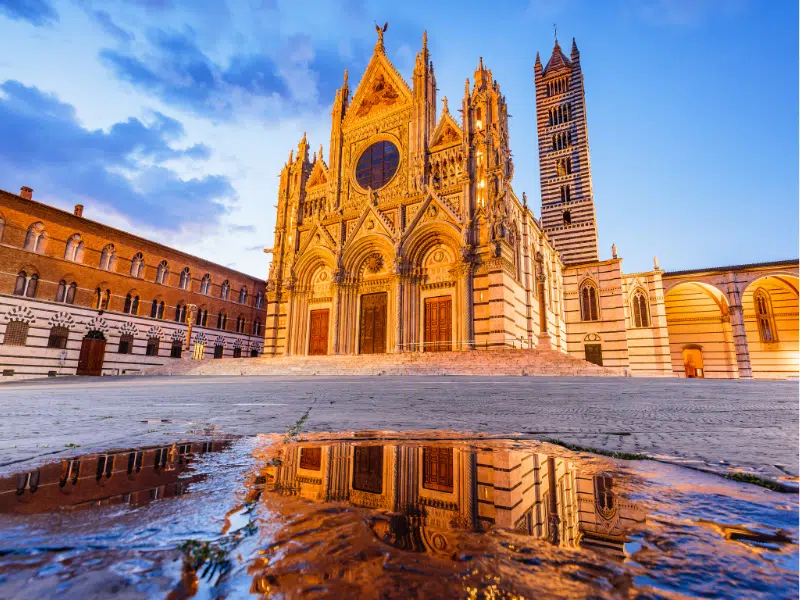
Siena was Florence's great rival in the Middle Ages, and after the Black Death of 1348 it never had the money to modernise. That is why its brick palaces, steep lanes and shell-shaped square look much as they did 700 years ago, and why its historic centre has been a UNESCO World Heritage Site since 1995. Here are the facts and stories that make the city special.
10 fun facts about Siena
- A square shaped like a shell: the Piazza del Campo slopes down towards the town hall and is divided into nine sections, a tribute to the Government of the Nine that ruled Siena from 1287 to 1355.
- A tower named after a spendthrift: the Torre del Mangia, built between 1338 and 1348, takes its name from its first bell-ringer, Giovanni di Balduccio, nicknamed Mangiaguadagni, the profit-eater. About 400 steps lead to the top.
- A cathedral that was meant to be bigger: in the 1300s Siena began enlarging its cathedral so the existing church would become just the transept. The Black Death of 1348 stopped the work, and the unfinished wall, the Facciatone, still stands beside the cathedral.
- A floor too precious to walk on: the cathedral floor is made of 56 inlaid marble panels created over several centuries. Most of the time it is covered to protect it and only fully uncovered for a few weeks a year.
- The fountain of joy: the Fonte Gaia on the Campo was carved by Jacopo della Quercia and finished in 1419. The fountain you see today is a 19th-century copy, and the worn originals are kept in Santa Maria della Scala.
- The world's oldest bank: Banca Monte dei Paschi di Siena, founded in 1472, is considered the oldest bank in the world still in operation.
- A lesson in good government: in the town hall, Ambrogio Lorenzetti's frescoes of Good and Bad Government, painted in 1338–1339, show what a well-run city and a badly run one look like.
- Sons of Remus: legend says Siena was founded by Senius and Aschius, the sons of Remus, which is why statues of the she-wolf feeding twins appear all over town. The city's black-and-white coat of arms, the Balzana, is linked to the colours of their horses.
- A painting carried through the streets: when Duccio finished his Maestà for the cathedral altar in 1311, the people of Siena carried it in procession from his workshop to the cathedral. It is now in the cathedral museum.
- A patron saint of Europe: Saint Catherine of Siena, born here in 1347, is a patron saint of Italy and of Europe. Her head is kept as a relic in the Basilica of San Domenico.
The Palio, told properly
Twice a year, on 2 July and 16 August, the Piazza del Campo becomes a racetrack. Siena is divided into 17 contrade, city districts with their own flags, animals and churches, and ten of them race in each Palio. The square is covered with earth, the jockeys ride bareback, and the race lasts three laps and about 90 seconds. A horse can win without its rider, because the horse, not the jockey, is what counts. The days before are full of trial races, processions and the blessing of each horse inside its contrada's church. The winning contrada receives the drappellone, a painted silk banner, and celebrates for weeks.
Santa Maria della Scala, explained
Opposite the cathedral stands Santa Maria della Scala, one of the oldest hospitals in Europe. For centuries it cared for the sick, abandoned children and pilgrims walking the Via Francigena to Rome, and it worked as a hospital until the late 20th century. Today it is a museum. In its Pellegrinaio, the pilgrims' hall, frescoes from the 1440s show everyday scenes of hospital life, from washing patients to caring for foundlings.
What to eat in Siena
- Panforte: a dense, spiced cake of honey, nuts and candied fruit that goes back to the Middle Ages.
- Ricciarelli: soft almond biscuits dusted with icing sugar, protected as a local speciality.
- Pici: thick hand-rolled pasta, often served with garlic and tomato sauce or with cheese and pepper.
- Cinta senese: cured meats from a local breed of pig with a white band around its body, shown in Lorenzetti's frescoes in the town hall.
- Chianti Classico: the wine region starts just north of Siena, so local reds are easy to find on every menu.
Good to know before you go
- The cathedral floor is only uncovered for a few weeks each year, usually in summer and early autumn, so check the dates if you want to see it.
- On Palio days the centre is packed. If you want to watch from a balcony or a stand rather than the middle of the square, book months ahead.
- The climb up the Torre del Mangia is limited to small groups, so expect to wait in busy periods.
- The historic centre is closed to most traffic, so park outside the walls and walk or take the escalators up into town.
Explore Siena with World City Trail
Our Siena scavenger hunt turns these sights into a game you play on your phone. The route links 10 stops and takes around two hours, with about 24 minutes of walking, and leads you to the Pinacoteca Nazionale, Santa Maria della Scala and Siena Cathedral, among other sights.
At each stop you solve a puzzle and hear a short story, at your own pace. You can start whenever you like.
Play the Siena scavenger hunt →
Facts checked in October 2026.