
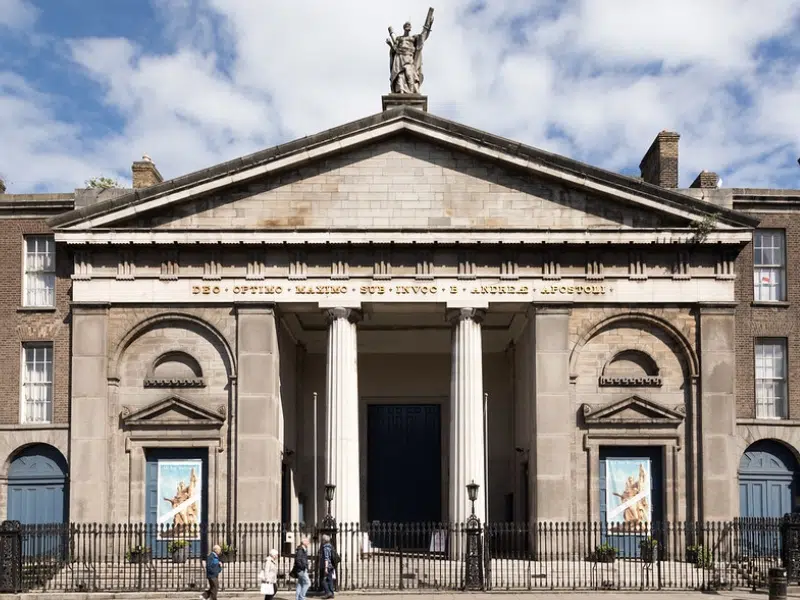
St Andrew's is the large Catholic parish church on Westland Row in Dublin's south city centre, a few minutes' walk from Trinity College. Begun in 1832, only three years after Catholic Emancipation, it was one of the biggest and most expensive churches of its day. Readers of Ulysses know it under another name: James Joyce calls it All Hallows, and it is where Leopold Bloom slips in during the novel's fifth episode.
St Andrew's Church at a glance
- Where: Westland Row, next to Pearse Station, between Trinity College and Merrion Square.
- Built: 1832–1837; the church was consecrated on 2 January 1834, before the building was fully finished.
- By: John Bolger, working from plans drawn by James Leeson; the statue of St Andrew on the portico is by John Smyth.
- What it is today: the Catholic parish church of Westland Row, still in daily use.
- Time needed: 20–30 minutes.
A church for the age of Emancipation
Until the Catholic Relief Act of 1829, Catholics in Ireland were barred from most public offices, and many of their chapels were tucked away in back lanes. St Andrew's was built to show that this had changed. The parish priest, Dr Michael Blake, laid the foundation stone in 1832, and the project had a powerful supporter in Daniel O'Connell, the leader of the Emancipation campaign, who was one of its parishioners. The church cost around £20,000, a huge sum at the time, and contemporaries described it as perhaps the largest and most costly building of its kind in the kingdom.
The design is classical: a temple front with Doric columns facing the street, and a wide, light interior behind it. The church has hosted state funerals, society weddings and large public liturgies, and its interior was restored and repainted from 1942, after pieces of ceiling ornament fell in January 1940. In 2012 the parish celebrated the church's 180th anniversary.
What to look for
- The portico: a Doric temple front squeezed into the terrace of Westland Row, crowned by the statue of St Andrew with his cross.
- The organ: built by John White of Dublin in 1870–71, with pipework from the workshop of the French organ builder Aristide Cavaillé-Coll.
- The interior: a broad, galleried space under a decorated ceiling, more like a grand hall than a Gothic church.
- The setting: the railway bridge of Pearse Station runs right next to the church, a reminder that Ireland's first railway, the Dublin and Kingstown, started from Westland Row in 1834.
Leopold Bloom's church
In the 'Lotus Eaters' episode of Ulysses, set on the morning of 16 June 1904, Bloom wanders into All Hallows on Westland Row, the name Joyce gave St Andrew's after the medieval priory of All Hallows whose lands the area once belonged to. Bloom watches a Mass from the back, muses on the Latin and the communion, and slips out again. On Bloomsday, 16 June, Joyce fans following Bloom's route through the city often pass by.
Tips for your visit
- This is a busy parish church: come between services, dress respectfully and keep quiet near people praying.
- Look at the facade from across the street; Westland Row is narrow, so the portico is easy to miss from close up.
- Combine it with Merrion Square and the Oscar Wilde statue, or with a walk through Trinity College, both a few minutes away.
Nearby
- Oscar Wilde's birthplace: Wilde was born in 1854 at 21 Westland Row, just along the street; a plaque marks the house.
- Trinity College: Ireland's oldest university, home of the Book of Kells and the Long Room library.
- Merrion Square: a Georgian square with a park, colourful front doors and the reclining statue of Oscar Wilde.
- National Gallery of Ireland: Irish and European art on Merrion Square West, with free entry to the permanent collection.
See Dublin with World City Trail
Our Dublin scavenger hunt turns the city centre into a game you play on your phone. The route links 10 stops and takes around three hours, with about 59 minutes of walking. It includes Dublin Castle, Christ Church Cathedral and St Patrick's Cathedral.
If you prefer a different format, there is also a self-guided walking tour and an outdoor escape game in Dublin.
Play the Dublin scavenger hunt →
Take the self-guided walking tour of Dublin →
Play the outdoor escape game in Dublin →
Facts checked in October 2026.