
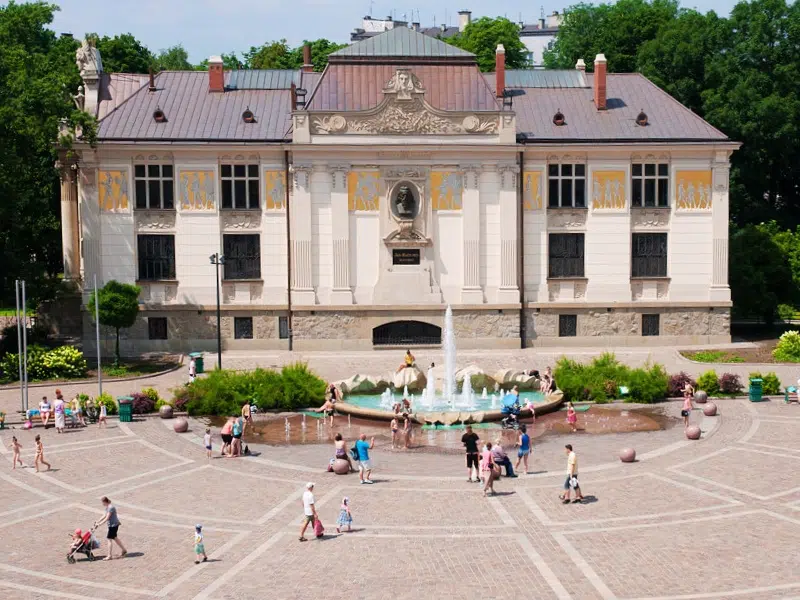
Plac Szczepański is a square on the north-western edge of Kraków's Old Town, a couple of minutes from the Main Market Square. It only exists because two churches were demolished here in the early 19th century, and around the open space that they left, Kraków built some of its finest Art Nouveau architecture, along with the Old Town's tallest building.
Plac Szczepański at a glance
- Where: in the Old Town, between the Planty park and ulica Szczepańska and ulica św. Tomasza, a short walk north-west of the Main Market Square.
- Created: in the early 19th century, after the demolition of the medieval church of St Stephen (św. Szczepan), which gave the square its name.
- What it is today: a pedestrian square with a fountain added in 2010, lined with theatres, galleries and cafés.
- Main buildings: the Old Theatre, the Palace of Art, the Bunkier Sztuki gallery and the Art Deco savings bank of 1936.
- Time needed: 15–20 minutes to look around, longer if you visit an exhibition.
From churchyard to marketplace to square
For centuries this corner of the city was occupied by the Gothic church of St Stephen and the small church of Saints Matthias and Matthew, with buildings that had belonged to the Jesuits. All of this was cleared at the start of the 19th century. On 3 August 1811 the newly formed National Guard of Kraków held its first parade here, and the square was officially named after it; a black marble plaque on the Szołayski House still records the name. Kraków's residents ignored it and kept calling it Plac Szczepański, after the lost church.
In the 19th century the square became one of the city's largest marketplaces. Around 1900 the buildings around it were rebuilt in the new Art Nouveau style, and in 1936 a seven-storey savings bank went up on the north side, the tallest building in the Old Town, nicknamed Kraków's skyscraper before the war. In the second half of the 20th century the square was used as a car park, until 2007; it was renovated in 2010 and given its fountain.
What to look for
- The Old Theatre (Stary Teatr) at number 1, one of Poland's most important stages, founded in 1798 and given its Art Nouveau look in a remodelling completed in 1906.
- The Palace of Art (Pałac Sztuki) at number 4, built in 1901 for the Society of Friends of Fine Arts, with a frieze and busts of artists on the facade.
- The Wolny House at number 2, a Vienna Secession building of 1908–09, built for an undertaker whose funeral parlour was on the ground floor.
- Bunkier Sztuki at number 3a, a post-war modernist gallery of contemporary art in the corner by the Planty.
- The Art Deco savings bank at number 5, from 1936, still the tallest building in the Old Town.
- The black marble plaque of 1811 on the Szołayski House at number 9, recording the square's forgotten official name.
The alchemist's house
Number 8, the Agricultural Society building of 1909, stands on the site of a house that in the 17th century belonged to Michał Sędziwój, a Polish alchemist known across Europe. When the old house was demolished in 1908, workers found a Gothic door, Renaissance stone carving and Jewish gravestones with Hebrew inscriptions in its cellars; some of the finds went to the lapidarium of the Czapski Museum. Nothing of the alchemist's house is visible today, but it is a good story to know as you pass.
Tips for your visit
- Come in the evening, when the theatre and gallery crowds fill the square and the cafés.
- Stand by the fountain and turn slowly: the best way to compare the different Art Nouveau facades is from the middle of the square.
- Check the programmes of the Palace of Art and Bunkier Sztuki; their exhibitions are a good reason to step inside.
- Combine the square with a walk along the Planty, the green belt that runs right behind it.
Nearby
- Main Market Square: Kraków's great medieval square, a couple of minutes' walk down ulica Szczepańska.
- Planty: the park ring that replaced the old city walls, directly behind the Palace of Art.
- Czartoryski Museum: a few minutes east, home to Leonardo da Vinci's Lady with an Ermine.
- St Florian's Gate: the last surviving medieval city gate, a short walk east along the Planty.
See Kraków with World City Trail
Our Kraków scavenger hunt turns the old town into a game you play on your phone. The route links 11 stops and takes around 3 hours, with about 47 minutes of walking. It includes the Town Hall Tower, the Cloth Hall, St Mary's Basilica and St Florian's Gate. You can play in English, German, French, Italian, Spanish, Dutch and Polish.
If you prefer a different format, Kraków also has a self-guided walking tour and an outdoor escape game.
Play the Kraków scavenger hunt →
Take the self-guided walking tour of Kraków →
Play the outdoor escape game in Kraków →
Facts checked in October 2026.